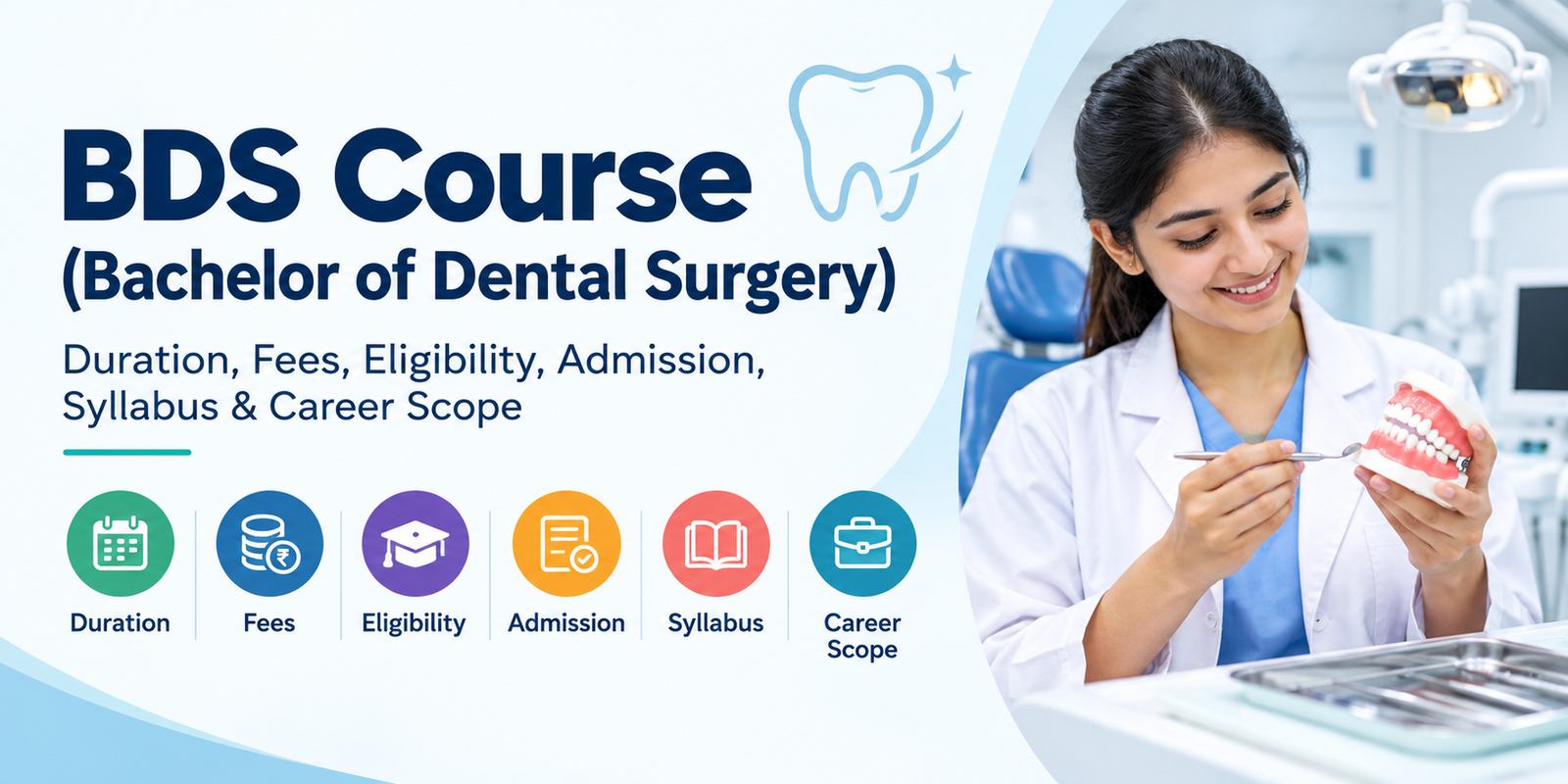
The BDS Course (Bachelor of Dental Surgery) is a professional undergraduate programme for students interested in pursuing a career in dentistry and oral healthcare. It provides theoretical knowledge, lab training and clinical experience in areas such as oral anatomy, dental pathology, restorative dentistry, orthodontics, prosthodontics, periodontics and oral surgery.
In India, admission to BDS programmes is based on NEET-UG followed by the applicable counselling process. The course normally extends over five years including academic training and compulsory rotating internship. The academic component and internship structure are governed by the applicable dental education regulations.
For students who have completed Class 12 with Physics, Chemistry and Biology/Biotechnology and are interested in healthcare but specifically want to specialise in oral and dental care, BDS can be an important undergraduate pathway.
This guide covers BDS full form, course duration, eligibility, fees, admission, syllabus, subjects, career options, higher studies, salary and future scope.
What is BDS?
BDS stands for Bachelor of Dental Surgery. It is an undergraduate professional degree in dentistry that prepares students to work in the field of oral and dental healthcare.
The BDS curriculum combines basic medical sciences with specialised dental subjects. During the programme, students gradually move from foundational subjects such as anatomy and physiology to clinical disciplines such as conservative dentistry, prosthodontics, orthodontics, periodontics and oral surgery.
Unlike a general science degree, BDS involves substantial practical and clinical training. Students learn how to examine patients, identify common oral conditions, plan dental treatment and perform procedures under appropriate supervision.
The programme also includes clinical internship training. Under the applicable BDS regulations, the rotating internship is compulsory, and the degree is awarded after completion of the internship.
BDS Course Highlights
|
Particular |
Details |
|
Full Form |
Bachelor of Dental Surgery |
|
Course Level |
Undergraduate |
|
Field |
Dental Science |
|
Course Duration |
Generally 5 years including internship |
|
Academic Training |
Four academic years in the traditional structure |
|
Internship |
One-year compulsory rotating internship |
|
Entrance Exam |
NEET-UG |
|
Eligibility |
Class 12 with required subjects including Physics, Chemistry and Biology/Biotechnology |
|
Admission Process |
NEET-UG followed by counselling |
|
Course Type |
Professional degree |
|
Major Areas |
Oral healthcare, dental surgery, restorative dentistry, orthodontics, prosthodontics and more |
|
Higher Study |
MDS and other relevant postgraduate programmes |
|
Career Areas |
Dental clinics, hospitals, government services, academics, research and private practice |
The exact structure can depend on the regulations and university applicable to a particular admission batch, so students should verify the current requirements of the college and counselling authority before applying.
BDS Course Duration
The BDS course duration is generally five years, consisting of academic dental education followed by a compulsory rotating internship.
The academic component covers foundational medical sciences, pre-clinical dental subjects and clinical dental training. After successfully completing the required academic examinations, students undergo the compulsory internship.
The traditional BDS structure provides four academic years plus one year of rotating internship. The internship gives students practical exposure to different areas of dentistry and patient care.
BDS Duration Structure
|
Component |
Duration |
|
Academic study |
4 years |
|
Rotating internship |
1 year |
|
Total |
Approximately 5 years |
The internship is an important part of BDS rather than simply an optional training period. The applicable regulations state that the internship must be completed before the BDS degree is granted.
BDS Eligibility Criteria
Students planning to pursue BDS must meet the eligibility conditions prescribed for dental education and the applicable admission authority.
Generally, candidates should have completed Class 12 or an equivalent examination with Physics, Chemistry and Biology/Biotechnology from a recognised board.
Students should also satisfy the minimum qualifying requirements specified for BDS admission and qualify for NEET-UG.
Basic BDS Eligibility
The commonly applicable requirements include:
- Completion of Class 12 or equivalent qualification.
- Physics and Chemistry as required subjects.
- Biology/Biotechnology as the relevant biological science subject.
- English as prescribed under the applicable eligibility requirements.
- Meeting the minimum qualifying percentage or other academic requirements.
- Meeting the applicable age criteria.
- Qualifying NEET-UG.
- Satisfying the requirements of the relevant counselling authority.
Eligibility rules can change and may differ in implementation according to the current admission regulations, so candidates should check the official admission notification for the year in which they are applying.
Is NEET Required for BDS Admission?
Yes. NEET-UG is the entrance examination used for admission to recognised BDS programmes in India. Current BDS admission information states that candidates seeking recognised BDS seats need to qualify NEET-UG and participate in the applicable counselling process.
This means students should not assume that they can secure a recognised BDS seat through a separate college-level entrance examination instead of NEET.
After the NEET result, counselling authorities conduct the seat allocation process according to the applicable quota, institution type, category and admission rules.
BDS Admission Process
The BDS admission process generally follows these stages:
Step 1: Complete Class 12
Candidates should complete the required Class 12 subjects and satisfy the academic eligibility criteria.
Step 2: Appear for NEET-UG
Students need to register for and appear in NEET-UG conducted by the National Testing Agency.
Step 3: Qualify NEET
Candidates must meet the applicable NEET qualifying requirements.
Step 4: Register for Counselling
Eligible candidates participate in the counselling process conducted by the appropriate authority.
Depending on the seat and institution, counselling may involve the Medical Counselling Committee (MCC) or the relevant state/UT counselling authority.
Step 5: Choice Filling
Students select their preferred BDS colleges and courses according to the options available to them.
Step 6: Seat Allotment
Seats are allotted based on factors such as NEET performance, rank, category, preferences, seat availability and applicable counselling rules.
Step 7: Document Verification
Candidates submit and verify the required documents.
Step 8: College Reporting
After receiving a seat, the candidate completes the admission formalities and reports to the allotted dental college within the specified deadline.
BDS Course Fees in India
The BDS course fees vary considerably between government, private, deemed and other institutions. There is no single fee applicable to every BDS college.
Government dental colleges generally have lower tuition fees, while private and deemed universities may have substantially higher fees. In addition to tuition fees, students may have to consider hostel, mess, examination, university, clinical, library, laboratory and other institutional charges.
For example, published fee structures from individual universities can differ significantly, which is why students should always check the official fee structure of the specific college before taking admission.
Factors Affecting BDS Fees
- Type of college
- Government or private institution
- Deemed university status
- State and counselling quota
- Category of admission
- Tuition fee
- Hostel and mess charges
- Examination and university fees
- Other institutional charges
Therefore, instead of relying on a single nationwide BDS fee figure, students should compare the complete five-year cost, including tuition and living expenses.
BDS Syllabus
The BDS syllabus is designed to take students from basic medical sciences to advanced clinical dental practice.
The exact subject arrangement can vary according to the university and applicable curriculum, but the major areas of study generally include basic sciences, pre-clinical dental sciences and clinical dental subjects.
Major BDS Subjects
Some of the important subjects studied during BDS include:
- Human Anatomy
- Human Physiology
- Biochemistry
- Dental Anatomy
- Oral Histology
- General Pathology
- Microbiology
- Pharmacology
- Dental Materials
- Pre-clinical Conservative Dentistry
- Pre-clinical Prosthodontics
- Oral Pathology
- Oral Medicine and Radiology
- Conservative Dentistry and Endodontics
- Prosthodontics
- Periodontology
- Orthodontics
- Oral and Maxillofacial Surgery
- Paediatric and Preventive Dentistry
- Public Health Dentistry
The curriculum gradually introduces students to diagnosis, prevention and treatment of dental and oral diseases.
BDS Syllabus Year-Wise
First Year BDS
The first year generally focuses on fundamental medical and dental sciences.
Important areas include:
- General Anatomy
- Physiology
- Biochemistry
- Dental Anatomy
- Dental Histology
- Oral Biology
- Introductory dental sciences
Students develop an understanding of the structure and functioning of the human body, particularly the head, neck, oral cavity and teeth.
Second Year BDS
The second stage introduces students to more specialised dental and biomedical subjects.
Major areas may include:
- Pathology
- Microbiology
- Pharmacology
- Dental Materials
- Pre-clinical Conservative Dentistry
- Pre-clinical Prosthodontics
- Oral Pathology
Practical and laboratory training becomes increasingly important.
Third Year BDS
Students begin to spend more time studying clinical dental disciplines.
Subjects may include:
- General Medicine
- General Surgery
- Oral Pathology
- Oral Medicine and Radiology
- Periodontology
- Conservative Dentistry
- Prosthodontics
Students begin applying theoretical concepts to patient diagnosis and treatment planning.
Final Year BDS
The final academic stage focuses heavily on clinical dentistry.
Important areas include:
- Conservative Dentistry and Endodontics
- Prosthodontics
- Periodontology
- Orthodontics
- Oral and Maxillofacial Surgery
- Paediatric Dentistry
- Public Health Dentistry
- Oral Medicine and Radiology
Clinical postings help students develop practical skills in patient examination and dental treatment.
BDS Internship
The BDS internship is a compulsory component of dental education.
The rotating internship provides practical exposure to various departments of dentistry. Students get opportunities to work with patients under appropriate supervision and understand how a dental hospital or clinical setup operates.
The internship can include exposure to areas such as:
- Conservative Dentistry
- Prosthodontics
- Oral Surgery
- Periodontology
- Orthodontics
- Paediatric Dentistry
- Oral Medicine
- Public Health Dentistry
According to the applicable regulations, the internship is compulsory and the BDS degree is granted after successful completion of the required internship.
Skills Developed During BDS
BDS is not limited to textbook learning. Students develop a combination of clinical, scientific and communication skills.
Clinical Skills
Students learn patient examination, diagnosis, treatment planning and dental procedures under supervision.
Communication Skills
Dentists need to explain treatment procedures, preventive care and oral hygiene practices clearly to patients.
Diagnostic Skills
BDS students learn how to interpret clinical findings, dental investigations and radiographic information.
Manual Skills
Dentistry requires precision and coordination because many procedures involve working in a small and highly detailed area.
Patient Management
Students learn how to interact with patients, understand their concerns and maintain appropriate clinical behaviour.
Career Scope After BDS
The career scope after BDS extends across clinical practice, hospitals, government services, education, research, public health and the dental industry.
A BDS graduate can choose employment immediately after completing the required degree and registration requirements or pursue higher education.
1. Private Dental Clinic
Many BDS graduates begin their careers by working as dentists in private dental clinics.
This can help graduates gain practical experience and understand different aspects of clinical practice.
2. Hospital Dentist
BDS graduates can work in hospitals and healthcare institutions where dental services are available.
Hospital-based work can provide exposure to patients with different medical and dental conditions.
3. Government Dental Services
Graduates can explore government employment opportunities through applicable recruitment examinations and notifications.
The eligibility requirements depend on the specific post and recruiting organisation.
4. Dental Colleges
BDS graduates interested in academics can explore teaching-related opportunities where they meet the applicable qualifications and institutional requirements.
For long-term academic progression, postgraduate dental education is generally important.
5. Public Health Dentistry
Graduates can work in community oral-health programmes, public-health initiatives and preventive dentistry projects.
6. Dental Research
Students interested in scientific work can pursue research opportunities in universities, institutions and dental product companies.
7. Dental Industry
The dental industry includes companies involved in dental materials, equipment, instruments, implants, oral-care products and other healthcare products.
BDS graduates with relevant skills may explore non-clinical roles in areas such as clinical support, product training, medical/dental sales and healthcare management.
8. Private Practice
After fulfilling the applicable registration and professional requirements, dentists can establish their own dental practice.
However, starting a clinic requires more than clinical knowledge. Dentists also need to understand patient management, equipment, staffing, regulatory requirements and basic business operations.
Higher Studies After BDS
Students who want to specialise can pursue postgraduate dental education.
The most common postgraduate pathway is MDS (Master of Dental Surgery).
MDS allows students to specialise in a particular branch of dentistry.
Popular dental specialisations include:
- Prosthodontics
- Orthodontics
- Periodontology
- Conservative Dentistry and Endodontics
- Oral and Maxillofacial Surgery
- Oral Medicine and Radiology
- Paediatric and Preventive Dentistry
- Oral Pathology
- Public Health Dentistry
Students may also consider relevant courses in public health, healthcare management, hospital administration, research and other related areas depending on their career interests.
BDS Salary in India
The salary after BDS varies significantly depending on experience, location, type of employer, clinical skills and the nature of the job.
Fresh BDS graduates may start with comparatively modest salaries, particularly while gaining clinical experience. Earnings can increase with experience, specialisation, advanced skills and an established patient base.
Salary can also differ between:
- Private clinics
- Hospitals
- Government employment
- Dental colleges
- Corporate dental chains
- Dental product companies
- Research organisations
- Private practice
Therefore, students should not choose BDS based only on an advertised starting salary. Career growth in dentistry is strongly influenced by clinical experience, specialisation, professional reputation and the ability to build long-term patient relationships.
BDS vs MBBS
BDS and MBBS are both professional healthcare degrees, but they prepare students for different areas of healthcare.
|
Feature |
BDS |
MBBS |
|
Full Form |
Bachelor of Dental Surgery |
Bachelor of Medicine, Bachelor of Surgery |
|
Primary Focus |
Oral and dental healthcare |
General medicine and surgery |
|
Course Level |
Undergraduate |
Undergraduate |
|
Entrance |
NEET-UG |
NEET-UG |
|
Clinical Area |
Teeth, mouth, jaws and oral health |
Broad medical conditions |
|
Internship |
Compulsory |
Compulsory as applicable |
|
Higher Study |
MDS |
MD/MS and other PG pathways |
|
Main Professional Area |
Dentistry |
Medicine and surgery |
The choice between the two depends on a student's interests, preferred clinical field and long-term career plans.
Is BDS a Good Career Option?
BDS can be suitable for students who have a genuine interest in dentistry, patient care and clinical work.
The profession requires patience, precision, communication skills and continuous learning. Dentistry is also a field where practical experience becomes increasingly important as students move from classroom education to clinical practice.
Students should research individual colleges carefully before admission. Factors such as recognition, affiliation, clinical patient exposure, faculty, infrastructure, internship opportunities, fee structure, hostel facilities and counselling route are important when comparing institutions.
Advantages of Pursuing BDS
Some potential advantages of pursuing BDS include:
- Professional healthcare qualification
- Specialised training in dentistry
- Strong clinical component
- Multiple career pathways
- Opportunity for private practice
- Scope for postgraduate specialisation
- Opportunities in hospitals and dental clinics
- Options in public health and research
- Possibility of working in the dental industry
However, dentistry is a skill-based profession, and career development generally requires continuous clinical learning and professional development.
Frequently Asked Questions About BDS
What is the full form of BDS?
BDS stands for Bachelor of Dental Surgery. It is an undergraduate professional degree in dentistry.
How many years is the BDS course?
BDS is generally a five-year programme, including academic dental education and a compulsory one-year rotating internship.
Is NEET required for BDS?
Yes. NEET-UG is the entrance examination used for admission to recognised BDS programmes in India.
What are the BDS eligibility criteria?
Candidates generally need to complete Class 12 with the required science subjects, including Physics, Chemistry and Biology/Biotechnology, and satisfy the applicable academic, age and NEET requirements.
What is the BDS course fee?
BDS fees vary significantly by institution, state, category and quota. Government colleges generally have different fee structures from private and deemed universities. Students should check the latest official fee structure of the specific college.
What subjects are taught in BDS?
BDS covers subjects such as anatomy, physiology, biochemistry, pathology, microbiology, pharmacology, dental materials, oral pathology, prosthodontics, orthodontics, periodontology, conservative dentistry, oral surgery, paediatric dentistry and public health dentistry.
What can I do after BDS?
After BDS, graduates can explore careers in private dental clinics, hospitals, government services, dental colleges, public health, research, dental companies and private practice, subject to applicable registration and recruitment requirements.
Can I do MDS after BDS?
Yes. BDS graduates who meet the applicable eligibility and entrance requirements can pursue MDS to specialise in a particular branch of dentistry.
Is BDS difficult?
BDS combines theoretical learning, laboratory work and clinical training. Students need to study medical and dental sciences while also developing practical and manual skills. The difficulty level therefore depends on the student's preparation, interest and ability to manage both academic and clinical work.
Can BDS graduates open a dental clinic?
BDS graduates can pursue private dental practice after completing the required degree, internship and applicable professional registration and regulatory requirements.
Conclusion
The Bachelor of Dental Surgery (BDS) is a specialised undergraduate healthcare programme for students who want to build their careers in dentistry. The course combines medical sciences, dental theory, laboratory training and clinical practice, followed by compulsory internship training.
For NEET aspirants, understanding the complete BDS pathway is important before choosing a college. Students should compare BDS fees, college recognition, clinical exposure, faculty, infrastructure, internship facilities, location, hostel costs and counselling requirements rather than considering tuition fees alone.
After completing BDS and the required professional formalities, graduates can explore clinical practice, hospitals, government services, public health, research, academics and the dental industry. Those seeking specialisation can pursue postgraduate dental education such as MDS.
Ultimately, BDS can provide a structured pathway into dentistry for students who are interested in oral healthcare, clinical work and long-term professional practice.