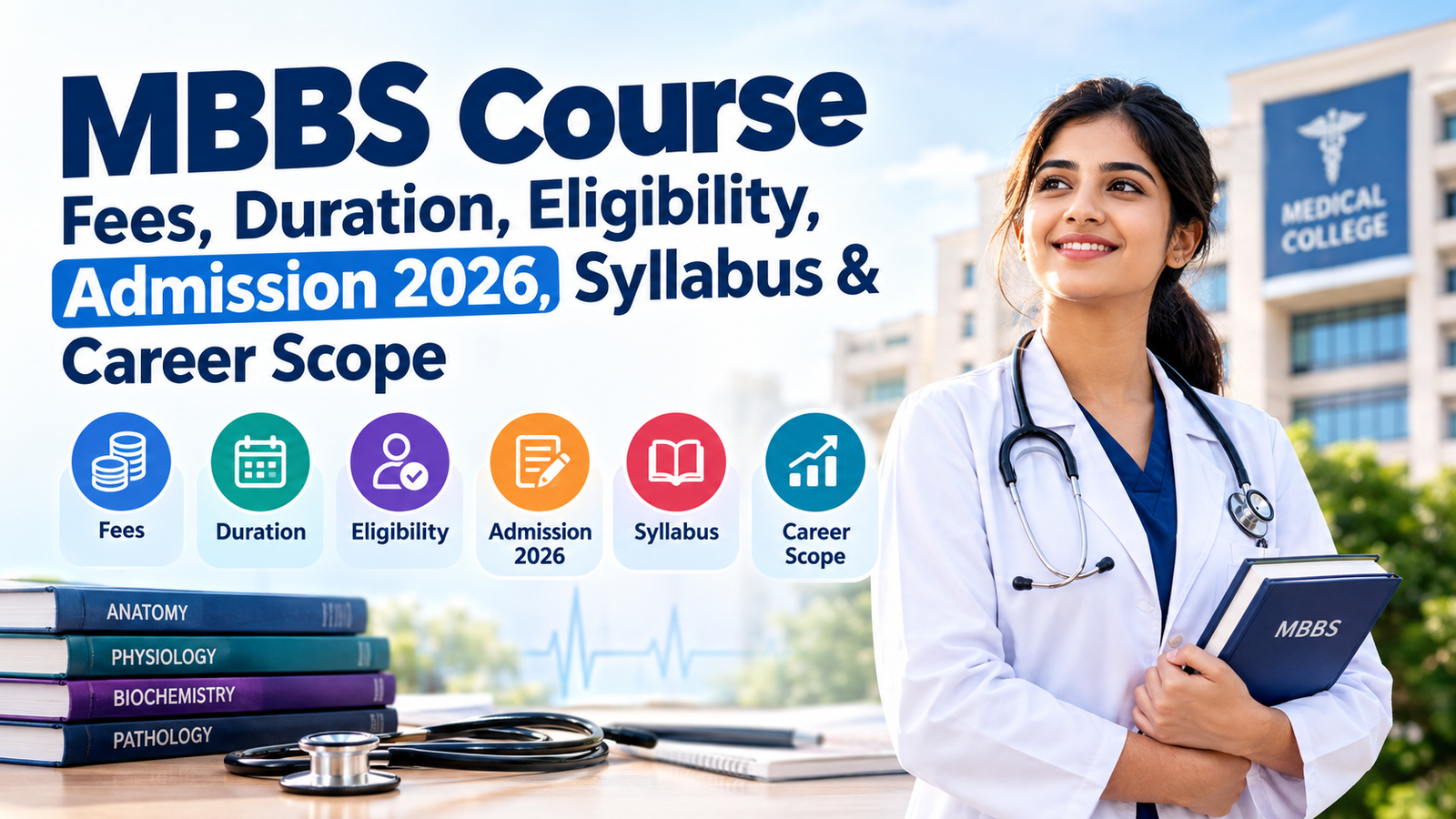
MBBS (Bachelor of Medicine and Bachelor of Surgery) is the primary undergraduate medical degree for students who want to become doctors and build a career in clinical medicine. The course provides comprehensive education in medical sciences, disease diagnosis, treatment, patient care, preventive medicine and clinical practice.
MBBS is a professional medical programme that combines classroom learning with laboratory work, clinical postings, practical training and a compulsory internship. Students begin with foundational subjects such as Anatomy, Physiology and Biochemistry and gradually progress to para-clinical and clinical subjects such as Pathology, Pharmacology, Microbiology, General Medicine, General Surgery, Pediatrics, Obstetrics and Gynecology, Psychiatry and Community Medicine.
In India, admission to MBBS courses is primarily based on NEET-UG, followed by the applicable counselling process. The National Medical Commission (NMC) regulates medical education and establishes standards for undergraduate medical training.
For students planning to pursue medicine, understanding the MBBS course structure, eligibility, fees, admission process, syllabus, internship, career opportunities and higher-study options is important before selecting a medical college.
What is an MBBS Course?
MBBS stands for Bachelor of Medicine and Bachelor of Surgery. It is an undergraduate medical programme designed to provide students with the knowledge and clinical skills required to understand, diagnose and manage diseases and provide patient care.
Although the name contains the words "Medicine" and "Surgery," MBBS is not limited to these two areas. Students receive broad exposure to several branches of medical science and healthcare.
The programme generally begins with basic medical sciences and progresses towards clinical medicine. During the clinical phase, students interact with patients under supervision and learn how medical knowledge is applied in real healthcare settings.
The MBBS curriculum also focuses on communication skills, professional ethics, clinical reasoning, patient safety and other competencies required in medical practice.
MBBS Course Highlights
|
Particular |
Details |
|
Course Name |
Bachelor of Medicine and Bachelor of Surgery |
|
Short Form |
MBBS |
|
Course Level |
Undergraduate |
|
Course Type |
Medical/Clinical |
|
Duration |
Approximately 5.5 years including internship |
|
Academic Education |
Approximately 4.5 years |
|
Internship |
1 year compulsory rotating internship |
|
Entrance Examination |
NEET-UG |
|
Eligibility |
10+2 with prescribed science subjects |
|
Major Subjects |
Anatomy, Physiology, Biochemistry, Pathology, Pharmacology, Medicine, Surgery and others |
|
Study Mode |
Full-time |
|
Admission |
Entrance examination followed by counselling |
|
Career Areas |
Clinical practice, hospitals, public health, research and higher education |
MBBS Course Duration
The MBBS programme generally takes approximately 5.5 years, including academic education and compulsory rotating internship.
The academic component is generally around 4.5 years, followed by a one-year compulsory rotating internship. The internship provides practical exposure to different medical departments and helps students develop clinical skills under supervision.
The exact academic organisation, examinations and training requirements can depend on the applicable regulatory framework and university.
MBBS Course Duration Structure
|
Component |
Approximate Duration |
|
Academic Medical Education |
4.5 years |
|
Compulsory Rotating Internship |
1 year |
|
Total |
Approximately 5.5 years |
The academic portion includes theoretical classes, practical sessions, laboratory work, clinical postings and skills training. The internship focuses more heavily on supervised clinical experience.
MBBS Eligibility Criteria
Students seeking MBBS admission in India must fulfil the eligibility requirements prescribed by the relevant medical education and admission authorities.
Generally, candidates must have completed Class 12 or an equivalent examination with the required science subjects, including Physics, Chemistry and Biology/Biotechnology. The applicable English requirement and other conditions must also be fulfilled.
Candidates must also satisfy the prescribed age and NEET-UG eligibility requirements.
Basic MBBS Eligibility
A candidate generally needs to:
- Pass Class 12 or an equivalent qualifying examination.
- Study Physics, Chemistry and Biology/Biotechnology as prescribed.
- Fulfil the applicable English requirement.
- Meet the prescribed minimum age requirement.
- Qualify NEET-UG as required.
- Meet the applicable qualifying percentile or category requirements.
- Fulfil the conditions specified by the counselling authority and medical college.
Eligibility regulations can be updated by the competent authorities. Therefore, students should verify the latest official requirements before applying.
NEET-UG Qualifying Criteria
The qualifying percentile is different from the actual admission cutoff.
|
Category |
General Qualifying Percentile |
|
General/Unreserved |
50th percentile |
|
EWS |
50th percentile |
|
OBC |
40th percentile |
|
SC |
40th percentile |
|
ST |
40th percentile |
|
PwD – General/EWS |
45th percentile |
|
PwD – Reserved Categories |
40th percentile |
These percentages represent the commonly prescribed qualifying percentile framework and should not be interpreted as the score required to secure a particular MBBS college.
The actual admission cutoff can change depending on factors such as:
- NEET performance
- Number of applicants
- Number of available seats
- College
- Category
- State
- Counselling round
- Quota
- Seat type
MBBS Admission Process
MBBS admission in India generally follows a national entrance examination and counselling-based process.
Step 1: Check Eligibility
Before applying, candidates should verify their educational qualifications, subjects, age and other applicable requirements.
Step 2: Apply for NEET-UG
Eligible candidates register for the NEET-UG examination through the official examination authority.
Step 3: Appear for the Entrance Examination
Candidates appear for NEET-UG and receive their examination result, score and rank according to the applicable examination process.
Step 4: Participate in Counselling
Candidates who meet the applicable requirements participate in the relevant counselling process.
Different seats can be handled through different counselling authorities depending on the institution, state, quota and category.
Step 5: Choice Filling
Candidates select their preferred medical colleges and courses from the available options.
Step 6: Seat Allotment
Seats are allotted according to the applicable counselling rules, candidate rank, category, choices, seat availability and other criteria.
Step 7: Document Verification
The candidate submits the required documents for verification.
Step 8: Fee Payment
After accepting the allotted seat, the candidate pays the applicable admission or tuition fees.
Step 9: Join the Medical College
The candidate completes the remaining admission formalities and joins the medical college according to the prescribed schedule.
Students should verify the latest counselling schedule, fee structure, seat matrix and recognition status through the relevant official authorities before taking admission.
MBBS Course Fees
The MBBS fees in India vary significantly from one medical college to another. There is no single fee applicable to all MBBS colleges.
Government medical colleges generally have comparatively lower tuition fees, while private medical colleges can have considerably higher fees. Deemed universities and different quota categories can have separate fee structures.
MBBS Fee Structure by College Type
|
College Type |
General Fee Pattern |
|
Government Medical College |
Generally lower tuition fees |
|
State Government College |
Usually comparatively affordable |
|
Private Medical College |
Generally higher |
|
Deemed University |
Institution-specific and often higher |
|
Management Quota |
Generally higher than government quota |
|
NRI Quota |
Institution and counselling-specific |
Apart from tuition fees, students should consider other expenses such as:
- Hostel fees
- Mess charges
- Examination fees
- University charges
- Library fees
- Laboratory charges
- Books and study material
- Medical equipment and instruments
- Transportation
- Personal expenses
The actual fee should always be checked from the latest official fee notification of the medical college or relevant counselling authority.
MBBS Syllabus
The MBBS syllabus progresses from basic medical sciences to clinical medicine and practical patient care.
The curriculum is designed to help students understand the structure and functioning of the human body, disease mechanisms, diagnosis, treatment, prevention and patient management.
Major MBBS Subjects
|
Academic Area |
Major Subjects |
|
Basic Medical Sciences |
Anatomy, Physiology, Biochemistry |
|
Para-Clinical Sciences |
Pathology, Pharmacology, Microbiology |
|
Forensic & Legal Medicine |
Forensic Medicine and Toxicology |
|
Community Health |
Community Medicine |
|
Clinical Sciences |
General Medicine, General Surgery |
|
Child Health |
Pediatrics |
|
Women's Health |
Obstetrics and Gynecology |
|
Clinical Specialities |
Psychiatry, Dermatology and others |
|
Surgical Specialities |
Orthopedics, Ophthalmology, ENT and others |
|
Professional Development |
Ethics, Communication and Clinical Skills |
Anatomy
Anatomy deals with the structure of the human body. It is one of the foundational subjects of medical education.
Students learn about:
- Bones
- Muscles
- Organs
- Blood vessels
- Nerves
- Body systems
- Regional anatomy
- Histology
- Embryology
- Neuroanatomy
A strong understanding of anatomy is important for later clinical and surgical subjects.
Physiology
Physiology explains how the human body functions.
Students study the normal functioning of different body systems, including:
- Cardiovascular system
- Respiratory system
- Nervous system
- Renal system
- Gastrointestinal system
- Endocrine system
- Reproductive system
Physiology forms an important foundation for understanding how diseases alter normal body functions.
Biochemistry
Biochemistry focuses on the chemical processes occurring within the human body.
Major areas include:
- Carbohydrates
- Proteins
- Lipids
- Enzymes
- Vitamins
- Minerals
- Metabolism
- Molecular biology
- Clinical biochemistry
Pathology
Pathology deals with diseases and the changes they produce in cells, tissues and organs.
Students learn about:
- Cellular injury
- Inflammation
- Neoplasia
- Blood disorders
- Organ diseases
- Tissue changes
- Laboratory diagnosis
Pathology helps students understand how diseases develop and how they can be identified through investigations.
Pharmacology
Pharmacology is the study of medicines and their effects on the human body.
Students learn about:
- Drug classification
- Mechanism of action
- Dosage
- Therapeutic uses
- Adverse effects
- Drug interactions
- Clinical pharmacology
This subject helps students understand the appropriate and safe use of medicines.
Microbiology
Microbiology focuses on microorganisms and infectious diseases.
The subject generally includes:
- Bacteriology
- Virology
- Mycology
- Parasitology
- Immunology
- Infection control
- Laboratory diagnosis
Students learn how infectious organisms cause disease and how infections can be diagnosed, prevented and controlled.
Community Medicine
Community Medicine focuses on preventive medicine and population health.
Important topics include:
- Epidemiology
- Biostatistics
- Public health
- Health education
- Environmental health
- Maternal and child health
- Nutrition
- Communicable diseases
- Non-communicable diseases
- Preventive healthcare
General Medicine
General Medicine is one of the major clinical subjects in MBBS.
Students learn how to evaluate and manage diseases affecting adults, including conditions involving:
- Heart
- Lungs
- Kidneys
- Liver
- Gastrointestinal system
- Nervous system
- Endocrine system
- Blood
Clinical postings allow students to observe patient evaluation, diagnosis and treatment under supervision.
General Surgery
General Surgery introduces students to surgical conditions and their management.
Students learn about:
- Surgical history and examination
- Wounds
- Trauma
- Surgical infections
- Abdominal diseases
- Pre-operative care
- Post-operative care
- Basic surgical principles
Obstetrics and Gynecology
Obstetrics and Gynecology deals with women's reproductive health, pregnancy and childbirth.
Major areas include:
- Antenatal care
- Normal pregnancy
- Labour
- Complications of pregnancy
- Gynecological diseases
- Reproductive health
- Family planning
- Maternal healthcare
Pediatrics
Pediatrics focuses on the health and diseases of children and adolescents.
Students study:
- Growth and development
- Childhood diseases
- Nutrition
- Neonatal care
- Pediatric infections
- Common emergencies
- Preventive child healthcare
Clinical Training During MBBS
Clinical education is an essential part of the MBBS course.
Students gradually move from theoretical learning to supervised patient interaction. Clinical postings allow students to observe doctors, take patient histories, perform basic examinations and understand the process of diagnosis and treatment.
Important Clinical Skills
Students may develop competencies in areas such as:
- Patient history taking
- Physical examination
- Communication
- Clinical reasoning
- Basic diagnostic interpretation
- Patient counselling
- Medical documentation
- Emergency response skills
- Professional ethics
- Teamwork
The exact competencies and assessment methods depend on the applicable medical education curriculum.
MBBS Internship
After completing the required academic and examination requirements, students undergo a compulsory rotating internship.
The internship generally lasts one year and provides practical exposure across different medical departments.
Students may rotate through areas such as:
- General Medicine
- General Surgery
- Pediatrics
- Obstetrics and Gynecology
- Community Medicine
- Orthopedics
- Psychiatry
- Emergency services
- Other prescribed departments
Internship training helps students transition from undergraduate medical education to professional medical practice.
Career Scope After MBBS
MBBS provides a broad foundation for careers in clinical medicine and other healthcare-related fields.
After completing the required training and registration requirements, graduates can explore different professional pathways.
Career Options After MBBS
|
Career Option |
Role |
|
General Physician |
Provides general medical care |
|
Medical Officer |
Provides medical services in healthcare institutions |
|
Resident Doctor |
Works in a clinical department |
|
Emergency Medical Services |
Provides care in emergency settings |
|
Public Health |
Works in population and community healthcare |
|
Clinical Research |
Participates in medical research and clinical studies |
|
Medical Research |
Works in research institutions |
|
Healthcare Administration |
Performs healthcare management functions |
|
Medical Education |
Academic and teaching opportunities subject to eligibility |
|
Higher Studies |
Pursues postgraduate medical education |
Career opportunities depend on the graduate's registration, qualifications, experience, location, employer and applicable regulations.
Higher Studies After MBBS
Many MBBS graduates choose postgraduate education to develop expertise in a particular medical speciality.
Common postgraduate pathways include:
- MD
- MS
- DNB
- Other recognised postgraduate programmes
Students can pursue specialities such as:
- General Medicine
- Pediatrics
- Dermatology
- Psychiatry
- Radiodiagnosis
- Anesthesiology
- General Surgery
- Orthopedics
- Obstetrics and Gynecology
- Ophthalmology
- ENT
- Pathology
- Respiratory Medicine
- Community Medicine
After postgraduate education, doctors may pursue further training in super-speciality fields where applicable.
MBBS Salary
There is no fixed salary for every MBBS graduate. Earnings depend on several factors, including experience, job role, location, employer, type of healthcare institution and additional qualifications.
A newly qualified MBBS graduate may work as a junior doctor or medical officer, while experienced doctors may have different opportunities in hospitals, clinics, public health organisations, research institutions or private practice.
Factors Affecting MBBS Salary
- Work experience
- Government or private employment
- Hospital type
- City and location
- Clinical responsibilities
- Working hours
- Additional qualifications
- Postgraduate specialisation
- Private practice
- Type of healthcare organisation
Students should evaluate salary information according to a specific job role rather than assuming one fixed salary for all MBBS graduates.
Government vs Private MBBS Colleges
Both government and private medical colleges offer MBBS programmes subject to applicable recognition and regulatory requirements.
|
Factor |
Government College |
Private College |
|
Tuition Fees |
Generally lower |
Generally higher |
|
Admission Competition |
Usually high |
Varies |
|
Admission Route |
NEET + applicable counselling |
NEET + applicable counselling |
|
Infrastructure |
Varies by institution |
Varies by institution |
|
Hospital Exposure |
Depends on attached hospital |
Depends on attached hospital |
|
Hostel |
Institution-specific |
Institution-specific |
|
Fee Structure |
Authority-specific |
College/counselling-specific |
Students should compare individual colleges rather than choosing solely on the basis of whether a college is government or private.
How to Choose an MBBS College
Selecting a medical college is an important decision because the quality of academic and clinical training can influence the student's overall medical education experience.
Before taking admission, students should check:
- Recognition and regulatory status
- Number of sanctioned MBBS seats
- University affiliation
- Official fee structure
- Attached teaching hospital
- Patient load and clinical exposure
- Faculty and teaching facilities
- Hostel and accommodation
- Internship arrangements
- Location and accessibility
- Infrastructure and laboratories
- Counselling and admission rules
Students should verify the latest information through official regulatory and counselling sources because recognition status, fees, seat availability and admission rules can change.
Advantages of Studying MBBS
An MBBS degree provides a broad foundation in medicine and can open multiple professional pathways.
Some of the major advantages include:
- Comprehensive medical education
- Exposure to different medical specialities
- Clinical and practical training
- Opportunity to pursue postgraduate specialisation
- Career opportunities in hospitals
- Opportunities in public health
- Research and academic pathways
- Scope for further professional development
Challenges of MBBS
Students should also understand the demanding nature of medical education.
Common challenges include:
- Large syllabus
- Long duration of education
- Regular examinations
- Extensive clinical training
- Patient-facing responsibilities
- Compulsory internship
- Need for continuous learning
- Competitive postgraduate entrance examinations for specialisation
Students interested in MBBS should be prepared for sustained academic and clinical commitment.
Frequently Asked Questions About MBBS
1. What is the full form of MBBS?
MBBS stands for Bachelor of Medicine and Bachelor of Surgery.
2. How long is the MBBS course?
The MBBS programme generally takes approximately 5.5 years, including around 4.5 years of academic education and one year of compulsory rotating internship.
3. Is NEET required for MBBS admission?
Yes. NEET-UG is the common entrance examination used for undergraduate medical admissions in India, subject to applicable admission rules.
4. What subjects are required for MBBS?
Students generally need Physics, Chemistry and Biology/Biotechnology in their qualifying examination along with the applicable English requirement.
5. What is the MBBS fee?
MBBS fees vary according to the medical college, state, quota, institution and category of seat. Government colleges generally have lower tuition fees, while private colleges and certain other seat categories can have substantially higher fees.
6. Is MBBS difficult?
MBBS requires consistent study, practical training, clinical learning and preparation for professional examinations. Students should be prepared for a demanding academic schedule.
7. Can I work after MBBS?
Yes. After completing the required academic programme, internship and applicable registration requirements, graduates can pursue eligible medical positions.
8. What can I study after MBBS?
Graduates can pursue recognised postgraduate programmes such as MD, MS or DNB, depending on eligibility and admission requirements.
9. What is the MBBS internship?
The MBBS internship is a compulsory period of supervised practical medical training. It provides clinical exposure across different departments and helps students develop practical skills.
10. What subjects are taught in MBBS?
Major subjects include Anatomy, Physiology, Biochemistry, Pathology, Pharmacology, Microbiology, Forensic Medicine, Community Medicine, General Medicine, General Surgery, Pediatrics, Obstetrics and Gynecology and other clinical disciplines.
11. Can MBBS graduates work in government hospitals?
Yes. Eligible MBBS graduates can apply for government medical positions according to the recruitment rules and eligibility requirements of the relevant organisation.
12. Can an MBBS graduate become a specialist?
Yes. An MBBS graduate can pursue postgraduate medical education such as MD, MS or DNB and subsequently undertake further specialist or super-specialist training where applicable.
13. Is practical training included in MBBS?
Yes. MBBS includes practical sessions, laboratory work, clinical postings, skills training and compulsory internship.
14. Which is better, government or private MBBS college?
Both types of institutions can provide medical education. Students should compare individual colleges based on recognition, fees, faculty, infrastructure, attached hospital, clinical exposure, internship facilities and other relevant factors rather than relying only on the ownership type.
15. What is the career scope after MBBS?
After MBBS, graduates can explore clinical practice, medical officer roles, hospitals, public health, research, clinical research, healthcare organisations, academic pathways and postgraduate medical education.
Conclusion
The MBBS course is a comprehensive undergraduate medical programme that combines basic medical sciences, clinical education, practical training and compulsory internship. It provides students with a broad understanding of the human body, diseases, diagnosis, treatment, prevention and patient care.
In India, admission to MBBS is primarily based on NEET-UG, followed by the applicable counselling process. Students must meet the prescribed academic, age and entrance examination requirements before participating in counselling.
The course generally takes around 5.5 years including a one-year compulsory rotating internship. During the programme, students study subjects ranging from Anatomy, Physiology and Biochemistry to Pathology, Pharmacology, Microbiology, Community Medicine, General Medicine, General Surgery, Pediatrics and Obstetrics and Gynecology.
MBBS also provides several options after graduation. Students can enter eligible medical roles after completing the required internship and registration requirements or continue their education through postgraduate programmes such as MD, MS or DNB.
Because MBBS fees, admission rules, seat availability, cutoff trends and regulatory requirements can vary, students should always verify the latest information from the relevant official authorities and the medical college before taking admission.
For anyone planning a career in medicine, understanding the course structure, eligibility, admission process, fees, syllabus, internship and career opportunities can help in making an informed choice about medical education.