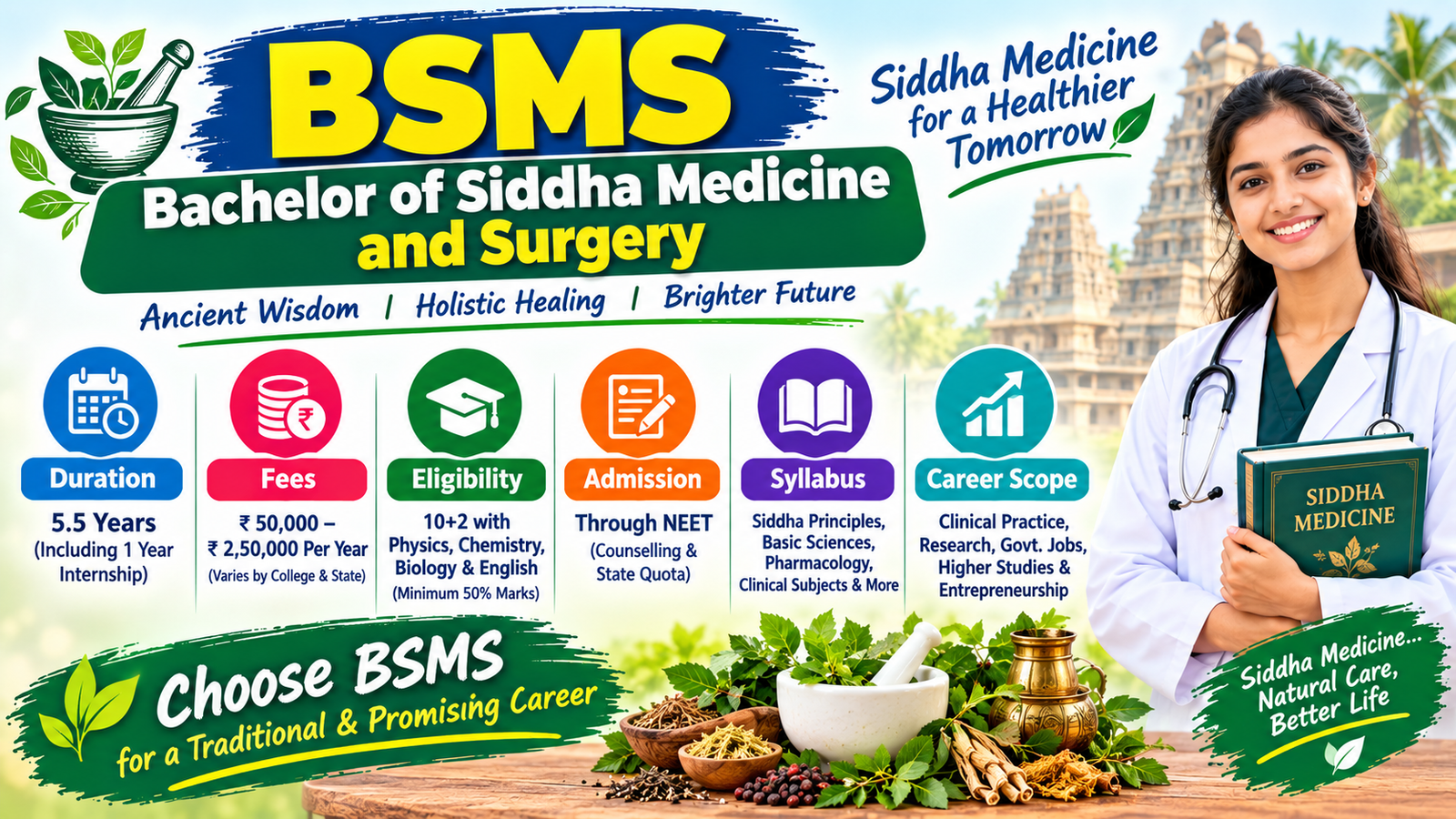
The BSMS course (Bachelor of Siddha Medicine and Surgery) is an undergraduate degree programme based on the Indian system of medicine known as Siddha medicine, meant for students desiring to build a career in Siddha healthcare practice, clinical fields, research, teaching, pharmacy, wellness and other related domains.
Siddha medicine is one of the Indian systems of medicine having its own principles of diagnosis, treatment, pharmacology and preventive healthcare. The BSMS course combines traditional Siddha knowledge along with scientific and modern medical education. Lab-based and clinical training are also part of the course curriculum.
Some key pointers for students aiming to pursue BSMS right after school are:
- i) BSMS eligibility
- ii) NEET requirements
- iii) BSMS course duration
- iv) Fees for BSMS in India
- v) Syllabus for BSMS
- vi) Admission process for BSMS
- vii) Colleges for BSMS
- viii) Internship for BSMS
- ix) Career scope after BSMS
BSMS Course or Bachelor of Siddha Medicine and Surgery
The BSMS degree is a professional undergraduate degree in the Siddha system of medicine. The course introduces students to the fundamental principles of Siddha medicine, human anatomy and physiology, pathology, pharmacology, clinical subjects, diagnosis and therapeutic practices.
This course also includes practical and clinical training to enable students to understand how Siddha concepts are applied in healthcare settings.
As per the National Commission for Indian System of Medicine (NCISM), the BSMS programme is designed to create graduates with knowledge of Siddha medicine, contemporary developments and relevant scientific and technological concepts along with hands-on training.
BSMS can be a good option for students interested in traditional Indian medicine but who want a structured education in biomedical sciences and clinical practice.
BSMS Course Highlights
|
Name of the Course |
Full Form |
|
Name of the Course |
Bachelor of Siddha Medicine and Surgery |
|
Course Level |
Undergraduate |
|
Course Type |
Medical/Indian System of Medicine |
|
Duration |
5.5 years including 1-year internship |
|
Academic Structure |
Three professional phases of 18 months each |
|
Entrance Exam |
NEET-UG |
|
Basic/Required Subjects |
Physics, Chemistry and Biology in Class 12 |
|
Governing Body |
National Commission for Indian System of Medicine (NCISM) |
|
Admission Mode |
NEET-based counselling |
|
Internship |
1 year compulsory internship |
|
Major Area of Study |
Siddha Medicine and related modern medical sciences |
Currently prescribed by the National Commission for Indian System of Medicine, the BSMS course has been split into three professional years of 18 months each followed by a one-year internship (making the total programme 5.5 years).
BSMS Course Duration
The total course for a BSMS degree is 5.5 years, including academic education and a compulsory internship.
The academic part of the course spans out into three professional phases of 18 months each:
- First Professional BSMS - 18 months
- Second Professional BSMS - 18 months
- Third Professional BSMS - 18 months
- Compulsory internship - 1 year
The internship in a healthcare setting offers hands-on exposure for practical training.
BSMS Eligibility Criteria
Students wanting to apply for BSMS admission in various government and private organisations should be aware of the eligibility requirements prescribed by these institutes and the relevant counselling authorities.
As per the NCISM regulations,
|
Eligibility Requirement |
Details |
|
Educational Qualification |
A candidate must have passed Class 12 or an equivalent examination from a recognised board with Physics Chemistry Biology |
|
Minimum Marks |
The regulations prescribe a minimum of 50% marks in Physics, Chemistry and Biology taken together for General category candidates and 40% for Scheduled Caste, Scheduled Tribe and Other Backward Class candidates |
|
Tamil Language Requirement |
B.S.M.S. has an additional language-related requirement because Siddha medicine has a strong connection with Tamil literature and terminology. NCISM regulations state that the candidate should have studied Tamil as one of the subjects in Class 10 or Class 12. Candidates who have not studied Tamil may be required to study it during the First Professional B.S.M.S programme. Students should always check the latest admission notification and applicable category-specific rules before applying. |
|
Age Requirement |
The candidate must have attained 17 years of age on or before 31 December of the year of admission, subject to the applicable regulations. |
Is NEET required for BSMS?
Yes, NEET-UG is required for admission to BSMS.
Admission to undergraduate Siddha programmes is done through NEET-UG. The NEET information bulletin specifies NEET as the common entrance examination for admission to undergraduate BAMS, BSMS, BUMS and BHMS programmes; thus, students planning to study BSMS should prepare for:
- NEET Physics
- NEET Chemistry
- NEET Biology
Having achieved qualifying marks in NEET does not guarantee admission to any college; it is essential to participate in the applicable counselling process and select a college according to the seat availability and the candidate’s merit, choices and category.
BSMS Admission Process
The general process for BSMS admission follows a NEET-based counselling system.
1. Appear for NEET-UG
Students first need to appear for the National Eligibility Cum Entrance Test conducted for undergraduate medical admissions.
2. Qualify NEET
Candidates must meet the applicable NEET qualifying criteria for admission to the BSMS programme.
3. Register for Counselling
Eligible candidates participate in the relevant counselling process.
The Ayush Admissions Central Counseling Committee (AACCC) conducts counselling for applicable All India Quota seats and certain other categories of BSMS seats. For the 2026-27 session, AACCC is conducting UG counselling for eligible NEET-qualified candidates seeking admission to BAMS, BSMS, BUMS and BHMS programmes.
State and UT counselling authorities handle seats that fall under their respective counselling jurisdictions.
4. Choice Filling
Candidates select preferred BSMS colleges according to the counselling rules.
5. Seat Allotment
Seats are allotted based on factors such as:
- NEET merit
- Candidate category
- Choice preference
- Seat availability
- Counselling rules
- Applicable reservation provisions
6. Document Verification and Admission
After allotment, the student must complete document verification, fee payment and reporting requirements within the prescribed deadline.
Documents Required for BSMS Admission
The exact document list can vary by counselling authority and college, but students may generally be asked for the following documents:
- NEET-UG scorecard
- NEET admit card
- Class 10 certificate
- Class 12 marksheet and certificate
- Date of birth proof
- Category certificate, if applicable
- Domicile certificate, where required
- Identity proof
- Passport-size photographs
- Migration certificate, where applicable
- Transfer certificate
- Medical fitness certificate
- Counselling allotment letter
- Other documents specified by the counselling authority
Candidates should check the official counselling notification before reporting to the allotted institute.
BSMS Fees in India
The fees for a BSMS course vary significantly from one college to another. Government colleges generally have lower tuition fees, whereas private and deemed institutions can charge substantially higher amounts.
Apart from tuition fees, students may need to consider:
- Admission fees
- University fees
- Examination fees
- Hostel fees
- Mess charges
- Library fees
- Laboratory fees
- Clinical or institutional charges
- Security deposit, where applicable
- Other college-specific charges
Thus, it is not possible to have a common BSMS fee structure applicable to every college.
A more practical approach is to consider the complete annual cost, rather than just looking at tuition fees.
BSMS Fees: Government vs Private Colleges
|
College Type |
Fee Pattern |
|
Government BSMS College |
Usually comparatively lower |
|
Government-Aided Institution |
Varies according to institution and regulations |
|
Private BSMS College |
Generally higher |
|
Deemed University |
Institution-specific fee structure |
Students should verify the latest fee structure directly from the concerned college and official counselling documents before taking admission.
BSMS Syllabus
The syllabus for BSMS combines Siddha medicine and modern medical sciences.
The exact subject names and academic arrangement are governed by the applicable NCISM curriculum.
First Professional BSMS
The first professional phase focuses on fundamental concepts and foundational medical sciences.
Students study areas related to:
- History and fundamental principles of Siddha medicine
- Basic concepts of Siddha philosophy
- Human anatomy
- Human physiology
- Siddha-related foundational subjects
- Basic medical concepts
- Language and communication requirements
- Practical and introductory clinical learning
The NCISM BSMS curriculum identifies the History and Fundamental Principles of Siddha Medicine among the first professional courses.
Second Professional BSMS
The second professional phase moves towards more advanced Siddha and medical subjects.
Students are introduced to areas involving:
- Pathology
- Pharmacology
- Pharmacognosy-related concepts
- Siddha pharmacology
- Diagnostic principles
- Clinical subjects
- Medical laboratory concepts
- Therapeutic approaches
- Practical training
The NCISM curriculum describes the second professional BSMS phase as an 18-month programme with multiple courses and an outcome-based learning approach.
Third Professional BSMS
The third professional phase has a stronger clinical orientation.
Students gain knowledge in areas such as:
- Siddha clinical medicine
- Speciality-based clinical subjects
- Diagnosis
- Therapeutics
- Surgery-related concepts
- Obstetrics and gynaecology-related areas
- Paediatrics
- Preventive and social medicine
- Clinical practice
- Hospital training
The objective is to prepare students for supervised clinical responsibilities and professional practice after graduation.
BSMS Internship
A one-year compulsory internship forms an important part of the BSMS programme.
During internship, students receive practical exposure in clinical departments and healthcare settings, enabling them to apply their classroom learning in real-world patient care.
Depending on the institution and applicable regulations, internship exposure may cover areas such as:
- General clinical practice
- Siddha medicine
- Speciality departments
- Pharmacy-related activities
- Diagnostic services
- Hospital administration
- Community healthcare
- Preventive healthcare
Students should complete the required internship and other regulatory requirements before proceeding to professional registration or further studies, as applicable.
Skills Developed During BSMS
BSMS is not limited to theoretical study; the programme aims to develop several professional competencies.
Students can develop skills in:
- Patient communication
- Clinical observation
- Case history taking
- Basic diagnosis
- Siddha principles of diagnosis
- Understanding of medicinal preparations
- Clinical documentation
- Preventive healthcare
- Community healthcare
- Research methodology
- Laboratory procedures
- Professional ethics
- Healthcare communication
Practical training becomes increasingly important as students progress through the professional phases.
Career Scope After BSMS
After completing BSMS and fulfilling the applicable internship and registration requirements, graduates can explore different career paths.
1. Siddha Physician
Graduates can work in Siddha healthcare settings and provide services within the scope of their professional registration and applicable regulations.
2. Government Healthcare Sector
BSMS graduates may find opportunities in government healthcare institutions, AYUSH-related services and other public-sector healthcare programmes, depending on recruitment rules.
3. Private Hospitals and Clinics
Private Siddha hospitals and clinics can offer employment opportunities for graduates interested in clinical practice.
4. Siddha Pharmacy
The Siddha pharmaceutical sector offers opportunities related to medicinal preparations, quality control, manufacturing and related activities.
5. Research
Students interested in research can explore opportunities in Siddha medicine, pharmacology, medicinal plants, drug development, clinical research and traditional medicine documentation.
6. Teaching
After obtaining the required higher qualification and meeting regulatory requirements, graduates can move towards academic and teaching careers.
7. Public Health
BSMS graduates may also explore roles connected with preventive healthcare, community medicine and health-awareness programmes.
8. Wellness and Healthcare Services
The growing interest in traditional systems of medicine has also created opportunities in wellness-oriented healthcare services, subject to professional and legal requirements.
Higher Studies After BSMS
Students wanting to specialise after BSMS can consider postgraduate education.
Depending on eligibility, regulations and available programmes, graduates may pursue postgraduate studies in Siddha medicine and related specialisations.
Higher education can help students develop deeper expertise in:
- Clinical Siddha medicine
- Speciality practice
- Pharmacology
- Research
- Teaching
- Academic medicine
Students should check the latest postgraduate admission regulations and entrance requirements before selecting a programme.
BSMS vs MBBS
BSMS and MBBS are both undergraduate healthcare programmes, but they pertain to different systems of medicine.
|
Feature |
BSMS |
MBBS |
|
Full Form |
Bachelor of Siddha Medicine and Surgery |
Bachelor of Medicine and Bachelor of Surgery |
|
Medical System |
Siddha |
Modern medicine |
|
Entrance |
NEET-UG |
NEET-UG |
|
Duration |
5.5 years including internship |
Generally 5.5 years including internship |
|
Regulatory Framework |
NCISM |
National Medical Commission |
|
Main Focus |
Siddha medicine + modern scientific education |
Modern medical science |
|
Career Area |
Siddha/AYUSH healthcare |
Modern medical healthcare |
The choice between these programmes depends on the student’s academic interests, preferred healthcare system and long-term career plans.
Why Choose BSMS?
BSMS can be considered by students interested in Siddha medicine and who want professional education in an Indian system of medicine.
Some students choose the programme because it offers exposure to:
- Traditional Siddha principles
- Modern medical sciences
- Clinical training
- Medicinal preparations
- Preventive healthcare
- Research
- Community healthcare
- Healthcare entrepreneurship
However, students should understand the course structure and professional pathway before making their admission decision.
Things to Check Before Choosing a BSMS College
Before taking admission in any BSMS college, students should not compare colleges only on the basis of fees. Some important pointers are:
Check
- Whether the institution has the required regulatory permission for the relevant academic session
- Current counselling and seat status
- College infrastructure
- Hospital and clinical facilities
- Faculty availability
- Internship arrangements
- Library and laboratory facilities
- Hostel and accommodation options
- Total course fees
- Previous academic performance and institutional facilities
Regulatory status can change between academic sessions, so students should verify the latest information through official sources before paying admission fees.
BSMS Course: Frequently Asked Questions
Is BSMS a medical degree?
Yes. BSMS is a recognised undergraduate degree in the Siddha system of medicine, regulated under the framework of the National Commission for Indian System of Medicine.
What is the full form of BSMS?
BSMS stands for Bachelor of Siddha Medicine and Surgery.
Is NEET compulsory for BSMS admission?
Yes. NEET-UG is the entrance examination route for admission to undergraduate BSMS programmes in India.
What is the duration of the BSMS course?
The BSMS programme is 5.5 years, comprising three 18-month professional phases followed by a one-year internship.
What subjects are required for BSMS?
Students generally need Physics, Chemistry and Biology at the Class 12 level. The applicable regulations also contain a Tamil-language requirement for BSMS candidates.
Can I pursue BSMS after Class 12?
Yes. Students who satisfy the required Class 12, age, NEET and other eligibility conditions can participate in the BSMS admission process.
Is there an internship in BSMS?
Yes. A one-year internship is included after the three professional phases of the BSMS programme.
What can I do after BSMS?
BSMS graduates can explore clinical practice, government and private healthcare, Siddha pharmaceutical work, research, public health, teaching after the required higher qualification and other related healthcare opportunities.
Does BSMS have good career opportunities?
Career opportunities depend on factors such as professional registration, postgraduate qualifications, experience, location and the type of healthcare organisation. Students interested in Siddha medicine can build careers across clinical, academic, research, pharmaceutical and healthcare sectors.
Conclusion
The BSMS (Bachelor of Siddha Medicine and Surgery) course is a professional undergraduate programme for students interested in the Siddha system of medicine. The course combines Siddha principles with modern medical sciences, practical education and clinical training.
The programme has a 5.5-year structure, including one-year internship, and admission is based on NEET-UG followed by the applicable counselling process.
For students planning BSMS admission, it is essential to look beyond the course name and understand the complete pathway—from NEET preparation and eligibility to counselling, college selection, fees, clinical training, internship and future career options.
Because fees, seat availability, counselling schedules and institutional permissions can change from one academic year to another, candidates should verify the latest information through the relevant official counselling authority and the concerned BSMS institution before making an admission decision.