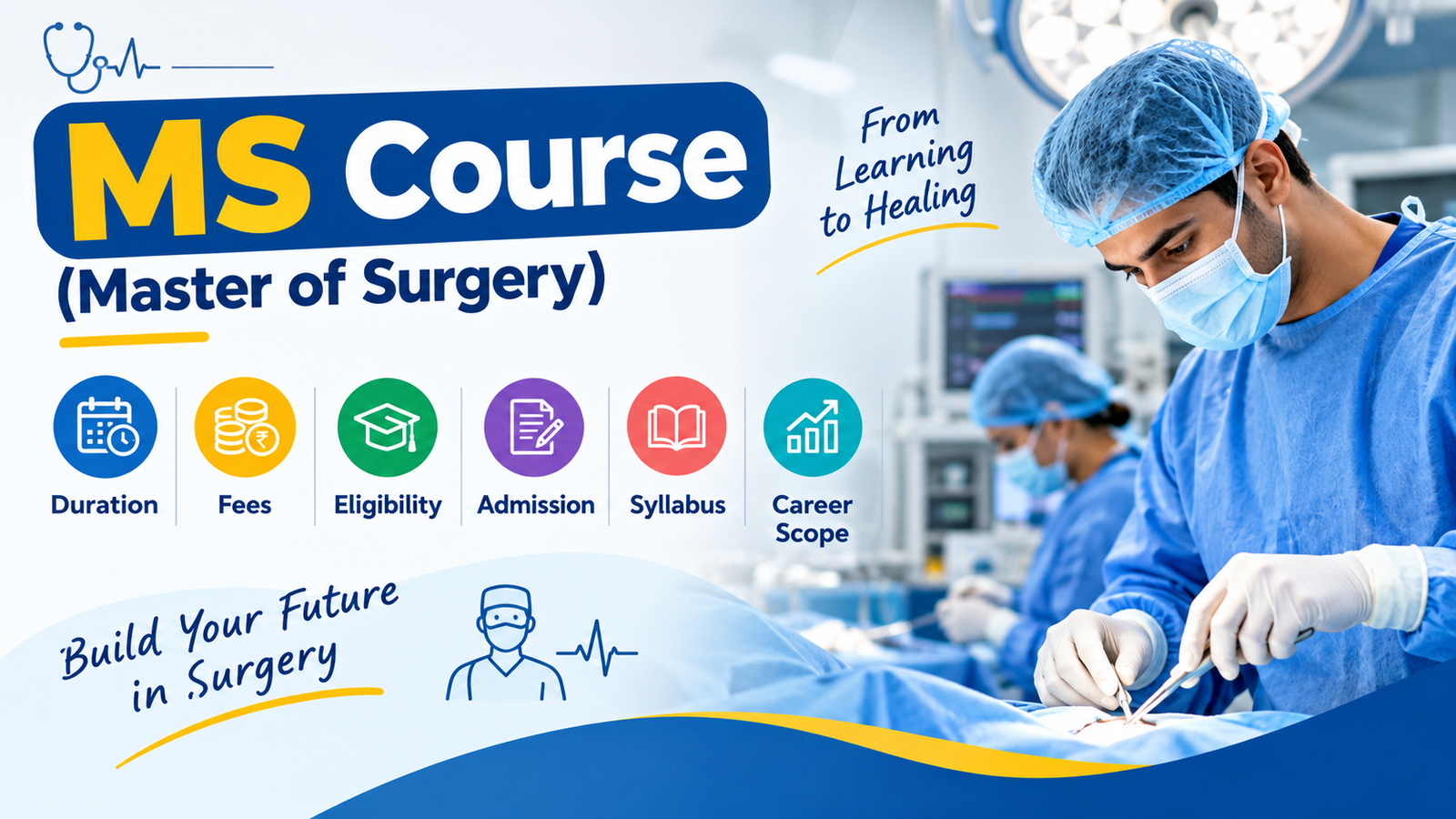
MS Course (Master of Surgery) is a postgraduate medical programme for MBBS graduates interested in developing a specialised career in surgical medicine. Unlike undergraduate medical education, an MS programme focuses on extensive training in surgical diagnosis, techniques, clinical decision-making, patient management and postoperative care.
In India, MS (Master of Surgery) is generally a three-year postgraduate degree. Students obtain extensive clinical training in hospitals and teaching institutions studying a particular surgical specialisation. Common MS specialisations include General Surgery, Orthopaedics, Ophthalmology, ENT and Obstetrics & Gynaecology, depending on the institution and applicable postgraduate regulations.
Admission to MS courses in India are primarily based on performance in the NEET PG examination, followed by the applicable counselling process. Government medical colleges, private medical colleges, deemed universities and other recognised institutions offer postgraduate surgical programmes.
For MBBS graduates who enjoy hands-on clinical work and want to develop advanced surgical skills, MS can provide a structured pathway towards specialist practice, teaching, research and further super-specialisation.
What is an MS Course?
MS stands for Master of Surgery. It is a postgraduate medical degree designed to provide advanced training in surgical disciplines.
During the programme, students learn how to evaluate patients, identify conditions requiring surgical intervention, assist and perform procedures under supervision, manage emergencies and provide appropriate postoperative care.
The course combines:
- Advanced theoretical medical education
- Clinical case discussions
- Hospital-based training
- Surgical procedures
- Emergency management
- Ward and outpatient duties
- Operation theatre exposure
- Postoperative patient care
- Research and academic activities
The exact curriculum, training structure and assessment pattern can vary according to the specialisation and institution.
MS Course Highlights
|
Particular |
Details |
|
Full Form |
Master of Surgery |
|
Course Level |
Postgraduate |
|
Duration |
Generally 3 years |
|
Basic Qualification |
MBBS |
|
Entrance Examination |
NEET PG, subject to applicable admission rules |
|
Admission Mode |
Entrance exam and counselling |
|
Study Mode |
Full-time |
|
Major Areas |
General Surgery, Orthopaedics, ENT, Ophthalmology and other surgical disciplines |
|
Training |
Clinical, practical and academic |
|
Further Study |
MCh, DrNB and other advanced training pathways |
|
Career Areas |
Hospitals, clinics, teaching, research and healthcare institutions |
MS Course Duration
The standard duration of an MS course in India is three years after completing MBBS and fulfilling the required internship and admission conditions.
The three-year programme is primarily focused on advanced specialty training. Students progressively develop clinical knowledge, surgical judgement and practical skills.
First Year
The initial phase generally focuses on strengthening clinical fundamentals and understanding the principles of the chosen surgical discipline. Students become familiar with hospital procedures, patient evaluation, investigations, diagnosis and basic surgical management.
Second Year
Students generally receive greater exposure to clinical cases, operative procedures and emergency management. Their responsibilities increase as they gain experience under supervision.
Third Year
The final phase generally involves advanced clinical responsibilities, greater surgical exposure, academic activities and preparation for final postgraduate assessments.
The exact distribution of training and academic requirements depends on the university, speciality and applicable regulatory framework.
MS Course Eligibility Criteria
Students interested in pursuing an MS degree must satisfy the eligibility conditions applicable to postgraduate medical admissions.
Generally, candidates need to have:
- Completed an MBBS degree from a recognised medical institution.
- Completed or fulfilled the required compulsory rotating internship within the prescribed eligibility period.
- Obtained the required registration with the relevant medical regulatory authority.
- Qualified in the applicable postgraduate medical entrance examination.
- Fulfilled the eligibility requirements specified for the particular counselling and institution.
Eligibility requirements can change between admission cycles, so candidates should always verify the latest official admission notification before applying.
Is NEET PG Required for MS Admission?
Yes, NEET PG is the principal national entrance examination used for admission to many postgraduate medical degree and diploma programmes in India, subject to the prevailing admission framework.
A candidate's NEET PG performance plays an important role in determining eligibility for postgraduate counselling and seat allocation.
The counselling process may differ depending on the category of institution and seat type. Candidates may need to participate in the appropriate national or state counselling process.
Because admission rules and counselling arrangements can change, students should check the latest official notifications before making admission decisions.
MS Course Admission Process
The MS admission process usually involves several stages.
Step 1: Complete MBBS
Candidates must complete their MBBS education and satisfy the applicable internship requirements.
Step 2: Appear for NEET PG
Eligible candidates appear for the postgraduate medical entrance examination.
Step 3: Obtain a Qualifying Rank
Candidates need to meet the applicable eligibility and qualifying requirements.
Step 4: Register for Counselling
Eligible candidates register for the relevant counselling authority and select their preferred colleges and specialisations according to the available choices.
Step 5: Choice Filling
Candidates enter their preferred MS specialisations and institutions based on their priorities, rank, category and available seats.
Step 6: Seat Allotment
Seats are allotted according to the applicable counselling rules, candidate merit, reservation criteria, choices and seat availability.
Step 7: Document Verification and Admission
After seat allotment, candidates complete document verification, fee payment and other admission formalities.
MS Course Fees in India
The MS course fees vary considerably depending on the type of institution, specialisation, location and seat category.
Government medical colleges generally have significantly lower tuition fees than private medical colleges and deemed universities. Private and deemed institutions may have substantially higher fees.
|
Institution Type |
General Fee Trend |
|
Government Medical College |
Usually comparatively low |
|
State Government Institution |
Generally affordable |
|
Private Medical College |
Higher |
|
Deemed University |
Can be substantially higher |
Apart from tuition fees, students may need to consider hostel charges, examination fees, university charges, accommodation, food, books, equipment and other institutional expenses.
Candidates should check the latest fee structure published by the concerned college or counselling authority rather than relying on old fee figures.
MS Specialisations in India
MS is offered in several surgical disciplines. Availability differs from one medical college to another.
MS General Surgery
MS General Surgery is one of the major postgraduate surgical programmes. It provides broad training in surgical diagnosis, operative management, emergency surgery and postoperative care.
It can also serve as a foundation for pursuing further specialisation.
MS Orthopaedics
MS Orthopaedics focuses on the diagnosis and management of conditions affecting bones, joints, muscles, ligaments and related structures.
Training can include trauma management, fracture care, joint disorders and various orthopaedic procedures.
MS Ophthalmology
MS Ophthalmology focuses on diseases and disorders of the eye and visual system.
Students receive training in clinical ophthalmology, diagnosis, medical treatment and surgical procedures related to eye care.
MS ENT
MS ENT focuses on conditions affecting the ear, nose and throat, along with related head and neck conditions.
Training includes clinical diagnosis, medical management and relevant surgical procedures.
MS Obstetrics and Gynaecology
Obstetrics and Gynaecology involves the management of pregnancy, childbirth and diseases of the female reproductive system. The discipline combines medical and surgical care.
The availability and naming of postgraduate programmes can depend on the applicable regulatory and institutional framework.
MS Course Syllabus
The MS syllabus depends heavily on the chosen specialisation. However, postgraduate surgical education generally combines theoretical knowledge with intensive clinical training.
General Areas Covered
Students may study topics related to:
- Surgical anatomy
- Pathology
- Pharmacology relevant to surgery
- Microbiology
- Clinical diagnosis
- Surgical infections
- Trauma
- Anaesthesia principles
- Emergency management
- Operative techniques
- Postoperative complications
- Critical care
- Wound management
- Patient safety
- Surgical ethics
- Research methodology
MS General Surgery Syllabus
Students pursuing MS General Surgery may encounter subjects and clinical areas such as:
- Gastrointestinal surgery
- Breast diseases
- Thyroid and endocrine surgery
- Vascular disorders
- Urological conditions
- Surgical infections
- Abdominal emergencies
- Trauma and emergency surgery
- Hernia
- Burns
- Oncology-related surgical management
- Paediatric surgical conditions
- Preoperative evaluation
- Postoperative management
The precise syllabus should be checked with the respective university or medical institution.
Practical Training in MS
Clinical training is one of the most important parts of the MS course.
Unlike programmes that are primarily classroom-based, MS education requires extensive hospital exposure.
Students may participate in:
- Outpatient departments
- Inpatient wards
- Operation theatres
- Emergency departments
- Intensive care settings
- Clinical case presentations
- Surgical demonstrations
- Ward rounds
- Postoperative follow-up
- Academic seminars
- Journal clubs
- Research activities
The purpose of this training is to develop clinical judgement and gradually increase responsibility under appropriate supervision.
Skills Developed During an MS Course
An MS graduate develops a combination of clinical, technical and professional skills.
Important skills may include:
- Patient assessment
- Clinical diagnosis
- Surgical decision-making
- Interpretation of investigations
- Emergency response
- Preoperative planning
- Operative assistance
- Surgical techniques
- Postoperative management
- Complication recognition
- Patient counselling
- Team coordination
- Medical documentation
- Research and academic presentation
Surgical education also requires communication and teamwork because patient outcomes often depend on coordination between surgeons, anaesthetists, nurses and other healthcare professionals.
MS vs MD
MS and MD are both postgraduate medical degrees, but their primary academic focus is different.
|
Feature |
MS |
MD |
|
Full Form |
Master of Surgery |
Doctor of Medicine |
|
Broad Focus |
Surgical disciplines |
Medical/non-surgical disciplines |
|
Training |
Surgery and operative care |
Diagnosis and medical management |
|
Clinical Work |
Strong surgical component |
Strong medical component |
|
Examples |
General Surgery, Orthopaedics |
General Medicine, Paediatrics |
|
Further Training |
MCh/DrNB and other advanced pathways |
DM/DrNB and other advanced pathways |
The appropriate programme depends on the candidate's intended speciality and long-term career interests.
Career Scope After MS
An MS degree can open several career pathways within clinical medicine, healthcare education and research.
1. Surgeon in Hospitals
Graduates can work as specialists in government hospitals, private hospitals and other healthcare institutions, subject to applicable registration and employment requirements.
2. Private Practice
After completing the required qualifications and registration requirements, graduates may establish or join a surgical practice.
3. Medical Colleges
MS graduates can pursue academic careers in medical colleges and teaching hospitals, subject to the applicable eligibility criteria.
4. Government Healthcare Sector
Qualified specialists may apply for relevant positions in government hospitals and healthcare services when vacancies are available.
5. Research
Doctors interested in medical research can participate in clinical studies, academic research and healthcare projects.
6. Further Specialisation
MS graduates, particularly those completing relevant surgical disciplines, may pursue advanced training such as MCh or DrNB, depending on the speciality and prevailing eligibility rules.
Jobs After MS
Common career roles can include:
- General Surgeon
- Orthopaedic Surgeon
- ENT Specialist
- Ophthalmology Specialist
- Surgical Consultant
- Medical College Faculty
- Clinical Research Professional
- Hospital Specialist
- Government Medical Officer/Specialist, where applicable
- Academic Physician
The actual designation depends on the candidate's specialisation, registration, experience and employer.
MS Salary in India
The salary after MS varies significantly according to specialisation, experience, location, employer and type of practice.
A newly qualified specialist working in a hospital may have a different compensation structure from a senior surgeon working in a private hospital or running an established practice.
Factors affecting earnings include:
- Surgical speciality
- Years of experience
- Hospital type
- City
- Professional reputation
- Clinical workload
- Additional qualifications
- Private practice
- Academic responsibilities
Therefore, students should avoid treating a single salary figure as representative of every MS graduate.
Is MS a Good Career Option After MBBS?
MS can be a suitable postgraduate pathway for MBBS graduates who are particularly interested in surgery, procedural medicine, hospital-based care and clinical decision-making.
Before choosing a speciality, students should consider:
- Interest in surgical work
- Preferred patient population
- Lifestyle expectations
- Training intensity
- Career opportunities
- Scope for further specialisation
- Location preferences
- Long-term professional goals
Choosing a postgraduate specialisation is an important career decision, so students should evaluate the actual curriculum, training environment and career requirements rather than selecting a programme only on the basis of perceived salary.
Advantages of Pursuing an MS Course
An MS programme provides structured specialist training after MBBS.
Some key advantages include:
- Advanced knowledge of a surgical speciality
- Extensive clinical exposure
- Practical surgical training
- Opportunities for further specialisation
- Academic and teaching opportunities
- Research exposure
- Career opportunities across public and private healthcare
Challenges of an MS Course
MS training can also be demanding. Students may experience long clinical hours, emergency duties, academic responsibilities and considerable surgical workload.
The programme requires:
- Consistent study
- Clinical discipline
- Physical stamina
- Good communication
- Decision-making ability
- Teamwork
- Commitment to patient care
Understanding these demands before admission can help students prepare realistically for postgraduate medical training.
Documents Required for MS Admission
The exact document list varies by counselling authority and institution. Commonly required documents may include:
- MBBS degree certificate
- MBBS mark sheets
- Internship completion certificate
- NEET PG scorecard/rank information
- Medical registration certificate
- Identity proof
- Passport-size photographs
- Category certificate, where applicable
- Domicile certificate, where applicable
- Migration or other certificates, if required
- Counselling allotment letter
Candidates should check the latest counselling instructions because documentation requirements can change.
Frequently Asked Questions About MS Course
What is the full form of MS in medical education?
MS stands for Master of Surgery. It is a postgraduate medical degree focused on surgical specialisation.
How many years is an MS course?
The MS course is generally three years after MBBS, subject to the applicable postgraduate medical education regulations.
Is NEET PG required for MS?
Yes. NEET PG is the principal entrance examination used for postgraduate medical admissions in India under the prevailing admission system, subject to applicable rules and exemptions, if any.
Can I pursue MS after MBBS?
Yes. MBBS graduates who fulfil the applicable eligibility requirements can pursue MS through the prescribed postgraduate admission process.
What are the main MS specialisations?
Major MS disciplines can include General Surgery, Orthopaedics, Ophthalmology and ENT, among others, depending on the institution and applicable programme structure.
What is the difference between MS and MD?
MS primarily focuses on surgical disciplines, while MD generally focuses on non-surgical medical specialities.
What can I do after MS General Surgery?
After MS General Surgery, graduates can work as surgeons, pursue academic careers, enter hospital practice, undertake research or explore further advanced surgical training such as relevant MCh or DrNB pathways.
Can MS graduates pursue super-specialisation?
Yes. Depending on the speciality and eligibility requirements, MS graduates can pursue advanced training such as MCh or DrNB.
Are MS course fees the same in every college?
No. Fees can vary considerably between government colleges, private medical colleges and deemed universities. Seat category and institution-specific policies can also affect the total cost.
Does MS involve practical training?
Yes. Clinical and practical training is a major component of MS education. Students receive hospital-based exposure through wards, outpatient departments, emergency services and operation theatres.
Conclusion
The MS Course (Master of Surgery) is a specialised postgraduate medical programme designed for MBBS graduates who want advanced training in surgical medicine. With generally three years of postgraduate education, the programme combines academic learning with intensive clinical and practical exposure.
Admission is primarily linked to the postgraduate medical entrance and counselling system, while fees vary significantly according to the institution and seat category. Students can choose from different surgical disciplines depending on the programmes offered by medical colleges.
For MBBS graduates, MS can lead to careers in hospitals, private practice, medical education, research and further specialist training. However, the right speciality should be selected after considering clinical interests, training requirements, career plans and the nature of day-to-day professional work.
For students planning postgraduate medical education, understanding MS eligibility, NEET PG admission, course duration, fees, syllabus, specialisations and career scope is an important first step toward making an informed career plan.