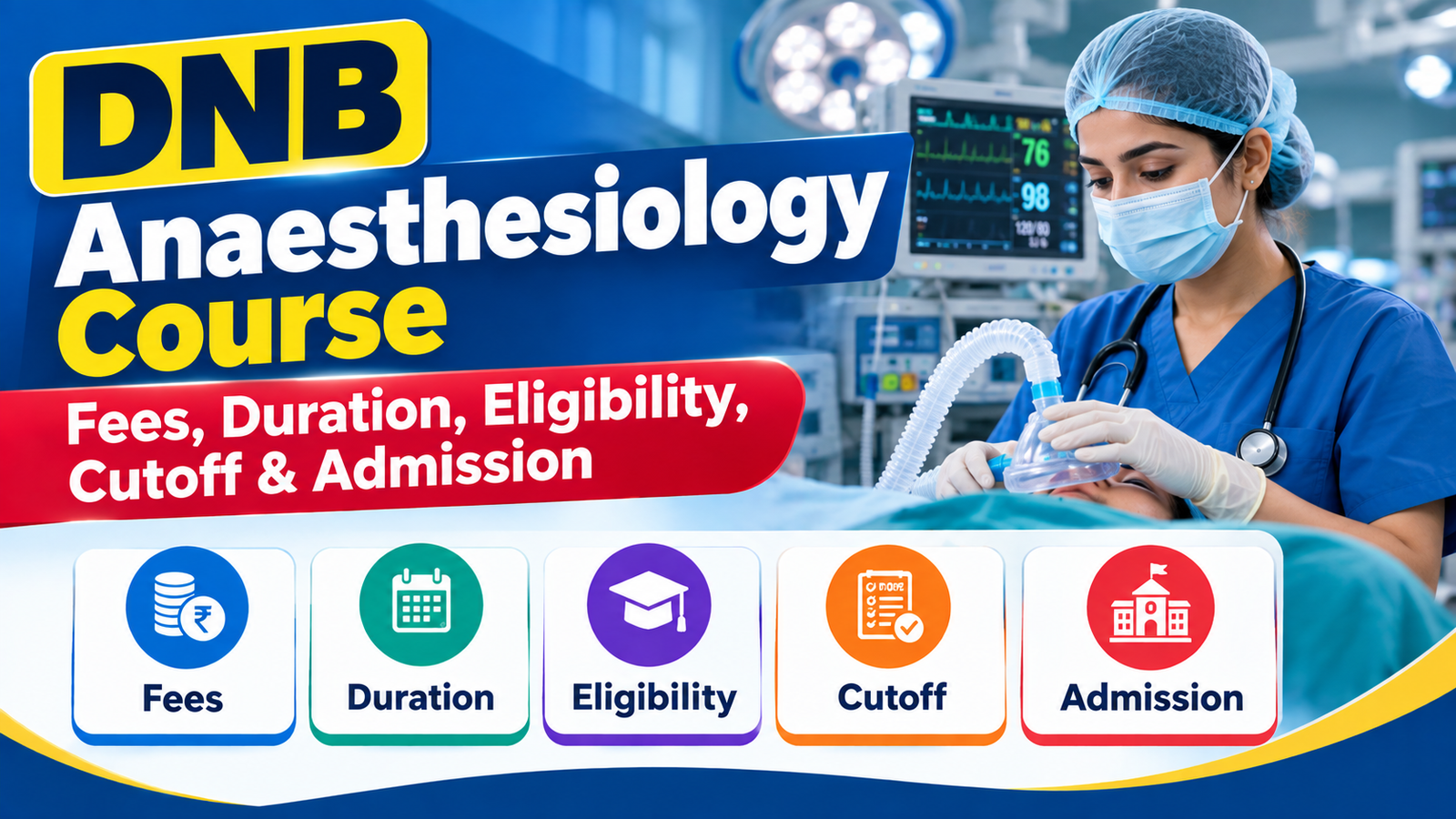
Before an operation begins, an anaesthesiologist has already made several decisions. Is the patient fit for the planned procedure? Which form of anaesthesia is suitable? What could go wrong, and how will the team respond?
DNB Anaesthesiology trains MBBS graduates to make those decisions and care for patients before, during, and after procedures. Trainees learn airway management, monitoring, pain relief, resuscitation, and the care of seriously ill patients. It is clinical work with a technical side—and a great deal of responsibility.
MBBS introduces these skills, but does not provide the sustained specialist training needed to practise anaesthesiology. A DNB trainee works in an accredited hospital, takes on responsibility gradually under supervision, and completes the training and assessment requirements of the National Board of Examinations in Medical Sciences (NBEMS).
For the post-MBBS DNB route covered in this article, admission follows NEET-PG and counselling conducted by the Medical Counselling Committee (MCC). DNB Anaesthesiology is also available through a separate post-diploma route, with different eligibility, entrance examination, counselling, and duration. Candidates should identify the route before comparing seats or earlier allotments.
What is DNB Anaesthesiology?
DNB stands for Diplomate of the National Board. In this case, it is a postgraduate qualification in anaesthesiology awarded through NBEMS after prescribed training and assessment. Training takes place in hospitals or institutions accredited for the programme.
Anaesthesiology is often described as “putting patients to sleep,” but that covers only a small part of the work. An anaesthesiologist assesses risk before a procedure, plans anaesthesia, maintains breathing and circulation during it, responds to sudden changes, and makes sure the patient is safely cared for afterward.
Not every patient receives general anaesthesia. Depending on the procedure and the person’s condition, the plan may involve regional anaesthesia, sedation, or another technique. The anaesthesiologist explains the options and risks, then works with surgeons, nurses, and other clinicians throughout the patient’s care.
The specialty also opens paths into critical care, pain medicine, trauma care, cardiac or neuroanaesthesia, paediatric anaesthesia, and other focused fields. A graduate who wants further training must meet the entry requirements of the particular fellowship or advanced programme.
Course Highlights
|
Particular |
Details |
|
Course Name |
DNB Anaesthesiology |
|
Degree |
Diplomate of National Board in Anaesthesiology |
|
Level |
Postgraduate medical qualification |
|
Duration |
Generally three years for the post-MBBS route; a separate post-diploma route also exists |
|
Basic Qualification |
Recognised MBBS qualification for the post-MBBS route, subject to current rules |
|
Entrance Exam |
NEET-PG for post-MBBS DNB; DNB-PDCET applies to the separate post-diploma route |
|
Admission Process |
Entrance result, relevant counselling, choice filling, allotment, reporting, and NBEMS trainee registration |
|
Training Type |
Supervised operating theatre, recovery, emergency, critical care, academic, and research work |
|
Major Focus |
Safe anaesthesia, airway and physiological management, perioperative care, and pain relief |
|
Further Study |
Eligible fellowships or advanced training in anaesthesia-related fields |
|
Career Areas |
Hospitals, surgical centres, critical care, pain services, teaching, and research |
Course details note: Confirm the route, duration, accredited hospital, and current seat availability in the official NBEMS and counselling documents.
DNB Anaesthesiology Duration: Year by Year
The post-MBBS DNB Anaesthesiology programme generally runs for three years. A post-diploma DNB pathway is also available, but it has a different duration and admission process; it should not be confused with direct entry after MBBS.
The progression below describes the post-MBBS route. Hospitals may organise rotations differently according to their services and NBEMS training requirements.
Duration note: Check the current NBEMS programme guidance and the accredited hospital’s rotation plan before accepting a seat.
Year 1: Learn the routine—and why it matters
Junior trainees begin with preoperative assessment, equipment checks, monitoring, basic airway skills, and supervised anaesthesia for suitable cases. They learn the medicines used during anaesthesia and what changes in heart rate, blood pressure, breathing, or consciousness may signal.
Recovery room care is part of this foundation. An operation being over does not mean the anaesthesiologist’s work is finished; pain, nausea, breathing problems, and other complications still need attention.
Case discussions, academic teaching, and planning a thesis or research project usually begin during this phase.
Year 2: Manage more varied patients
Trainees generally encounter a broader range of operations and patients with more complicated medical conditions. They develop skills in regional anaesthesia, difficult airway assessment, postoperative pain management, and responses to problems arising during surgery.
Exposure may include emergency surgery, obstetric anaesthesia, and intensive care, depending on the accredited hospital’s services. Research work moves forward alongside regular clinical duties.
A key lesson in this year is that the same procedure does not call for the same plan in every patient. Age, illness, urgency, and the patient’s wishes can change the approach.
Year 3: Lead the plan under supervision
Senior trainees take greater responsibility for assessing patients, presenting anaesthetic plans, managing more complex cases, and supporting junior colleagues. They continue to work with consultants and the wider operating theatre team.
They complete required academic work and prepare for NBEMS assessments. By the end of training, the goal is sound judgment as well as procedural skill: recognising risk early, responding calmly, and arranging appropriate postoperative care.
DNB Anaesthesiology Eligibility Criteria
The criteria below concern the post-MBBS route.
- Base degree: Candidates generally need an MBBS degree or accepted provisional MBBS qualification that satisfies the applicable recognition rules.
- Internship: The compulsory rotating internship must be completed by the deadline specified for that NEET-PG admission session.
- Medical registration: Applicants generally need the provisional or permanent registration described in the NEET-PG bulletin and admission instructions.
- Entrance examination: Post-MBBS DNB applicants take NEET-PG. Doctors seeking the separate post-diploma DNB route should check DNB-PDCET eligibility and counselling instead.
- Qualifying requirements: Candidates must meet the applicable examination qualification and the conditions for their category, seat type, and counselling process. Qualification does not guarantee allotment.
Read the current NBEMS information bulletin and MCC counselling scheme before applying. Internship deadlines and required documents can change between admission sessions.
DNB Anaesthesiology Admission Process
Step 1: Complete MBBS and internship
Finish both within the published eligibility dates. Gather your qualification, internship, registration, identity, and applicable category documents.
Step 2: Appear for NEET-PG
Apply through NBEMS for the post-MBBS route. If you already hold an eligible postgraduate diploma and want the post-diploma DNB route, check DNB-PDCET separately rather than following these steps unchanged.
Step 3: Review your result
Check your official result and qualifying status. Then examine the current DNB Anaesthesiology seat matrix. An accredited hospital’s seats and seat categories may change from one admission session to another.
Step 4: Register for counselling
MCC conducts the merit-based counselling for post-MBBS DNB seats following NEET-PG, alongside counselling for other postgraduate medical seats. The separate post-diploma DNB counselling is administered by NBEMS after DNB-PDCET.
Step 5: Fill hospital choices
Choose accredited hospitals listed in the live matrix and place them in your genuine order of preference. A DNB seat may be based in a government or private hospital; judge the training department, not just the ownership label.
Ask about case mix, emergency and obstetric work, intensive care exposure, regional techniques, consultant supervision, teaching time, and how trainees are supported during difficult cases.
Step 6: Review seat allotment
Follow the round’s rules on acceptance, upgrades, deposits, and deadlines. Read the current counselling scheme before deciding what to do with an allotted seat.
Step 7: Report and complete joining
Report to the allotted hospital with the required original documents. Complete its joining formalities and the applicable NBEMS trainee registration process as instructed.
Admission note: Confirm seats, eligibility, charges, reporting dates, and round rules through current NBEMS and MCC notices.
DNB Anaesthesiology Fees
DNB fees should not be compared as though every hospital were selling a separate college quota. NBEMS publishes course fee and stipend guidance for its programmes. The payable amount and payment process must be checked against those current rules and the official joining instructions. Living costs and any applicable charges also affect a trainee’s budget.
|
Institution or seat label |
How to read it for DNB Anaesthesiology |
|
Government College |
A DNB seat is possible only where the hospital or institution has the relevant NBEMS accreditation and a seat in the current matrix. Check NBEMS fee rules. |
|
State Government College |
The same accreditation and seat-matrix check applies. Accommodation and local employment terms may differ. |
|
Private College or Hospital |
A private hospital may offer an accredited DNB seat. Its ownership does not replace NBEMS admission and fee rules. |
|
Deemed University |
Do not assume that an MD seat and a DNB seat at an associated institution have the same fee structure or admission route. Check the exact listed programme. |
|
Management Quota |
Do not assume a management-quota route exists for DNB Anaesthesiology. Use the officially notified DNB seat and counselling process. |
When planning costs, check the written terms for:
- The applicable NBEMS annual course fee and payment process
- Counselling registration and security deposit, where applicable
- Examination-related charges
- Hostel, mess, transport, and other living costs
- Any permitted institutional deposit or charge
- Stipend, leave, and refund conditions
NBEMS also publishes minimum stipend guidance for DNB trainees. Check what the hospital will pay and when, alongside the cost of living near it.
Fee disclaimer: Verify the current NBEMS fee and stipend guidance, MCC payment rules, and your allotted hospital’s written joining terms before paying. Do not rely on an MD college fee table for a DNB seat.
DNB Anaesthesiology Cutoff
There is no single DNB Anaesthesiology cutoff. The NEET-PG qualifying cutoff determines eligibility under the examination rules. A hospital-wise closing rank or score describes the last candidate allotted a particular DNB seat in counselling.
That closing position depends on the category, seat type, and round. It can also move when candidates upgrade, vacancies arise, or a seat is added or removed.
What Determines the Cutoff?
- Seat count: The accredited seats in the live matrix limit availability.
- Hospital reputation: Case mix, supervision, location, and training facilities affect demand.
- Government or private setting: Working arrangements and location can influence preferences.
- Category: Applicable eligibility and reservation conditions shape the candidate pool.
- Seat or quota type: Compare only seats governed by the same applicable conditions.
- Round: Upgrades, withdrawals, and vacancies can change the closing position.
- Year-to-year competition: Candidate results and preferences do not stay the same.
Cutoff disclaimer: Use official NEET-PG qualifying notices and current MCC DNB allotment results. A previous hospital’s closing rank is a guide, not a guarantee.
What Rank or Score Is Needed for DNB Anaesthesiology?
No universal NEET-PG rank secures a DNB Anaesthesiology seat. The useful comparison is the result for a specific accredited hospital and seat type, not a general number quoted for the specialty.
Start with the live MCC DNB matrix. Review earlier official allotments for the same hospital, programme, category or seat type, and round. Then look at training: a hospital with excellent operative volume but limited teaching or supervision may not meet your needs.
Make a broad preference list of hospitals you would actually join. Include preferred departments and suitable alternatives, ordered according to your true preference and the counselling rules.
Rank and score disclaimer: Confirm current seats, eligibility, and allotments through official NBEMS and MCC sources; historical results cannot predict your individual allotment.
DNB Anaesthesiology Syllabus
NBEMS publishes a DNB Anaesthesiology curriculum covering perioperative care, basic sciences, anaesthetic techniques, recovery, and critical illness. The hospital’s rotations determine when trainees encounter each area.
Foundations and preoperative care
- Relevant anatomy and physiology
- Anaesthetic medicines and their effects
- Patient assessment and risk discussion
- Monitoring, equipment checks, and patient safety
Airway and general anaesthesia
- Airway assessment and management
- Induction, maintenance, and recovery from anaesthesia
- Responses to unexpected changes during surgery
- Planning for patients with difficult airways or medical conditions
Regional anaesthesia and pain
- Principles of spinal, epidural, and peripheral nerve techniques
- Local anaesthetics and their safe use
- Postoperative pain assessment and treatment
- Principles of acute and chronic pain care
Specialty settings
- Obstetric and paediatric anaesthesia
- Emergency and trauma cases
- Anaesthesia for different surgical specialties
- Sedation and care outside the main operating theatre
Recovery, critical care, and research
- Post-anaesthesia care and complications
- Resuscitation and care of critically ill patients
- Ventilation and relevant intensive care principles
- Research methods, critical appraisal, and thesis work
Practical Training in DNB Anaesthesiology
Much of the training happens around an operating list. Trainees assess patients beforehand, discuss a plan with a consultant, prepare equipment and medicines, monitor the patient during the procedure, and review recovery afterward.
Cases do not always go according to plan. A patient may become difficult to ventilate, develop low blood pressure, or need unanticipated postoperative support. Supervised exposure teaches trainees to recognise a problem early, call for help, and act as part of a team.
Practical experience can include airway procedures, vascular access, regional anaesthesia, resuscitation, and intensive care work, depending on the hospital and stage of training. Skills develop through observation, simulation where available, supervised performance, and review of outcomes.
Before accepting a DNB seat, ask current trainees whether they get regular consultant feedback and a suitable range of cases. Accreditation establishes the programme route; the day-to-day training environment still matters.
Career Scope After DNB Anaesthesiology
- Hospital anaesthesiologist: Provide perioperative care in operating theatres and procedure areas.
- Emergency and critical care work: Contribute to resuscitation and care of seriously ill patients in roles suited to the doctor’s training and appointment.
- Pain services: Work in acute or chronic pain care where appropriate facilities and further skills are available.
- Teaching and research: Pursue eligible roles in training institutions or research teams, subject to applicable recruitment requirements.
- Further focused training: Apply for eligible programmes in critical care, cardiac, neuro, paediatric, regional anaesthesia, or pain medicine.
The work often goes unnoticed when everything runs smoothly. That is part of its appeal for some doctors: careful preparation, constant observation, and quick action when a patient needs it.
Salary After DNB Anaesthesiology
Pay varies widely after qualification. A salaried hospital job, a critical care role, and work across several surgical facilities may have different duties and payment arrangements.
Employer type, city, sector, experience, on-call commitments, case mix, and additional training all affect earnings. Team support and safe working arrangements are important parts of any offer.
During training, compare the hospital’s written stipend terms with NBEMS guidance and the expected cost of living.
Salary disclaimer: Verify current stipend and employment terms directly with NBEMS guidance and the hospital or employer. Figures from another role or admission year may not apply to you.