An older patient comes to the hospital after a fall. She has diabetes and poor eyesight, takes several medicines, and has become less steady on her feet. The immediate question is whether she has an injury. The next question is harder: what caused the fall, and what would help her live safely after discharge?
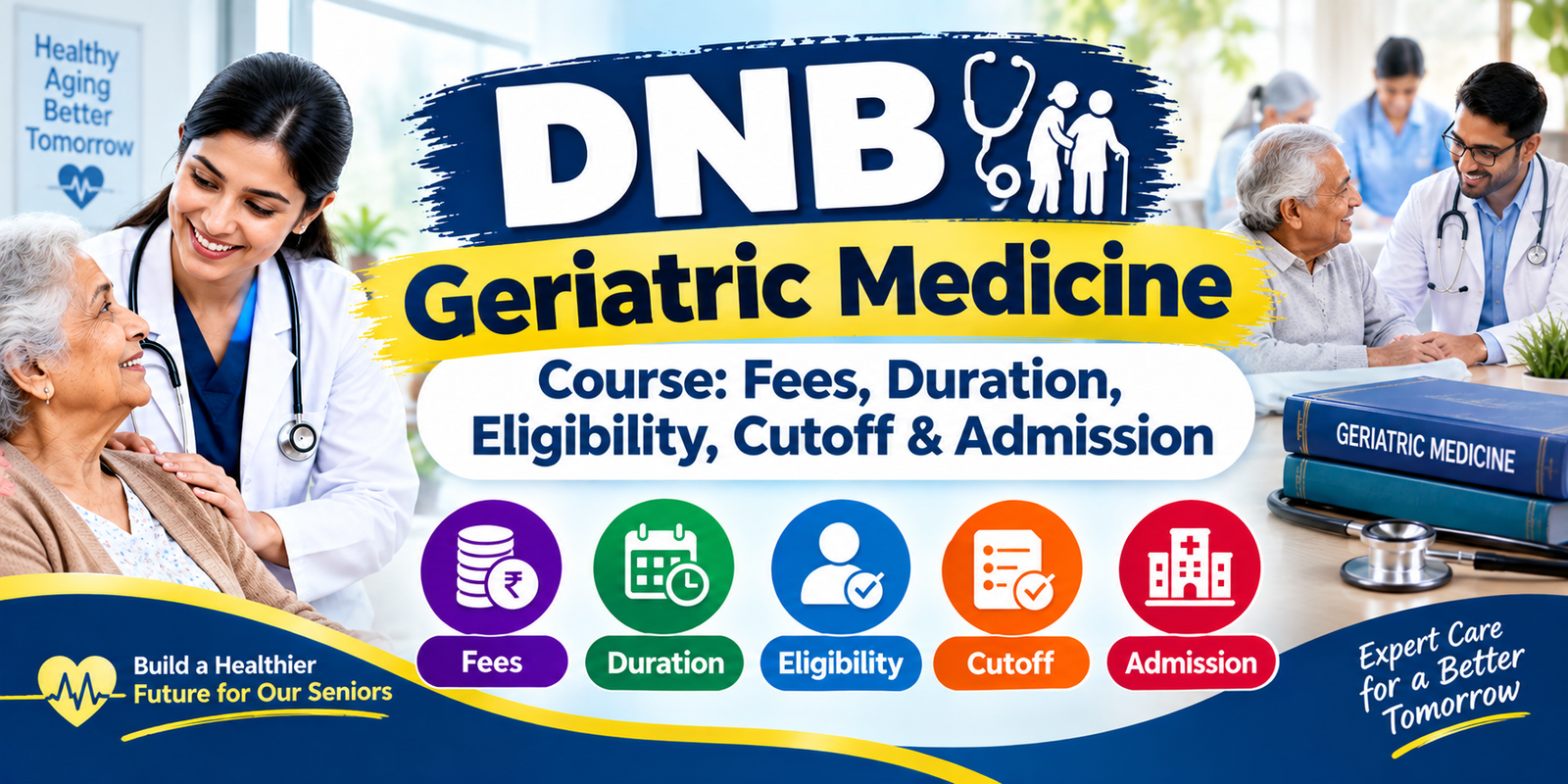
DNB Geriatric Medicine trains doctors to answer both. It is a postgraduate course taken after MBBS, with a focus on the medical care of older adults. Where MBBS provides a broad foundation, this residency develops specialist judgement about illness, medicines, mobility, memory, function and long-term care in later life.
The standard post-MBBS course lasts three years. Admission is through NEET-PG and counselling for a seat at a hospital or institution accredited by the National Board of Examinations in Medical Sciences (NBEMS). Geriatric Medicine has a small pool of DNB seats, so applicants need to examine the current seat matrix closely; last year’s options may not tell the whole story.
What is DNB Geriatric Medicine?
DNB stands for Diplomate of National Board. A doctor training in Geriatric Medicine learns to assess and treat older patients, often when several conditions are present at once.
That combination changes clinical decisions. A medicine may help one condition but increase the risk of falls. A patient may recover from an infection yet struggle to walk or manage meals at home. A good treatment plan must account for both the disease and the person’s ability to function.
The specialty covers acute illness as well as frailty, memory problems, mobility, nutrition, rehabilitation, preventive care and end-of-life decisions. Graduates can work in hospital services for older adults, outpatient clinics, long-term care, teaching or research. Some pursue further focused training where a programme’s eligibility rules permit it.
This is a post-MBBS DNB broad specialty. Applicants should not confuse it with a course that requires an MD or DNB in General Medicine before entry. NBEMS lists Geriatric Medicine among its post-MBBS DNB specialties.
Course highlights
|
Particular |
Details |
|
Course Name |
DNB Geriatric Medicine |
|
Degree |
Diplomate of National Board |
|
Level |
Postgraduate broad specialty |
|
Duration |
Three years |
|
Basic Qualification |
MBBS |
|
Entrance Exam |
NEET-PG |
|
Admission Process |
NEET-PG result, counselling registration, choice filling, allotment and reporting |
|
Training Type |
Supervised clinical care, specialty rotations, academic work and assessment |
|
Major Focus |
Health and function in older adults, including complex illness, frailty and long-term care |
|
Further Study |
Eligible fellowships or focused training, subject to programme rules |
|
Career Areas |
Hospitals, geriatric clinics, long-term care, teaching and research |
Duration: what happens in each year?
The course runs for three years, with a progression that is clearer in the NBEMS Geriatric Medicine curriculum than in many broad specialty descriptions. Posting arrangements at a particular accredited institution should still be checked when comparing seats.
Year 1: Geriatrics and the foundation of internal medicine
The resident begins by learning to assess older patients beyond a single diagnosis. History-taking may involve the patient, a caregiver and a review of previous records. Examination includes questions about memory, walking, daily activities, nutrition and medicines alongside the usual medical assessment.
The NBEMS curriculum describes the first part of training in Geriatric Medicine and the remainder of the first year in general or internal medicine, including acute emergencies. This gives residents a firm grounding in treating adult illness while they learn what ageing changes about its presentation and management.
Year 2: Learning from related specialties
Older patients frequently need care that crosses department lines. The curriculum therefore includes rotations in areas such as intensive care, cardiology, neurology, endocrinology, nephrology, oncology, rehabilitation and psychiatry, subject to the institution’s available training arrangements.
This year can change how a resident thinks about treatment. A stroke is also a question about swallowing, mobility and support at home. Kidney disease affects which medicines are safe. Depression or cognitive impairment may make a carefully written treatment plan impossible for a patient to follow without help.
Year 3: Coordinating care over time
The final year returns the resident’s attention to Geriatric Medicine, with greater responsibility under supervision. NBEMS includes long-term care, end-of-life care, day and community care, nutrition, and legal, ethical and economic issues in this stage of training.
Residents must be able to explain choices to patients and families, work with other professionals and plan beyond the hospital stay. They also complete academic requirements and prepare for the DNB final assessment.
Eligibility for DNB Geriatric Medicine
For the three-year post-MBBS route, candidates generally need to:
- Hold an eligible MBBS degree or provisional pass certificate under the applicable Indian medical education rules.
- Complete the compulsory rotating internship by the deadline set for that NEET-PG admission session.
- Have the required medical registration, provisional or permanent as allowed by the current rules.
- Appear for NEET-PG and meet the applicable qualifying requirement.
- Meet the counselling conditions for the seat and category under which they apply.
The National Medical Commission (NMC) governs medical education and registration standards. NBEMS administers the DNB course and conducts NEET-PG. Internship deadlines and document requirements are set for each session, so check the current NEET-PG information bulletin before applying.
Admission process, step by step
- Finish MBBS and internship. Keep degree, internship and medical registration documents ready.
- Apply for NEET-PG. Follow NBEMS’s application instructions for the relevant admission session.
- Check the result and rank. Meeting the qualifying requirement allows an eligible candidate to proceed, but does not secure a seat.
- Register for counselling. The Medical Counselling Committee (MCC) handles counselling for the standard post-MBBS DNB route alongside other PG medical seats. Review the current schedule and DNB seat matrix.
- Fill choices. Select the actual Geriatric Medicine seat and institution, placing acceptable options in your genuine order of preference.
- Review the allotment. Follow that round’s rules for acceptance, upgrade or later participation.
- Report to the allotted institution. Submit documents and complete joining and payment formalities within the notified period.
INI-CET is a separate entrance examination used by participating Institutes of National Importance for their PG courses. It is not the entrance route for a standard post-MBBS DNB Geriatric Medicine seat.
Fees: compare the course shown on the seat matrix
There is no single all-inclusive DNB Geriatric Medicine fee. NBEMS course-fee rules, counselling payments, examination charges and living costs all matter. A trainee stipend is relevant when planning household finances, but it should be considered separately from payments due for admission.
The usual government-versus-private college table can mislead here. A DNB seat is attached to an NBEMS-accredited hospital or institution. Its payment terms may differ from those of an MD seat at a college with a similar name.
|
Common fee category |
What to check for a DNB Geriatric Medicine seat |
|
Government College |
Confirm that the listed course is DNB rather than MD; use the terms for the actual seat. |
|
State Government College |
Do not apply the state’s MD tuition schedule automatically to an associated DNB hospital seat. |
|
Private College |
Check the accredited DNB seat and written joining charges, not the college’s private MD fee alone. |
|
Deemed University |
A deemed-university MD seat is a separate programme with its own payment rules. |
|
Management Quota |
Do not assume this is a standard DNB route. Use the seat category and admission process in official counselling material. |
Ask for an itemised statement covering course or tuition fees, any applicable institutional or university fee, registration and exam fees, hostel and mess charges, and refundable deposits. Check due dates and refund rules. Verify the final payable amount against the current NBEMS guidance, counselling notice and the allotted institution’s written terms.
What does the cutoff mean?
A NEET-PG qualifying cutoff determines whether a candidate meets the examination requirement for the relevant category. A closing rank tells you the rank at which a particular seat was last allotted in a particular counselling round. They answer different questions.
Closing ranks are also institution-wise, category-wise, quota-wise and round-wise. A result for one seat or category cannot simply be treated as the cutoff for every DNB Geriatric Medicine applicant.
The limited number of seats makes a broad national estimate especially unhelpful. Closing ranks can move when the seat matrix changes, candidates alter preferences, or a seat becomes available in a later round. The institution’s reputation, location, government or private status and the competition in that year also matter. Compare official seat matrices and allotment results for the exact category and round relevant to you; previous results are a guide, not a promise.
What rank or score is needed?
There is no universal NEET-PG rank or score for admission to DNB Geriatric Medicine. First find out which Geriatric Medicine seats appear in the current counselling matrix and which of their categories you are eligible for. Then compare previous official allotments for those institutions and rounds.
Do not judge a hospital by its name alone. Ask whether residents see enough older patients, how the geriatric unit works with general medicine, and whether rehabilitation, psychiatry, community care and end-of-life care are genuinely part of training.
A broad preference list helps if more than one institution is acceptable. Put choices in your true order rather than trying to predict the allotment algorithm. With a small specialty, leaving an acceptable seat off the list may mean losing an opportunity you would otherwise have taken.
DNB Geriatric Medicine syllabus
The curriculum connects internal medicine with the particular needs of older adults. Its major areas include:
- Biology of ageing: How ageing affects organ systems, disease presentation and recovery.
- Clinical medicine in older adults: Cardiovascular, respiratory, kidney, endocrine, gastrointestinal, neurological and other common conditions.
- Geriatric syndromes: Falls, frailty, delirium, cognitive decline, incontinence, immobility and pressure injuries.
- Medicines and treatment decisions: Reviewing multiple prescriptions, adverse effects, interactions and whether a treatment still serves the patient’s goals.
- Mental health and cognition: Depression, dementia, confusion during acute illness and assessment of decision-making needs.
- Nutrition and rehabilitation: Weight loss, functional assessment, mobility and recovery after illness or injury.
- Preventive and community care: Risk reduction, support at home, long-term care and coordination with caregivers.
- Ethics and end-of-life care: Communication, capacity, patient preferences, comfort-focused care and difficult family decisions.
NBEMS’s curriculum covers these topics alongside age-related disease across organ systems and the legal, ethical and economic aspects of care.
Practical training: what residents should experience
Geriatric assessment starts at the bedside but rarely ends there. Residents examine patients, review investigations and medicines, assess walking and daily function, speak with caregivers, and work out whether a discharge plan is safe. An older person who can walk through a hospital corridor may still be unable to manage stairs at home.
Hospital rotations provide experience with acute illness and related specialties. Rehabilitation and longer-term follow-up show what happens after the immediate medical problem settles. Where available, community and day-care exposure helps residents understand the support patients actually have. The NBEMS curriculum includes these settings and concerns in its training plan.
When comparing institutions, ask who supervises geriatric care, how residents take part in decisions, and whether they work with rehabilitation and other relevant teams. Those answers say more about training than a list of departments on a brochure.
Career scope after DNB Geriatric Medicine
Graduates may work in hospitals with geriatric or adult medicine services, run outpatient clinics for older adults, or contribute to rehabilitation and long-term care teams. Teaching and research are possible where the doctor meets the hiring institution’s eligibility requirements.
The specialty also lends itself to focused work in areas such as dementia care, frailty, rehabilitation or palliative care. Entry to a fellowship or another advanced programme depends on its own current criteria; applicants should check the specific course before planning on that route.
Salary and earning potential
Income varies by employer, city, public or private sector, clinical duties and experience. A hospital salary, a role in a long-term care organisation and independent consultation work have different pay structures. Further training and an established practice may change earning potential, but neither creates a dependable salary figure for every graduate.
For a prospective resident, the immediate decision is about training. Look for substantial patient exposure, sound supervision and the chance to follow older adults through acute illness, recovery and continuing care. Those are the skills the qualification is meant to build.