A surgeon requests blood for an urgent operation. The patient has an antibody that makes finding compatible units difficult. In another part of the hospital, a patient develops fever during a transfusion. Someone has to investigate what happened, advise the treating team and make sure the next transfusion is safe.
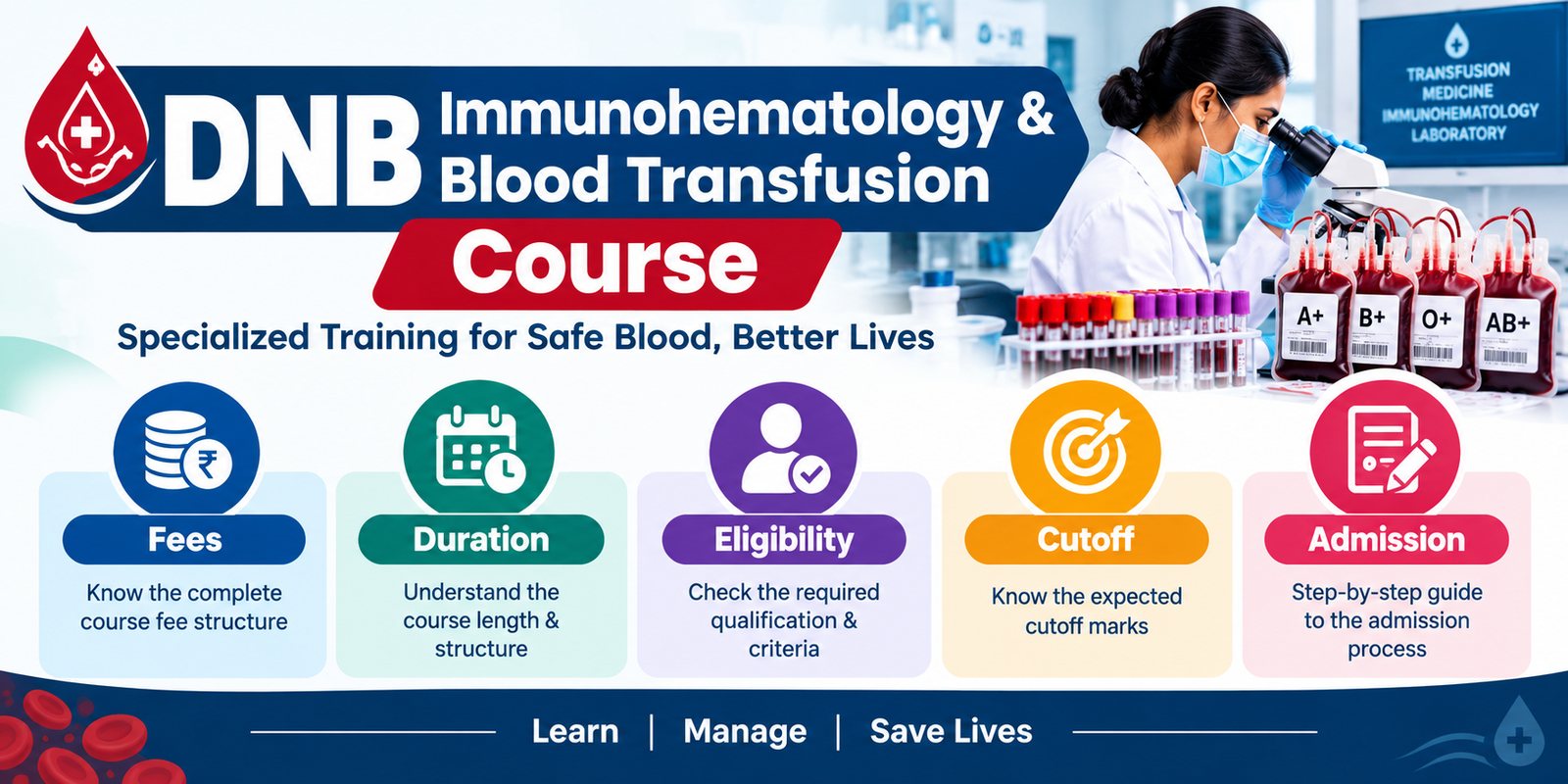
That work belongs to immunohematology and blood transfusion, also called transfusion medicine. The three-year DNB Immunohematology & Blood Transfusion course trains MBBS graduates to manage blood donation, testing, component preparation and clinical transfusion support. It goes well beyond what a doctor learns about blood groups during MBBS.
Admission to the post-MBBS DNB course is through NEET-PG, followed by counselling and allotment to an institution accredited by the National Board of Examinations in Medical Sciences (NBEMS). The specialty has relatively few accredited seats, so applicants should judge their chances against actual seat matrices and allotment results, not a single rank quoted online.
What is DNB Immunohematology & Blood Transfusion?
DNB stands for Diplomate of the National Board. Immunohematology is the study of blood groups and the immune reactions that matter when blood is transfused. Blood transfusion practice includes selecting donors, testing donated blood, preparing and storing components, checking compatibility, advising clinicians and investigating adverse reactions.
The specialist’s workplace is often a blood centre and hospital transfusion service, but this is not purely a laboratory job. A transfusion medicine doctor may assess a donor who has become unwell, advise on blood products for a newborn or a patient with repeated transfusions, and plan a procedure called apheresis, in which selected blood components are collected or removed.
NBEMS describes the role as a mix of clinical consultation, laboratory direction, blood component oversight, inventory decisions and compliance with applicable standards. Graduates may lead transfusion services, teach, conduct research or pursue focused training where eligible.
Course highlights
|
Particular |
Details |
|
Course Name |
DNB Immunohematology & Blood Transfusion |
|
Degree |
Diplomate of National Board |
|
Level |
Postgraduate broad specialty |
|
Duration |
Three years |
|
Basic Qualification |
MBBS |
|
Entrance Exam |
NEET-PG |
|
Admission Process |
NEET-PG result, counselling registration, choice filling, allotment and reporting |
|
Training Type |
Supervised blood centre, laboratory and clinical transfusion training |
|
Major Focus |
Donor care, blood grouping, compatibility testing, component therapy, apheresis and transfusion safety |
|
Further Study |
Eligible fellowships and focused training, subject to programme rules |
|
Career Areas |
Hospital transfusion services, blood centres, teaching, research and related clinical services |
Duration: how the three years develop
The post-MBBS DNB course lasts three years. Residents rotate through the department’s major services and relevant clinical and laboratory areas. NBEMS describes those rotations by training area, rather than prescribing that every resident must spend the same named posting in the same academic year. The year-by-year progression below explains how responsibility typically grows.
Year 1: Learning the chain from donor to patient
A new resident first has to understand how a unit of blood becomes a safe product for clinical use. That starts with donor assessment and collection, then moves through testing, component preparation, labelling, storage and issue.
In the laboratory, residents practise blood grouping and compatibility work under supervision. They learn why correct identification at every step matters: a technically sound test cannot protect a patient if the sample or unit belongs to someone else. They also attend teaching sessions and begin recording their work in a logbook.
Year 2: Solving problems, not just following steps
The work becomes less routine. A patient may have unexpected antibodies. A donor may react during collection. A ward may urgently request a component that is in short supply. Residents learn to investigate, discuss options with senior staff and communicate clearly with the treating team.
Training expands through transfusion-transmitted infection screening, component quality control and apheresis. Exposure to related clinical departments helps residents understand why a surgeon, obstetrician, haematologist or intensive care doctor is requesting a particular product.
Year 3: Taking a wider view of safety
By the final year, residents should be able to assess more complex requests under supervision, investigate transfusion reactions, contribute to apheresis planning and review how blood is used across the hospital. They must think about both the individual patient and the reliability of the service.
Academic work, research requirements and preparation for the DNB final examination continue. NBEMS’s curriculum distinguishes skills expected during early exposure from the higher level of responsibility expected by the third year, and requires a certified record of training for practical assessment.
Eligibility for DNB Immunohematology & Blood Transfusion
For the standard post-MBBS route, a candidate generally needs to:
- Hold an eligible MBBS degree or provisional pass certificate under the applicable Indian medical education rules.
- Complete the compulsory rotating internship by the deadline set for the admission session.
- Have the required medical registration, provisional or permanent as permitted by the current examination rules.
- Appear for NEET-PG and meet its applicable qualifying requirement.
- Meet counselling and seat-specific conditions, including any relevant category and document requirements.
The National Medical Commission (NMC) sets medical education and registration standards. NBEMS conducts NEET-PG and administers DNB training. Internship and document deadlines can change, so read the current NEET-PG information bulletin before applying.
Admission process, step by step
- Finish MBBS and internship. Gather degree or provisional qualification documents, internship proof and registration records.
- Apply for and take NEET-PG. This is the examination used for the post-MBBS DNB route.
- Check the result and rank. Meeting the qualifying requirement makes an eligible candidate able to participate in admission; it does not guarantee a seat.
- Register for counselling. The Medical Counselling Committee (MCC) handles the standard post-MBBS DNB counselling route. Follow its current schedule and seat matrix.
- Fill choices in genuine preference order. Choose the course at specific institutions. Find out what each offers in donor services, immunohematology, component preparation and clinical consultation.
- Review the allotment. Read the rules for the round before accepting a seat or seeking an upgrade.
- Report to the allotted institution. Complete document verification, payment and joining requirements by the notified deadline.
INI-CET is a separate PG entrance examination for participating Institutes of National Importance. It is not the exam used to enter a standard post-MBBS DNB seat through NEET-PG counselling.
Fees: why the institution label can mislead
There is no single all-inclusive fee for every DNB Immunohematology & Blood Transfusion seat. Families need to account for the NBEMS course fee, counselling and examination payments, and accommodation. A training stipend affects the overall budget, but it should be considered separately from money due at admission.
DNB seats are offered through NBEMS-accredited hospitals or institutions. A government or private college label may refer to a different MD course, with a different fee schedule.
|
Common fee-table category |
How to read it for a DNB seat |
|
Government College |
Confirm whether the listed seat is DNB or MD. Use the written charges for the actual DNB seat. |
|
State Government College |
State MD fees do not automatically apply to a DNB seat at an associated hospital. |
|
Private College |
Check the accredited DNB programme’s joining terms rather than assuming the college’s private MD tuition applies. |
|
Deemed University |
A deemed-university MD seat and a DNB seat are separate choices with separate payment rules. |
|
Management Quota |
Do not assume this is a standard admission category for DNB. Follow the category shown in official counselling material. |
Ask for an itemised statement covering course or tuition fees, any applicable institutional or university fee, registration and examination fees, hostel and mess charges, and refundable deposits. Check when payments fall due and what happens if a seat is surrendered under the counselling rules. Verify the final amount with current NBEMS guidance and the allotted institution’s written terms.
What does the cutoff mean?
A NEET-PG qualifying cutoff tells you whether a candidate meets the examination’s qualifying requirement for their category. A closing rank tells you the rank at which a particular seat was last allotted in a counselling round. Qualifying for NEET-PG and being likely to secure this specialty are different matters.
Closing ranks must be read by institution, category, quota and round. They can shift with the number of seats offered, an institution’s reputation and location, government or private status, candidates’ choices and movement between rounds. Year-to-year competition changes them too. This is a small specialty in the DNB seat listings, which makes a single national “cutoff rank” particularly misleading. Use the current MCC seat matrix and relevant previous allotment results for comparison.
What rank or score is needed?
No universal NEET-PG score or rank secures DNB Immunohematology & Blood Transfusion. Start with the seats in the current counselling matrix and the categories for which you are eligible. Then compare recent official allotments for the same institution, category, quota and round where available.
Next, examine the training. A hospital may have an active surgical service but limited exposure to therapeutic apheresis; another may offer broad laboratory work but a different mix of clinical consultations. Ask where residents rotate, what they do themselves under supervision and how often they discuss difficult cases with clinicians.
Fill a broad preference list if several institutions are acceptable. Rank them in your real order of choice. Leaving an acceptable seat off the list reduces your options; putting an institution you would never join on the list creates another problem.
DNB Immunohematology & Blood Transfusion syllabus
The subject connects laboratory science with decisions made at a patient’s bedside. Major areas include:
- Blood groups and immunohematology: ABO and Rh typing, other clinically significant antigens, antibody screening and identification.
- Pre-transfusion testing: Sample and patient identification, compatibility testing, crossmatching and special testing when routine results do not agree.
- Donor management: Donor eligibility, counselling, collection, adverse reactions and care after donation.
- Blood components: Preparation, labelling, storage, quality control and appropriate use of red cells, platelets, plasma and other components.
- Transfusion-transmitted infections: Screening methods, interpretation, donor follow-up and safe handling of biological material.
- Clinical transfusion practice: Choosing products for patients, supporting those who receive repeated transfusions, and recognising and investigating reactions.
- Apheresis: Donor procedures, therapeutic applications, patient assessment and complications.
- Service management and research: Inventory decisions, quality systems, records, clinical audit, ethics and research methods.
NBEMS’s curriculum includes rotations in donor management, component preparation, infection screening, immunohematology, compatibility testing and quality systems, with additional experience in allied clinical and laboratory departments.
Practical training: what residents actually do
A resident may interview a prospective donor in the morning, investigate an unusual antibody in the laboratory and discuss a difficult transfusion request with a clinical team later that day. The specialty requires steady hands, but it also requires judgement and communication.
Practical work includes supervised blood collection, blood grouping, antibody workups, crossmatching, component preparation and quality checks. Residents learn to assess donor reactions and transfusion reactions. Where the service offers it, they participate in donor and therapeutic apheresis. Clinical exposure connects laboratory findings to patients in settings such as surgery, obstetrics, haematology and intensive care.
Before choosing a training institution, ask how much of that work a resident performs, which services are available on site, and what arrangements exist for allied postings. A busy blood bank alone does not tell you how well it teaches.
Career scope after DNB Immunohematology & Blood Transfusion
Graduates can work in hospital transfusion services and blood centres, providing clinical advice and helping direct testing, component supply and quality systems. Larger centres may offer work involving apheresis, transplant support or complex compatibility problems.
Teaching and research are further options, subject to the eligibility rules of the institution hiring them. Doctors interested in a narrow area can investigate relevant fellowships or focused training programmes, but should check each programme’s entry requirements before treating it as a guaranteed next step.
Salary and earning potential
There is no reliable salary figure that covers all graduates. Pay varies with employer type, city, public or private sector, experience, responsibilities and the services the centre provides. A salaried hospital role differs from a senior position directing a large transfusion service.
When comparing residency seats, look first at the training that can be demonstrated: the range of cases, laboratory supervision, clinical consultations and apheresis exposure. Those experiences will shape the work a graduate is qualified to take on.