A patient with cancer has a scan to find out where the disease has spread. Another receives a radioactive medicine to treat a thyroid condition. Both may be cared for by a nuclear medicine specialist, but the doctor’s work is more than reading images or giving an injection. It involves choosing the right study or treatment, preparing the patient, interpreting the result and using radioactive materials safely.
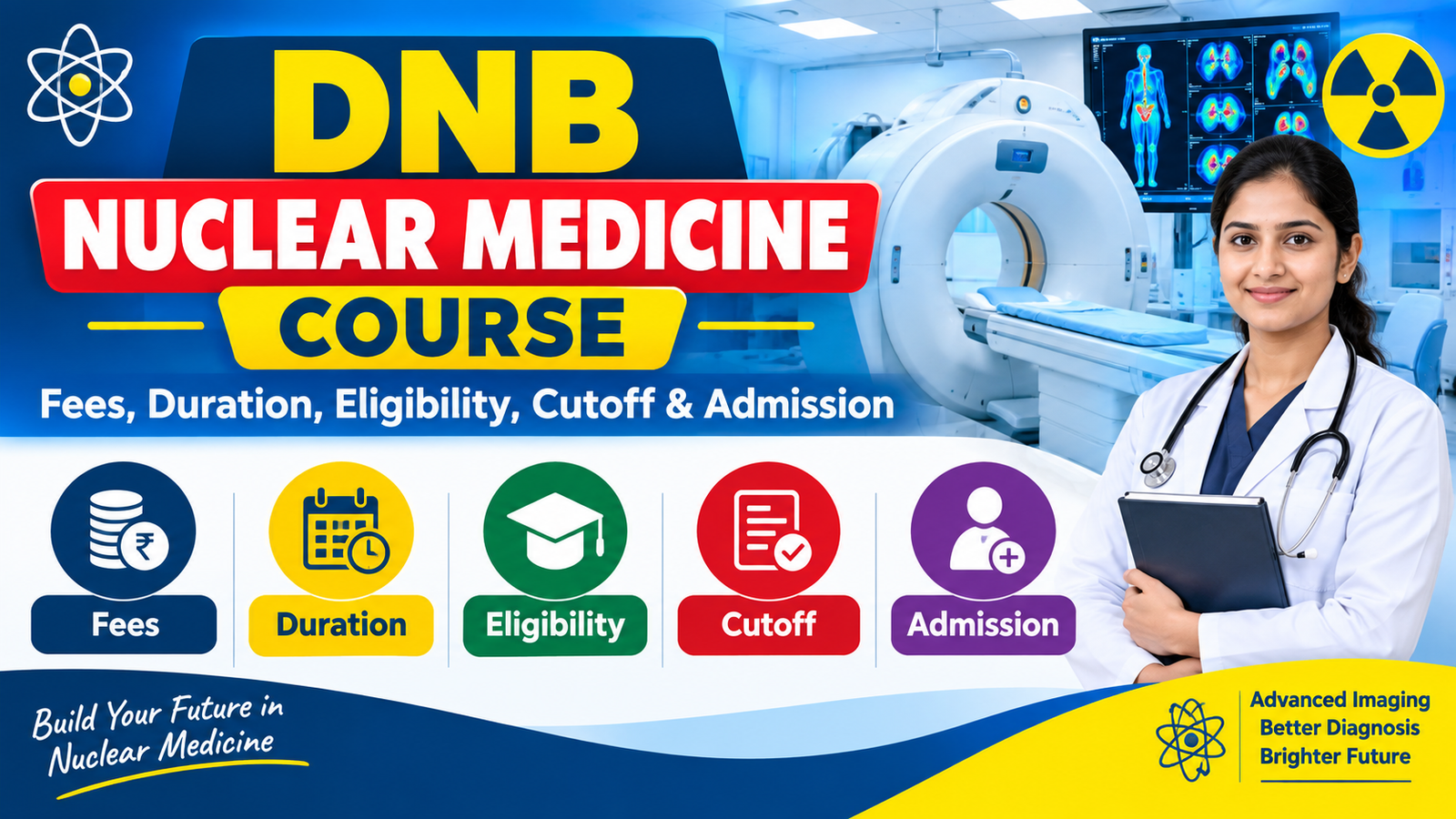
DNB Nuclear Medicine is postgraduate medical training for doctors who have completed MBBS. MBBS introduces the science and clinical uses of imaging; this course develops specialist skills in nuclear medicine imaging and radionuclide treatment. The standard post-MBBS route lasts three years. Candidates enter through NEET-PG, then seek a seat through counselling at a training institution accredited by the National Board of Examinations in Medical Sciences (NBEMS).
There is also a separate post-diploma DNB route for eligible diploma holders. It has different entry requirements and counselling. An MBBS graduate looking at NEET-PG should focus on the three-year post-MBBS seats, rather than combining results from the two routes.
What is DNB Nuclear Medicine?
DNB means Diplomate of National Board. Nuclear Medicine uses small amounts of radioactive substances, called radiopharmaceuticals, to study how the body functions and, in selected conditions, to deliver treatment. A scan can show activity in tissue that an anatomical image alone may not explain.
The work includes patient assessment, choosing an appropriate test, interpreting images and discussing findings with the referring doctor. Specialists may also help select patients for radionuclide therapy, explain its benefits and risks, and arrange follow-up. Nuclear Medicine is closely connected with oncology, endocrinology, cardiology and other clinical fields.
A DNB graduate may work in a hospital imaging and therapy service, join a cancer centre, teach or take part in research. Some pursue focused training in areas such as molecular imaging or radionuclide therapy, subject to each programme’s entry rules. NBEMS’s curriculum covers diagnostic imaging, radiopharmaceuticals, therapy and radiation protection.
Course highlights
|
Particular |
Details |
|
Course Name |
DNB Nuclear Medicine |
|
Degree |
Diplomate of National Board |
|
Level |
Postgraduate broad specialty |
|
Duration |
Three years for the post-MBBS route; a separate post-diploma route exists for eligible candidates |
|
Basic Qualification |
MBBS for the three-year route |
|
Entrance Exam |
NEET-PG for the post-MBBS route |
|
Admission Process |
Entrance result, counselling registration, choice filling, allotment and reporting |
|
Training Type |
Supervised imaging, clinical assessment, therapy exposure, academic work and radiation safety training |
|
Major Focus |
Nuclear medicine imaging, radiopharmaceuticals, radionuclide therapy and safe practice |
|
Further Study |
Eligible fellowships and focused training, subject to programme rules |
|
Career Areas |
Hospitals, imaging centres, cancer services, teaching and research |
Duration: how training progresses
The post-MBBS DNB course lasts three years. The sequence of duties depends on the accredited institution and its facilities. The outline below describes how a resident’s responsibility grows; it is not a claim that every hospital gives the same posting in the same month.
Year 1: Learning the science and the workflow
A new resident has to understand what a radiopharmaceutical does, how an image is produced and why a scan may be useful for one clinical question but not another. Basic physics matters here. So do anatomy, physiology and careful patient history-taking.
Residents learn how patients are prepared, how studies are acquired, and how equipment and images are checked for technical problems. Radiation protection is taught from the start. The NBEMS curriculum includes the principles of SPECT, PET and hybrid imaging such as SPECT/CT and PET/CT, along with quality control and image processing.
Year 2: Connecting scans to clinical decisions
The resident begins interpreting a broader range of studies under supervision. A scan must be read in light of the patient’s symptoms, earlier imaging, laboratory results and treatment history. An area of uptake is a finding to investigate, not automatically a diagnosis.
Exposure may include oncology, thyroid and other endocrine conditions, cardiac studies, kidney assessment and neurological applications. Residents also learn to recognise misleading images caused by patient preparation, normal variation or technical error. Teaching sessions, case discussions and research work run alongside clinical duties.
Year 3: Greater responsibility in imaging and therapy
Senior residents take a larger role in planning studies, reporting findings and discussing cases with treating teams under consultant supervision. Where the institution is authorised and equipped to provide treatment, residents gain experience in patient selection, counselling, safe delivery and follow-up for radionuclide therapy.
The final year also brings preparation for DNB assessment. A specialist must be able to explain why a study or treatment is appropriate, what its limitations are and what the result means for the patient’s next decision.
Eligibility for DNB Nuclear Medicine
For the three-year post-MBBS route, a candidate generally needs to:
- Hold an eligible MBBS degree or provisional pass certificate under the applicable medical education rules.
- Complete the compulsory rotating internship by the deadline set for that admission session.
- Have the required medical registration, provisional or permanent as allowed by the current examination rules.
- Appear for NEET-PG and meet its applicable qualifying requirement.
- Meet counselling and seat-specific conditions, including document and category requirements where relevant.
The National Medical Commission (NMC) governs medical education and registration standards. NBEMS conducts NEET-PG and administers DNB training. Eligible post-diploma applicants follow a different entrance and admission pathway; they should use the current NBEMS post-diploma bulletin. For either route, check the current examination and counselling documents for internship dates and eligibility details.
Admission process, step by step
For an MBBS graduate applying to the three-year course:
- Finish MBBS and internship. Prepare your qualification, internship and registration documents.
- Apply for and take NEET-PG. This is the entrance examination for the post-MBBS DNB route.
- Review the result and rank. Qualifying permits an eligible candidate to proceed; it does not guarantee a Nuclear Medicine seat.
- Register for counselling. The Medical Counselling Committee (MCC) administers counselling for the standard post-MBBS DNB route alongside other PG medical courses. Read its current schedule and DNB seat matrix.
- Fill choices in genuine preference order. Research each institution’s imaging workload, therapy facilities, supervision, location and costs.
- Check the allotment. Follow that round’s rules on accepting a seat, seeking an upgrade or joining a later round.
- Report to the allotted institution. Complete document verification, payments and joining formalities within the notified deadline.
INI-CET is the separate entrance examination for PG courses at participating Institutes of National Importance. It is not the entrance exam for the standard post-MBBS DNB Nuclear Medicine route.
Fees: what belongs in the budget?
There is no single all-inclusive DNB Nuclear Medicine fee. NBEMS course fees, counselling payments, examination charges and living costs are separate items. Residents receive a stipend under applicable training rules, but families should not subtract an assumed stipend from the amount due at joining.
The usual government, private and deemed-university college comparison needs care. DNB seats are attached to NBEMS-accredited hospitals or institutions. An MD Nuclear Medicine seat at a college and a DNB seat at an associated hospital may have different terms.
|
Common fee-table category |
What to check for DNB Nuclear Medicine |
|
Government College |
Confirm that the advertised seat is DNB rather than MD; read the charges for the actual course. |
|
State Government College |
A state MD fee schedule does not automatically apply to an associated DNB seat. |
|
Private College |
Check the accredited DNB seat’s joining terms instead of assuming private MD tuition applies. |
|
Deemed University |
Deemed-university MD and DNB seats are separate choices with different payment arrangements. |
|
Management Quota |
Do not assume this is a standard DNB admission category. Follow the official seat matrix and counselling route. |
Ask for an itemised account of course or tuition fees, any applicable institutional or university fee, registration and exam fees, hostel and mess charges, and refundable deposits. Check payment dates and refund conditions. Use the current NBEMS rules, MCC documents and the allotted institution’s written terms for the final budget.
Understanding the cutoff
A NEET-PG qualifying cutoff is the examination threshold under the rules for a candidate’s category. A closing rank is the rank at which a specific seat was last allotted in a counselling round. The first establishes qualification; the second helps a candidate judge past competition for a seat.
Closing ranks differ by institution, category, quota and round. They can move when the number of seats changes, candidates choose different specialties, a hospital becomes more sought after, or seats open in later rounds. Government or private status, location and year-to-year competition also affect demand.
For Nuclear Medicine, compare the post-MBBS DNB seat matrix with post-MBBS allotment results. Do not mix those results with the separate post-diploma route. MCC’s current seat matrix and round notices are the proper starting point; previous closing ranks cannot promise a current-year allotment.
What rank or score is needed?
No universal NEET-PG score or rank secures DNB Nuclear Medicine. Find the seats available in the current round, identify the categories for which you qualify and compare recent official allotments for the same course, institution, quota, category and round.
Then look at training. Does the centre offer both SPECT and PET work? What range of patients does it see? Is radionuclide therapy available, and what role do residents have in it? How are difficult scans reviewed with consultants? These questions matter because institutions can differ substantially in the services they provide.
Fill a broad list of places you would genuinely join, in your true order of preference. A short list confined to a few well-known centres may leave acceptable options unused. Broad choice filling cannot create a seat, but it allows more of your preferences to be considered.
DNB Nuclear Medicine syllabus
The course combines clinical medicine, imaging science and patient safety. Major areas include:
- Radiation physics and protection: Radioactive decay, measurement, exposure control, safe handling and patient-specific precautions.
- Instrumentation and imaging: Gamma cameras, SPECT, PET, hybrid imaging, image processing and equipment quality control.
- Radiopharmaceuticals: How tracers are selected, prepared and used, and how their behaviour affects interpretation.
- Clinical diagnostic imaging: Applications in oncology, thyroid and endocrine disease, cardiology, neurology, kidney and other organ systems.
- Image interpretation: Normal patterns, disease findings, technical artefacts, false positives and false negatives.
- Radionuclide therapy: Patient selection, preparation, consent, treatment principles and follow-up for relevant conditions.
- Research and professional practice: Evidence appraisal, communication with referring teams, documentation and service quality.
The NBEMS curriculum covers PET and SPECT imaging, oncological and other diagnostic applications, radionuclide therapies and radiation protection. Availability of particular techniques for hands-on training depends on the accredited centre.
Practical training and radiation safety
Residents work with patients before and after a scan, review the referral question, check preparation and help interpret images under supervision. They learn to recognise when the scan answers the question—and when further clinical or anatomical imaging is needed. Case discussions with oncologists and other specialists are an important part of that judgement.
Therapy adds another layer: assessing suitability, explaining treatment, planning follow-up and protecting patients, staff and others from unnecessary exposure. India’s Atomic Energy Regulatory Board (AERB) sets requirements for nuclear medicine facilities and the use of radiation in these services. Training should take place within the institution’s authorised facilities and safety procedures.
When assessing a seat, ask which imaging and therapy services are actually running, how much supervised reporting residents do, and how radiation safety is taught in daily practice.
Career scope after DNB Nuclear Medicine
Graduates may work in hospital nuclear medicine departments, cancer centres and diagnostic services. Their responsibilities can include clinical consultation, scan interpretation, participation in radionuclide therapy and collaboration with oncology and other teams.
Teaching and research are possible where the graduate meets a post’s eligibility requirements. Focused training in molecular imaging or therapeutic applications may be available through relevant programmes, each with its own entry rules.
Salary and earning potential
Pay varies with employer type, city, public or private sector, experience and clinical responsibilities. A position in a hospital diagnostic department differs from a role at a centre providing a wider range of imaging and radionuclide therapy. No single salary figure describes both.
For a student choosing a residency, the more useful comparison is the training available at the allotted centre: patient mix, supervised interpretation, therapy exposure and radiation safety practice. Those will determine which roles the graduate is ready to take on.