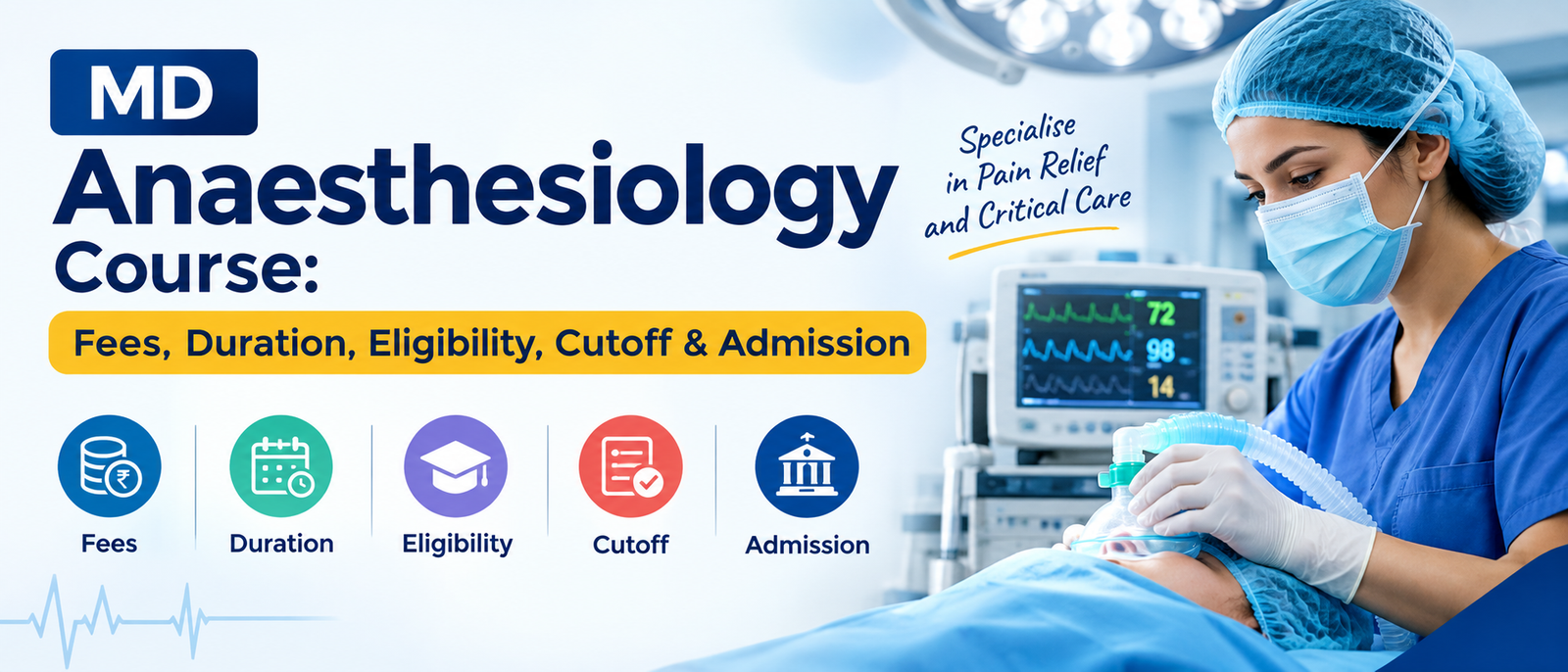
MD Anaesthesiology is a postgraduate medical degree for doctors who want to specialise in caring for patients before, during and after surgery. The work reaches beyond the operating theatre: anaesthesiologists also manage pain, support patients in intensive care and respond to medical emergencies.
During the course, doctors learn to assess patients before procedures, plan and administer anaesthesia, monitor vital functions, and manage complications. Training combines medical knowledge with supervised clinical decisions, often in situations where a patient’s condition can change quickly.
An MBBS degree gives a doctor a broad foundation across medicine and surgery. MD Anaesthesiology builds on that foundation through focused specialist training in anaesthesia, perioperative care, resuscitation and related areas.
Admission to most MD Anaesthesiology seats in India involves NEET-PG followed by counselling through the relevant authority. Seats at some institutes may follow a different notified entrance and counselling route, so applicants should check the process for each institution. The number of available seats and the level of competition vary by college, category and counselling round.
What is MD Anaesthesiology?
MD Anaesthesiology is a specialist degree in the safe use of anaesthesia and the care surrounding medical and surgical procedures. An anaesthesiologist evaluates whether a patient is ready for a procedure, chooses an appropriate anaesthesia plan, monitors the patient throughout and oversees recovery.
The specialty calls for close teamwork with surgeons, physicians, nurses and intensive care staff. It also demands an understanding of how illness, medicines and surgery affect breathing, circulation and consciousness. The National Medical Commission’s competency based curriculum describes training in clinical care, research and teaching alongside procedural skills.
After the degree, doctors may work in hospitals, teaching institutions, critical care services or pain services, depending on their training and the role’s requirements. Those who want further study can explore options such as critical care medicine and other relevant super specialty or fellowship programmes. Eligibility for each advanced programme must be checked against its current feeder qualification rules.
Course Highlights
|
Particular |
Details |
|
Course Name |
MD Anaesthesiology |
|
Degree |
Doctor of Medicine (MD) |
|
Level |
Postgraduate medical degree |
|
Duration |
Generally three years for the standard MD degree |
|
Basic Qualification |
Recognised MBBS qualification |
|
Entrance Exam |
Usually NEET-PG; check institute specific routes where applicable |
|
Admission Process |
Entrance result followed by the relevant counselling and seat allotment process |
|
Training Type |
Supervised clinical work, academic teaching, procedural training and research |
|
Major Focus |
Anaesthesia, perioperative care, resuscitation, pain management and critical care exposure |
|
Further Study |
Eligible super specialty courses and fellowships, subject to current entry rules |
|
Career Areas |
Hospitals, operating theatres, intensive care, pain services, teaching and research |
Duration and admission requirements should be confirmed in the current NMC regulations, examination bulletin and institution prospectus.
MD Anaesthesiology Duration
The standard MD Anaesthesiology course generally runs for three years. Residents learn through supervised patient care, departmental teaching, assessments and research work. The exact posting schedule can differ between institutions; the year wise outline below shows a typical progression rather than a fixed national timetable.
Year 1: Build the clinical foundation
Residents usually begin with preoperative assessment, basic airway skills, monitoring, anaesthesia equipment and the medicines commonly used in anaesthesia. They observe and assist with cases, then take on tasks under supervision as their skills develop.
Year 2: Handle a wider range of cases
Training generally expands to different surgical specialties, regional anaesthesia, postoperative care and the management of patients with more complex health conditions. Residents also spend time studying complications, emergency responses and critical care.
Year 3: Develop independent judgment
Senior residents typically take greater responsibility for planning care, managing difficult cases and guiding junior trainees, while continuing to work under appropriate supervision. They complete academic and research requirements and prepare for the final examination.
Confirm the current course duration, postings and assessment requirements with the admitting institution and applicable NMC documents.
MD Anaesthesiology Eligibility Criteria
- Base degree: You need an MBBS qualification recognised for postgraduate medical admission in India.
- Internship: You must complete the required compulsory rotating internship by the deadline stated for that admission session.
- Registration: You must meet the medical registration requirements specified in the current examination and counselling documents.
- Entrance exam: For seats filled through NEET-PG, you must appear in the examination and meet the applicable eligibility conditions. Some institutes may notify a separate admission route.
- Qualifying requirements: You must satisfy the applicable qualifying criteria and any document, category or institutional conditions for the seat you seek.
Check the latest official examination bulletin and counselling prospectus before applying. Internship deadlines, document requirements and qualifying criteria are session specific.
MD Anaesthesiology Admission Process
Step 1: Complete MBBS and internship
Finish your recognised MBBS course and the required internship within the deadline for your intended admission session. Keep your degree or provisional certificate, internship documents and registration records ready.
Step 2: Apply for the entrance examination
Register for NEET-PG if your target seats use that route. Read the current National Board of Examinations in Medical Sciences (NBEMS) bulletin carefully for eligibility, deadlines and application instructions.
Step 3: Check your result and eligibility
After the result is released, review your score, rank and qualifying status. An entrance result alone does not secure a seat; admission depends on counselling eligibility, available choices and allotment rules.
Step 4: Register for the right counselling process
Register with the Medical Counselling Committee (MCC) or the relevant state or institutional counselling authority, depending on the seats you are targeting. MCC handles specified postgraduate seat categories, including All India Quota and deemed university seats; state authorities run their respective processes.
Step 5: Fill and order your choices
Make a realistic preference list. It may include MD Anaesthesiology seats in central or other participating institutions, government medical colleges, private colleges and deemed universities, according to the counselling portal’s available options.
Order choices by what you would actually accept. Look at training exposure, location, fee structure and service obligations as well as the college’s name.
Step 6: Review seat allotment
The counselling authority allots seats according to its published rules, your merit position, choices and seat availability. Read the allotment notice for the deadline and any required action.
Step 7: Report and complete admission
Report as instructed, submit documents for verification and complete the applicable payment and joining formalities. Follow the current round’s rules if you want to participate in a later round.
MD Anaesthesiology Fees
There is no single fixed fee for MD Anaesthesiology in India. The payable amount depends on the institution, state, seat category and current fee orders. A college’s tuition figure may also leave out hostel charges, deposits or other costs.
|
College or seat type |
General fee pattern |
|
Government College |
Tuition is often comparatively lower, but the total varies by state and institution. |
|
State Government College |
Fees follow the relevant state or institutional rules and can differ across states. |
|
Private College |
Fees are generally higher than many government options and depend on the approved fee structure. |
|
Deemed University |
The university publishes its own applicable fee schedule, subject to relevant rules. |
|
Management Quota |
Where this category applies, its notified fee may differ from other seat categories at the same institution. |
When comparing offers, ask for the complete written fee schedule, including:
- Tuition and admission charges
- University and examination fees
- Hostel and mess charges
- Refundable security deposits
- Library, laboratory or other institutional charges
- Any applicable bond, service or exit conditions
Fees and charges can change. Verify every amount, payment deadline, refund rule and seat category against the official counselling notice and the college’s current fee document before paying.
MD Anaesthesiology Cutoff
“Cutoff” can mean several different things in PG medical admissions. It may refer to the NEET-PG qualifying criterion, the last rank allotted to a college, or the closing rank for a particular category, quota and counselling round.
That is why a cutoff from one college or year cannot answer every applicant’s question. Even within the same institution, the closing position can change between rounds as candidates join, upgrade or leave seats available.
Past cutoffs are only a guide. Verify current qualifying criteria and round wise allotment data through the official examination and counselling authorities.
What Determines the Cutoff?
- Seat count: The number of MD Anaesthesiology seats available in the relevant seat pool affects competition.
- College preference: Candidates may place institutions with strong clinical exposure or a preferred location higher on their lists.
- Government or private status: Cost and institutional preferences can influence demand.
- Category: Applicable reservation and eligibility rules affect category wise allotments.
- Quota: All India, state and other notified seat pools are assessed under their own rules.
- Counselling round: Seats and candidate choices change as counselling progresses.
- Year to year competition: Applicant preferences and the available seat matrix are not identical every session.
Rank or Score Required for MD Anaesthesiology
There is no universal NEET-PG score or rank that guarantees MD Anaesthesiology. Your chances depend on which seats you mean: a sought after government college, a state quota seat and a private college seat may have very different allotment patterns.
To assess your options, check your category and counselling eligibility first. Then compare recent official round wise allotments for the colleges you could attend, alongside the current seat matrix and fee schedules.
Build a broad preference list that includes ambitious choices and options you would realistically join. Keep the order true to your preferences, and review it whenever the counselling authority opens an edit window.
Previous closing ranks and scores do not predict admission. Use the current official seat matrix, counselling rules and allotment results for decisions.
MD Anaesthesiology Syllabus
The syllabus brings together basic sciences, clinical decision making and repeated practice with patients. Exact teaching plans vary by institution, but the NMC curriculum covers the core knowledge and competencies expected of an anaesthesiology trainee.
Applied basic sciences
- Anatomy relevant to the airway, spine, nerves and vascular access
- Physiology of breathing, circulation and organ function
- Pharmacology of anaesthetic, analgesic and related medicines
Preoperative assessment
- Medical history, examination and risk assessment
- Reviewing coexisting illnesses and investigations
- Preparing an anaesthesia plan and discussing it with the patient
General and regional anaesthesia
- Anaesthesia techniques, monitoring and recovery
- Airway management and ventilation
- Spinal, epidural and peripheral nerve techniques
Specialty specific care
- Anaesthesia for different surgical disciplines
- Care of patients across age groups and clinical conditions
- Obstetric, emergency and trauma related considerations
Critical care, pain and emergencies
- Resuscitation and management of unstable patients
- Postoperative and intensive care principles
- Acute and chronic pain assessment and management
Academic work and professional practice
- Reading and evaluating medical evidence
- Research methods, presentations and dissertation work
- Communication, consent, patient safety and teamwork
Practical Training in MD Anaesthesiology
Practical training is central to the degree. Residents assess patients before procedures, prepare equipment and medicines, assist with or administer anaesthesia under supervision, monitor patients during operations and manage recovery afterward.
They also practise airway techniques, vascular access, regional anaesthesia and responses to emergencies. Clinical exposure can include operating theatres, postoperative recovery areas, intensive care units and pain services, according to the institution’s facilities and rotation plan.
The goal is more than learning a procedure. A resident must learn when a technique is suitable, how to spot trouble early and when to ask for help. Supervision and responsibility should progress with demonstrated competence.
Career Scope After MD Anaesthesiology
- Hospital anaesthesiologist: Provide anaesthesia and perioperative care for surgical and other procedures.
- Critical care roles: Work with intensive care teams, subject to the position’s training and credential requirements.
- Pain services: Help assess and manage acute or chronic pain, with further focused training where needed.
- Teaching: Train medical students and residents after meeting the applicable faculty eligibility requirements.
- Research: Study patient safety, medicines, monitoring, pain care or other questions in the specialty.
- Further specialisation: Apply for an eligible super specialty course or fellowship after checking its current feeder qualifications and selection process.
MD Anaesthesiology Salary
Pay after MD Anaesthesiology varies widely, so a single figure would give a misleading picture. A doctor’s income depends on the employer, city, public or private sector, experience, working hours and the kind of clinical work involved.
A hospital appointment, an academic post and independent or group practice can also have different payment structures. When considering a role, compare the full terms: duties, on call work, benefits, professional support and opportunities to develop further skills.