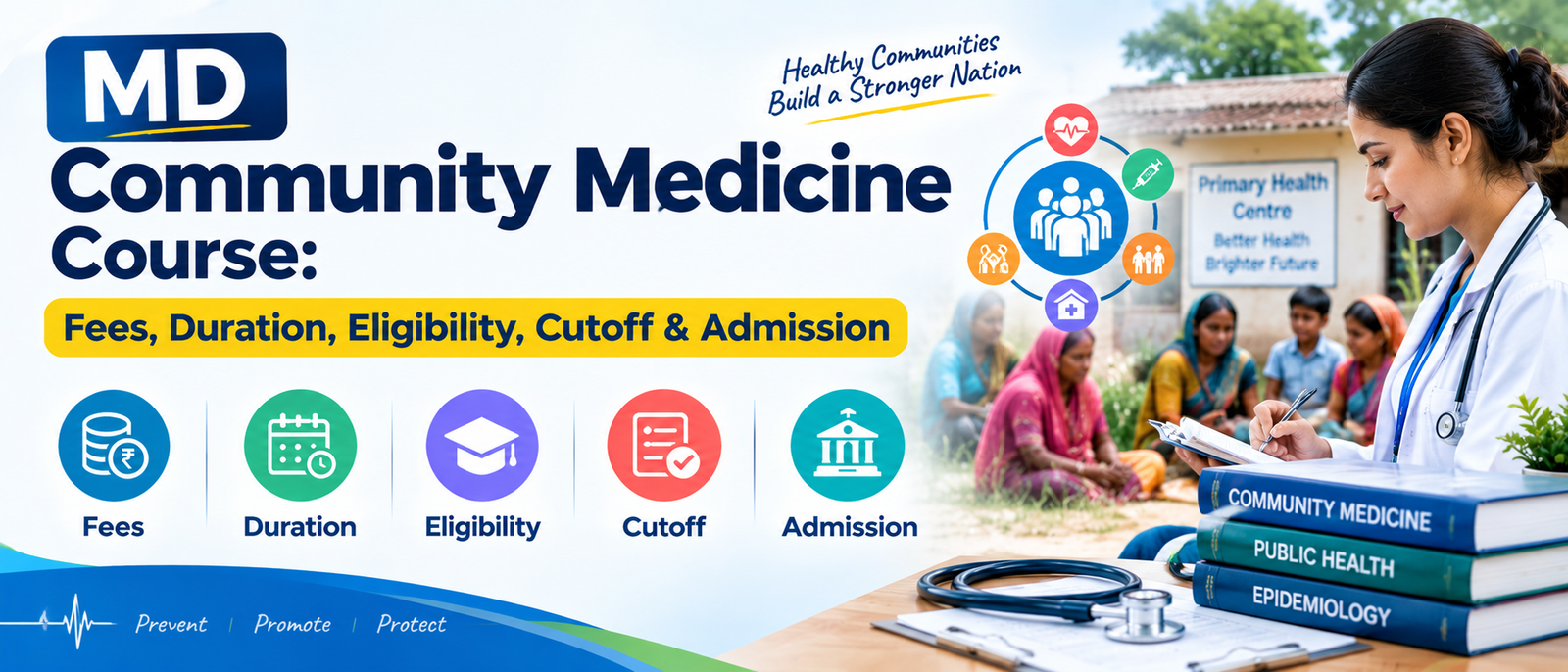
MD Community Medicine is a postgraduate medical course for doctors who want to work on health problems affecting groups of people, from a neighbourhood to an entire district. It suits those interested in prevention, disease patterns, health programmes, research and medical teaching.
The course asks questions that a busy clinic may not have time to answer. Why are cases rising in one area? Which people are missing out on care? Is a health programme reaching the community it was designed for? Residents learn to investigate such questions using fieldwork, epidemiology and data.
MBBS prepares a doctor to assess and treat individual patients across a range of specialties. MD Community Medicine builds on that medical foundation, with greater attention to populations, health systems and the social conditions that shape illness.
Admission generally follows an entrance examination and counselling. NEET-PG is the usual route for MD seats, though applicants should check the notified process for each institution.
Competition varies by college, quota, category and counselling round. A previous closing rank can offer context, but it cannot tell a candidate exactly where a seat will be allotted this time.
What is MD Community Medicine?
MD Community Medicine is a specialist medical degree focused on improving health at the population level. It combines clinical understanding with epidemiology, biostatistics, disease prevention, health education and the organisation of health services.
Residents learn to assess a community’s health needs, investigate disease patterns and evaluate interventions. They may work with primary care teams, collect and analyse field data, and study how programmes operate on the ground. The National Medical Commission’s (NMC) competency based curriculum includes field postings as part of training.
The degree can lead to work in medical colleges, public health programmes, research organisations and health administration, depending on a post’s requirements. Graduates may pursue further focused training in areas such as epidemiology, implementation research, health policy, environmental health or medical education. Entry to any advanced programme depends on its current eligibility rules.
Course Highlights
|
Particular |
Details |
|
Course Name |
MD Community Medicine |
|
Degree |
Doctor of Medicine (MD) |
|
Level |
Postgraduate medical course |
|
Duration |
Generally three years for the standard MD course |
|
Basic Qualification |
Recognised MBBS qualification |
|
Entrance Exam |
Usually NEET-PG; check institution specific routes where applicable |
|
Admission Process |
Entrance result followed by relevant counselling and seat allotment |
|
Training Type |
Fieldwork, public health practice, teaching and research |
|
Major Focus |
Epidemiology, prevention, primary care and health systems |
|
Further Study |
Research degrees, fellowships or focused public health training, subject to eligibility |
|
Career Areas |
Medical colleges, public health services, research and programme roles |
Confirm the current duration and admission conditions in the NMC regulations, examination bulletin and institution prospectus.
MD Community Medicine Duration
The standard MD Community Medicine degree generally takes three years. It blends classroom learning with supervised fieldwork, teaching and research. The sequence of postings differs by institution, so the progression below is an illustration rather than a fixed national timetable.
Year 1: Understand the community and the methods
Residents usually strengthen their foundations in epidemiology, biostatistics, prevention and the organisation of health services. They learn how to define a health question, collect information responsibly and describe what the data shows.
Early field exposure helps turn those ideas into practical questions. Residents may observe primary care services, take part in community assessments and begin planning their research work.
Year 2: Apply skills in the field
Training generally becomes more hands-on through field postings, programme related work and investigations. Residents may study disease surveillance, maternal and child health, environmental risks or the delivery of preventive services.
Teaching duties also grow. A resident might guide undergraduate field visits, lead discussions or help students understand how individual cases connect with wider health patterns.
Year 3: Lead work under supervision
Senior residents typically take greater responsibility for planning field activities, interpreting findings and presenting recommendations. They complete required research and prepare for the final examination.
The goal is to make sound judgments with imperfect real-world information. Students should verify the current duration, field postings and assessment requirements with their institution.
MD Community Medicine Eligibility Criteria
- Base degree: Applicants need an MBBS degree or provisional pass certificate meeting the recognition requirements for the relevant admission process.
- Internship: The required compulsory rotating internship must be completed by the notified deadline.
- Registration: Applicants must meet the medical registration conditions in the current examination bulletin.
- Entrance exam: Candidates applying for seats through NEET-PG must appear in that examination.
- Qualifying requirements: Candidates must satisfy the applicable qualifying, counselling and document verification conditions.
The National Board of Examinations in Medical Sciences (NBEMS) sets out general MBBS, internship and registration conditions for NEET-PG. Read the current official bulletin for session specific deadlines and instructions.
MD Community Medicine Admission Process
Step 1: Complete MBBS and internship
Finish the qualifying MBBS degree and internship within the prescribed deadline. Keep your degree or provisional certificate, internship record and registration documents ready.
Step 2: Apply for the entrance examination
Register for NEET-PG if the seats you seek use that route. Follow the current NBEMS bulletin for application details and eligibility conditions.
Step 3: Review your result
Check your score, rank and qualifying status after results are published. Qualifying allows you to seek eligible seats through counselling; it does not guarantee an allotment.
Step 4: Register for counselling
Apply through the authority responsible for your target seats. The Medical Counselling Committee (MCC) handles specified postgraduate seat pools, including All India Quota and deemed university seats, while state authorities conduct their respective counselling processes.
Step 5: Fill your choices
Depending on eligibility and the seat matrix, you may consider MD Community Medicine seats in government colleges, state government colleges, private colleges and deemed universities. Check that the course and seat category are available before adding a choice.
Order colleges according to where you would genuinely prefer to study. Field practice areas, teaching, research support, location, fees and service conditions can all affect that decision.
Step 6: Check seat allotment
Allotment follows the counselling authority’s published rules and depends on eligibility, merit, choices and vacancies. Read the result and reporting instructions for the particular round.
Step 7: Report and complete admission
Submit your documents for verification and complete the college’s admission requirements by the notified deadline. If you hope to participate in a later round, check the applicable rules before deciding what to do with an allotted seat.
MD Community Medicine Fees
There is no single fixed fee for MD Community Medicine in India. Fees vary with the college, state, seat category and applicable fee schedule. A tuition amount alone may not show the full cost of joining and studying.
|
College or seat type |
General fee pattern |
|
Government College |
Tuition is often comparatively lower, but charges vary by institution. |
|
State Government College |
Fees follow the relevant state and college notifications. |
|
Private College |
Fees can be higher and may differ across colleges and seat categories. |
|
Deemed University |
The university publishes the applicable schedule, subject to relevant rules. |
|
Management Quota |
Where this category is notified, its fee may differ from other seats at the college. |
Before accepting an offer, request a written breakdown of:
- Tuition and admission charges
- University enrolment or registration fees
- Examination fees
- Hostel and mess charges
- Refundable security deposits
- Fieldwork related expenses, if any
- Other notified institutional charges
Fees, refund terms and service or bond conditions can change. Verify them against official counselling notices and the institution’s current documents before paying.
MD Community Medicine Cutoff
The word cutoff can describe different points in the admission process. It may mean the NEET-PG qualifying criterion or the last allotted rank for MD Community Medicine at a particular college.
A college’s closing position may also differ by category, quota and counselling round. As seats are filled, vacated or made available in later rounds, the outcome can change.
Check current qualifying criteria and official round wise allotment results. Previous cutoffs are a planning reference, not an admission guarantee.
What Determines the Cutoff?
- Seat count: The number of available seats in a particular pool affects allotment.
- College reputation: Applicants may value a department’s field training, teaching or research opportunities.
- Government or private status: Fees and institutional preferences influence choices.
- Category: Applicable category rules affect closing positions.
- Quota: All India, state and other notified quotas have different eligibility conditions.
- Counselling round: Vacancies and candidate decisions change between rounds.
- Year to year competition: The number and preferences of applicants vary each session.
Rank or Score Required for MD Community Medicine
There is no universal NEET-PG rank or score that secures an MD Community Medicine seat. A candidate’s chances depend on the college, category, quota, current seat matrix and choices made by other applicants.
Begin by checking which counselling processes and seat categories you are eligible for. Compare recent official allotment results for those specific pools, then examine each department’s field practice areas, academic support, fees and location.
Make a broad preference list. Include colleges you would be pleased to join as well as more ambitious choices, and arrange them in your genuine order of preference.
Historical ranks and scores cannot predict the current allotment. Verify the latest seat matrix and results with the relevant official counselling authority.
MD Community Medicine Syllabus
The syllabus connects medical science with the methods used to understand and improve population health. NMC’s competency based guidance includes academic work and field postings; universities and colleges organise their own teaching schedules within the applicable framework.
Epidemiology and Disease Surveillance
- Measuring how often diseases occur and who is affected
- Investigating outbreaks and interpreting surveillance information
- Assessing risk factors and prevention strategies
Biostatistics and Research Methods
- Study design, sampling and data collection
- Analysing and interpreting health data
- Assessing the strengths and limits of research findings
Communicable and Non-Communicable Diseases
- Prevention and control approaches for infectious diseases
- Risk factors for long-term conditions
- Screening and follow-up in community settings
Maternal, Child and Family Health
- Health needs across pregnancy, childhood and adolescence
- Nutrition, immunisation and preventive services
- Access to care for families and vulnerable groups
Environmental and Occupational Health
- Health effects of water, sanitation, air and waste
- Workplace exposures and prevention
- Community assessment of environmental risks
Health Systems and Programmes
- Primary care organisation and referral systems
- Planning, monitoring and evaluation of health programmes
- Health policy, communication and community participation
Medical Education and Research
- Teaching undergraduates in classrooms and field settings
- Dissertation work, academic presentations and critical reading
- Ethical practice when working with people and health data
Practical Training in MD Community Medicine
Fieldwork is a defining part of the course. Residents may work with urban and rural field practice areas, primary care facilities and community based activities linked to their department. The exact exposure depends on the institution’s facilities and posting plan.
They learn to collect and interpret community health information, participate in service activities, study disease patterns and assess how programmes operate. Practical work may involve surveys, health education, surveillance reviews or evaluations carried out under supervision.
Residents also teach medical students, discuss findings with healthcare teams and conduct a research project. Good fieldwork means listening as carefully as measuring: a programme may look effective on paper yet face barriers that only become clear when residents speak with the people using it.
Career Scope After MD Community Medicine
- Public health practice: Work in eligible roles involving disease prevention, surveillance or health programme delivery.
- Medical teaching: Teach community medicine and supervise student field learning, subject to faculty eligibility rules.
- Research: Study population health, interventions, health services or the causes of unequal access to care.
- Programme management: Help plan, implement or evaluate health initiatives where the role’s qualifications are met.
- Further specialisation: Pursue eligible fellowships, research degrees or focused training in epidemiology, policy or related fields.
- Clinical work: Graduates retain their MBBS background, but a particular clinical post must fit their registration, competence and the employer’s requirements.
MD Community Medicine Salary
Salary after MD Community Medicine varies widely. A faculty post, a public sector appointment, a research job and a programme role may all have different responsibilities and pay arrangements.
Earnings depend on the employer, city, sector, experience, seniority and the nature of the work. When comparing opportunities, look at field responsibilities, research support, benefits and long-term progression alongside the stated pay.