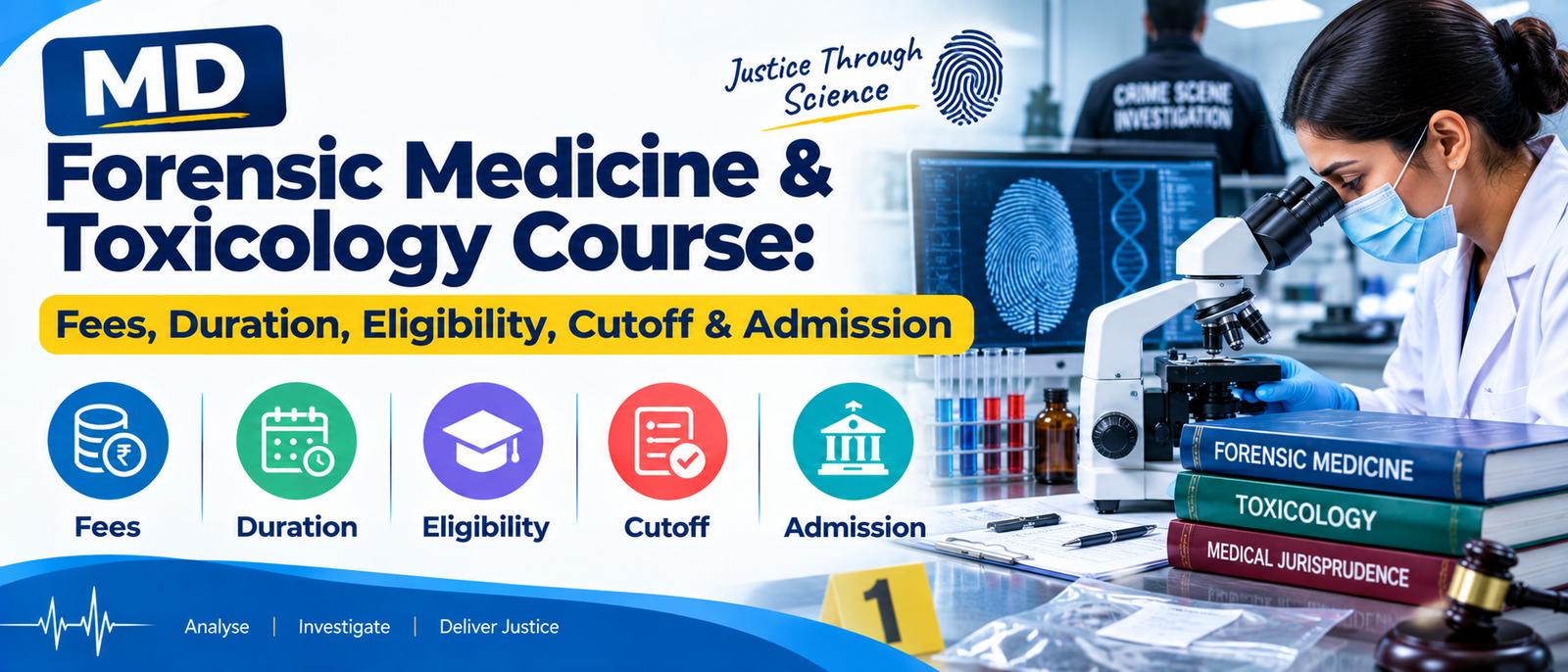
MD Forensic Medicine & Toxicology is a postgraduate medical course for doctors interested in the meeting point of medicine, science and the legal system. It suits someone who can examine evidence carefully, write precise reports and explain medical findings without overstating what they prove.
The course covers the medical investigation of injury and death, examination of living people in medico-legal cases, and the effects of poisons and drugs. Residents learn how to document observations, preserve relevant evidence and communicate findings to investigating authorities or courts when required.
MBBS introduces forensic medicine and toxicology as part of a broad medical education. The MD develops specialist skills through supervised casework, autopsies, teaching and research. It also demands a deeper understanding of professional duties, consent, confidentiality and the legal procedures applicable to a case.
Admission generally involves a postgraduate entrance examination followed by counselling. NEET-PG is the usual route for MD seats, although candidates should check the process notified for their target institution.
Seats and applicant choices change from one admission session to another. A candidate’s chances depend on the available colleges, category, quota and counselling round, so an old closing rank should be treated as a reference rather than a prediction.
What is MD Forensic Medicine & Toxicology?
MD Forensic Medicine & Toxicology is a specialist medical degree concerned with applying medical knowledge to questions that may have legal significance. A forensic medicine specialist may examine an injured person, assess a medico-legal case, conduct or assist with a postmortem examination, and provide an expert opinion within the limits of the findings.
Toxicology deals with the harmful effects of substances, including medicines, chemicals and other poisons. In this course, residents study how exposure may be recognised, investigated and interpreted. They also learn why a laboratory result, a clinical history and physical findings must be considered together.
Good forensic work requires restraint. A report should separate what was directly observed from what can reasonably be inferred. The National Medical Commission (NMC) lists MD Forensic Medicine and Toxicology among postgraduate broad specialty qualifications and publishes a competency based training curriculum for forensic medicine.
Graduates may pursue roles in medical college departments, hospital medico-legal services, authorised forensic services, teaching and research, subject to the qualifications required for each post. Further academic focus may include forensic toxicology, forensic pathology, clinical toxicology, medical law or research methods. A fellowship or certificate should be evaluated on its own terms; it does not automatically confer a separate recognised specialist qualification.
Course Highlights
|
Particular |
Details |
|
Course Name |
MD Forensic Medicine & Toxicology |
|
Degree |
Doctor of Medicine (MD) |
|
Level |
Postgraduate medical course |
|
Duration |
Generally three years for the standard MD degree |
|
Basic Qualification |
Recognised MBBS qualification |
|
Entrance Exam |
Usually NEET-PG; check institution specific routes where applicable |
|
Admission Process |
Entrance result followed by the relevant counselling and seat allotment |
|
Training Type |
Supervised medico-legal work, autopsy exposure, toxicology, teaching and research |
|
Major Focus |
Medical evidence relating to injury, death, poisoning and professional practice |
|
Further Study |
Relevant fellowships, research degrees or focused training, subject to eligibility |
|
Career Areas |
Medical colleges, authorised medico-legal services, research and teaching |
Confirm the current course duration, recognition status and admission requirements through NMC records, the entrance examination bulletin and the college prospectus.
MD Forensic Medicine & Toxicology Duration
The standard MD course generally takes three years. Residents progress through theory, supervised casework, practical examinations, teaching and research. The order of postings differs by institution, so the year wise outline below is illustrative rather than a fixed timetable.
Year 1: Learn methods and documentation
Residents strengthen their knowledge of anatomy, pathology, toxicology and the principles used in medico-legal assessment. They observe case examinations and postmortem work while learning how to record findings clearly and objectively.
They also become familiar with specimen handling, report formats and the importance of maintaining an accurate record of how evidence was collected and transferred. Early academic work usually includes seminars, case discussions and planning a research project.
Year 2: Apply knowledge to varied cases
Residents generally take a more active role in supervised examination of injuries, postmortem cases and toxicology related work. They learn to compare the history supplied with clinical or anatomical findings, consider alternative explanations and identify questions that cannot be answered from the available evidence.
Teaching responsibilities often grow at this stage. Residents may conduct undergraduate demonstrations, discuss medico-legal scenarios and continue collecting or analysing material for their dissertation.
Year 3: Refine expert judgment
Senior residents usually manage more complex academic and case discussions under faculty supervision. They practise preparing clear opinions, explaining the basis for conclusions and acknowledging uncertainty where evidence is limited.
They complete required research and prepare for final assessments. Verify the current duration, case exposure and examination requirements with the admitting institution and official regulations.
MD Forensic Medicine & Toxicology Eligibility Criteria
- Base degree: Applicants need an MBBS degree or provisional pass certificate that meets the recognition requirements for postgraduate medical admission.
- Internship: The compulsory rotating internship must be completed by the deadline notified for the admission session.
- Registration: Applicants must meet the medical registration conditions stated in the current examination documents.
- Entrance exam: Candidates seeking seats through NEET-PG must apply for and appear in that examination.
- Qualifying requirements: Candidates must satisfy the applicable examination, counselling, category and document verification conditions.
Read the current NBEMS information bulletin and the relevant counselling prospectus before applying. Internship deadlines, registration requirements and qualifying criteria are session specific.
MD Forensic Medicine & Toxicology Admission Process
Step 1: Complete MBBS and internship
Finish the qualifying MBBS course and internship within the notified deadline. Keep the degree or provisional certificate, internship proof and registration documents ready for verification.
Step 2: Apply for the entrance examination
Register for NEET-PG if the seats you seek use that route. Follow the current National Board of Examinations in Medical Sciences (NBEMS) bulletin for eligibility and application instructions.
Step 3: Review your result
Check your score, rank and qualifying status when results are published. A qualifying result permits participation under the applicable rules; it does not guarantee a seat at a preferred college.
Step 4: Register for counselling
Apply through the authority responsible for your target seats. The Medical Counselling Committee (MCC) handles specified postgraduate seat pools, including All India Quota and deemed university seats. State authorities conduct their respective counselling processes.
Step 5: Fill your choices
The published seat matrix may include MD Forensic Medicine & Toxicology seats in government colleges, state government colleges, private colleges or deemed universities. Availability differs by institution, so check the exact course name and seat category before adding a choice.
Order colleges by where you would genuinely prefer to train. Ask about supervised autopsy and living case exposure, departmental facilities, teaching support, location, total cost and any service obligation.
Step 6: Check seat allotment
Allotment follows the counselling authority’s published rules and depends on eligibility, merit, choices and seat availability. Read the result and reporting instructions for the specific round.
Step 7: Report and complete admission
Report to the allotted college, submit original documents as instructed and complete payment and joining formalities by the notified deadline. Review the current rules before choosing to retain a seat or seek an upgrade.
MD Forensic Medicine & Toxicology Fees
There is no single fixed fee for MD Forensic Medicine & Toxicology in India. The amount depends on the institution, state, seat category and applicable fee schedule. Tuition may be only part of the total payable.
|
College or seat type |
General fee pattern |
|
Government College |
Tuition is often comparatively lower, but charges vary by college. |
|
State Government College |
Fees follow the relevant state and institutional notifications. |
|
Private College |
Fees can be higher and may vary by college and seat category. |
|
Deemed University |
The university publishes its applicable fee schedule, subject to relevant rules. |
|
Management Quota |
Where such a category is notified, its fee may differ from other seats at the same institution. |
Request a written breakdown of:
- Tuition and admission charges
- University enrolment or registration fees
- Examination fees
- Hostel and mess charges
- Refundable security deposits
- Any notified laboratory, library or institutional charges
- Bond, service or exit conditions, where applicable
Fees, refund rules and service obligations can change. Verify the complete payable amount against official counselling notices and the institution’s current documents before paying.
MD Forensic Medicine & Toxicology Cutoff
A cutoff is not one fixed number. It may refer to the NEET-PG qualifying criterion or to the last allotted rank for a specific MD Forensic Medicine & Toxicology seat.
A college wise closing rank needs more detail: which category, which quota and which counselling round? A qualifying score establishes eligibility under the applicable rules, while an allotment depends on seat availability and candidate choices.
Verify current qualifying criteria and round wise allotment data through official examination and counselling portals. Past cutoffs are planning references, not guarantees.
What Determines the Cutoff?
- Seat count: The number of seats in a particular counselling pool affects availability.
- College reputation: Applicants may value a department’s case exposure, facilities and supervision.
- Government or private status: Fees and institutional preferences influence choices.
- Category: Applicable category rules affect allotment outcomes.
- Quota: All India, state and other notified pools have different eligibility conditions.
- Counselling round: Vacancies and candidate decisions can change between rounds.
- Year to year competition: Applicant numbers and preferences vary by session.
Rank or Score Required for MD Forensic Medicine & Toxicology
There is no universal NEET-PG rank or score for this specialty. The position needed for a seat depends on the college, category, quota, current seat matrix and the choices made by other candidates.
Begin by confirming where you are eligible to participate in counselling. Compare recent official allotment results for the same college and seat category, then review the current matrix. Avoid drawing a conclusion from a closing rank that belongs to a different quota or round.
Make a broad preference list that includes ambitious choices and colleges you would realistically join. Consider training quality alongside admission chances: hands-on case exposure and thoughtful supervision matter greatly in this field.
Previous scores and closing ranks cannot predict an allotment. Check current seats, qualifying criteria and results with the relevant official authorities.
MD Forensic Medicine & Toxicology Syllabus
The syllabus combines medicine, pathology, toxicology, ethics and the legal context of medical evidence. The NMC curriculum supplies a competency based framework, while universities organise the detailed teaching and assessment schedule.
Forensic Pathology and Investigation of Death
- Postmortem examination and documentation
- Natural, accidental, suicidal and suspected homicidal deaths as case contexts
- Interpreting injuries and disease findings together
- Understanding the limits of an opinion about cause and circumstances of death
Clinical Forensic Medicine
- Examination and documentation of living persons in medico-legal cases
- Assessment of injuries and relevant clinical findings
- Consent, privacy and sensitive communication
- Writing reports that distinguish observations from opinions
Forensic Toxicology
- Effects of commonly encountered toxic substances
- Clinical features and investigation of suspected poisoning
- Collection, preservation and interpretation of relevant samples
- How laboratory findings relate to the history and examination
Forensic Biology and Identification
- Principles used in identifying unknown persons
- Assessment of biological material within the specialist’s role
- Working with other forensic experts when a case requires additional analysis
Medical Law, Ethics and Professional Duties
- Medico-legal responsibilities and documentation
- Confidentiality, consent and professional conduct
- Giving evidence and explaining medical opinions
- Keeping knowledge of applicable law and procedure current
Research and Medical Education
- Research design, literature review and data interpretation
- Dissertation and case presentations
- Teaching undergraduate medical students
- Reviewing errors and improving documentation practices
Practical Training in MD Forensic Medicine & Toxicology
Practical training depends on a department’s authorised casework, facilities and supervision. Residents may observe and progressively participate in postmortem examinations, examinations of living persons in medico-legal cases, toxicology related specimen work and preparation of reports.
An autopsy is only one part of the job. The resident must consider the available history, examine and document findings systematically, select samples appropriately and avoid claiming more than the evidence supports. Records and specimen handling have to be clear enough for another professional to understand what was done.
Living case examinations demand equal care. The person being examined may be injured, distressed or vulnerable. Residents learn to explain the examination, follow applicable consent and safeguarding procedures, respect privacy and document findings in neutral language.
Training can also involve case conferences, toxicology discussions, interaction with laboratories and supervised exposure to court related processes where available. The exact work a resident is permitted to perform depends on institutional authorisation, supervision and the procedures applicable to the case.
Career Scope After MD Forensic Medicine & Toxicology
- Forensic medicine specialist: Work in an authorised department or service examining medico-legal cases and preparing medical opinions.
- Medical college faculty: Teach undergraduates and postgraduates after meeting the applicable faculty eligibility requirements.
- Hospital medico-legal services: Contribute to case documentation, examination and professional guidance within the scope of an appointed role.
- Toxicology related work: Apply relevant expertise in eligible clinical, laboratory, academic or advisory positions.
- Research: Study injury patterns, death investigation, toxicology, documentation or ethics.
- Further focused training: Pursue an eligible fellowship or research degree after checking its entry rules and recognition status.
The nature of a job matters as much as its title. Check whether the employer provides appropriate facilities, supervision or peer review, and clear procedures for handling sensitive cases.
MD Forensic Medicine & Toxicology Salary
Salary after MD Forensic Medicine & Toxicology varies widely. A medical college appointment, hospital post, public service position and research role may each have different duties and pay structures.
Earnings depend on the employer, city, public or private sector, experience, seniority and the responsibilities attached to the post. Compare the full role—including workload, facilities, professional support and benefits—rather than relying on a general salary estimate.