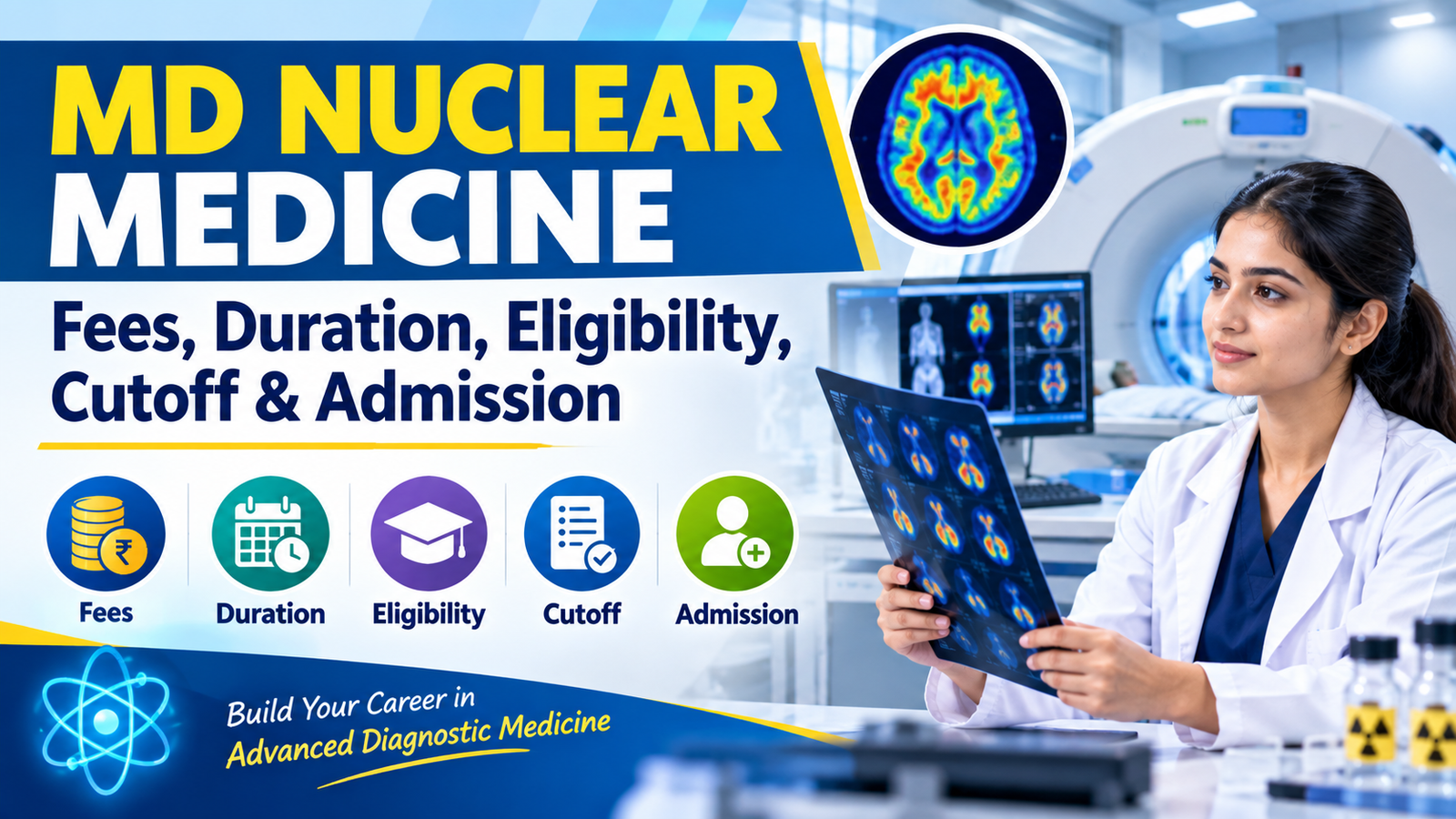
MD Nuclear Medicine is a postgraduate medical course for doctors interested in using small, controlled amounts of radioactive material to investigate disease and, in selected cases, treat it. It brings clinical medicine together with imaging, physiology, radiopharmaceuticals and radiation safety.
A nuclear medicine study can show how an organ or tissue is functioning, rather than only what it looks like. Residents learn to select appropriate investigations, interpret images in clinical context and discuss results with the referring team.
MBBS gives doctors a broad medical foundation. MD Nuclear Medicine builds specialist skills in procedures such as radionuclide imaging and therapy, alongside careful patient assessment and the safe handling of radioactive materials.
Admission generally involves a postgraduate entrance examination followed by counselling. NEET-PG is the usual route for MD seats, although candidates should check any separately notified process for a particular institution.
Seats are available only where a recognised programme and the required training facilities are in place. Competition varies by college, category, quota and counselling round. Verify current seats and allotment results with official sources; an earlier closing rank cannot guarantee admission.
What is MD Nuclear Medicine?
MD Nuclear Medicine is a specialist medical degree in the diagnostic and therapeutic use of radiopharmaceuticals. A radiopharmaceutical combines a radioactive substance with a compound that helps it travel to or interact with a particular part of the body.
For diagnosis, a suitable camera detects signals from the radiopharmaceutical and produces images that help clinicians assess function or disease activity. Depending on the department’s facilities, trainees may encounter planar imaging, SPECT or PET, sometimes combined with CT or MRI. The choice of test depends on the clinical question.
Nuclear medicine also has a treatment side. Certain radioactive substances can be used for specific conditions after careful patient selection, planning and follow-up. The National Medical Commission’s (NMC) revised curriculum covers both diagnostic imaging and therapeutic nuclear medicine.
Graduates may work in hospital nuclear medicine departments, specialised imaging and therapy services, teaching or research. Further focused training may involve areas such as PET imaging, radionuclide therapy or radiopharmaceutical research. Applicants should check the credentials and entry requirements of any fellowship separately.
Course Highlights
|
Particular |
Details |
|
Course Name |
MD Nuclear Medicine |
|
Degree |
Doctor of Medicine (MD) |
|
Level |
Postgraduate medical course |
|
Duration |
Generally three years for the standard MD course |
|
Basic Qualification |
Recognised MBBS qualification |
|
Entrance Exam |
Usually NEET-PG; check institution specific routes where applicable |
|
Admission Process |
Entrance result followed by applicable counselling and seat allotment |
|
Training Type |
Supervised imaging, therapy, patient assessment, academic work and research |
|
Major Focus |
Radiopharmaceutical diagnosis, radionuclide therapy and radiation safety |
|
Further Study |
Relevant fellowships or research, subject to eligibility |
|
Career Areas |
Nuclear medicine departments, teaching institutions and research |
Confirm the current course duration, seat recognition and admission requirements through NMC records, the entrance bulletin and the institution prospectus.
MD Nuclear Medicine Duration
The standard MD Nuclear Medicine programme generally takes three years. Residents learn through supervised clinical work, imaging interpretation, therapy exposure, teaching and research. The exact sequence of duties varies by institution, so the year wise outline below is illustrative.
Verify the current duration, rotations and assessment requirements with the admitting institution and applicable NMC regulations.
Year 1: Learn the foundations
Residents study radiation physics, radiobiology, radiopharmaceuticals and the principles behind nuclear medicine equipment. They learn to take a relevant clinical history, explain a procedure to a patient and understand why a particular investigation has been requested.
Early work is closely supervised. Correct identification, preparation, documentation and radiation protection are as important as reading the final image.
Year 2: Interpret a wider range of studies
Residents generally encounter more diagnostic cases across areas such as cancer, heart disease, endocrine disorders and other organ systems. They learn to assess image quality, recognise normal variants and identify findings that need correlation with other tests.
Where facilities permit, training may include PET and hybrid imaging. Residents also study the indications and precautions for therapeutic procedures and continue their research work.
Year 3: Refine clinical judgment
Senior residents typically take greater responsibility for selecting studies, interpreting difficult findings and discussing results with clinical teams under supervision. They develop a clearer sense of a test’s limitations: an unusual image finding may need another investigation or follow-up before anyone can draw a firm conclusion.
They complete academic requirements and prepare for final examinations. Exposure to specialised imaging and therapy depends on the department’s available equipment, authorisations and patient services.
MD Nuclear Medicine Eligibility Criteria
- Base degree: Applicants need an MBBS degree or provisional pass certificate meeting the recognition requirements for postgraduate medical admission.
- Internship: The compulsory rotating internship must be completed by the deadline notified for that admission session.
- Registration: Applicants must meet the medical registration conditions in the current examination documents.
- Entrance exam: Candidates seeking seats through NEET-PG must apply for and appear in that examination.
- Qualifying requirements: Candidates must satisfy the applicable examination, counselling, category and document verification conditions.
The National Board of Examinations in Medical Sciences (NBEMS) describes the general MBBS, internship and registration conditions for NEET-PG. Read the current official information bulletin for session specific deadlines and eligibility requirements.
MD Nuclear Medicine Admission Process
Step 1: Complete MBBS and internship
Finish the qualifying MBBS course and internship within the notified deadline. Keep your degree or provisional certificate, internship proof and registration documents ready.
Step 2: Apply for the entrance examination
Register for NEET-PG if your target seats use that route. Follow the current NBEMS bulletin for application instructions and eligibility conditions.
Step 3: Review your result
Check your score, rank and qualifying status when results are released. Qualifying permits participation under the applicable rules; it does not secure an MD Nuclear Medicine seat.
Step 4: Register for counselling
Apply through the authority responsible for your target seats. The Medical Counselling Committee (MCC) handles specified postgraduate seat pools, including All India Quota and deemed university seats. State authorities conduct their respective counselling processes.
Step 5: Fill your choices
Depending on eligibility and the published seat matrix, choices may include government colleges, state government colleges, private colleges and deemed universities offering MD Nuclear Medicine. Check that the exact MD course and seat category are listed.
Look closely at training facilities. Ask whether residents gain supervised experience in the imaging and therapy services that interest them, as well as about location, total fees and any bond or service condition. Put colleges in the order you would genuinely prefer to join them.
Step 6: Check seat allotment
Allotment follows the counselling authority’s published rules and depends on eligibility, merit, preferences and available seats. Read the instructions for the round in which you receive a result.
Step 7: Report and complete admission
Report to the allotted institution, submit documents for verification and complete payment and joining formalities by the deadline. Check current rules before deciding whether to retain a seat or seek an upgrade.
MD Nuclear Medicine Fees
There is no single fixed fee for MD Nuclear Medicine in India. Costs depend on the institution, state, seat category and current fee schedule. The department’s specialised equipment does not, by itself, tell you what an individual student will be charged.
|
College or seat type |
General fee pattern |
|
Government College |
Where the course is offered, tuition is often comparatively lower, but charges vary. |
|
State Government College |
Fees follow the relevant state and institutional notifications. |
|
Private College |
Where seats are available, fees may vary by college and seat category. |
|
Deemed University |
The university publishes its applicable fee schedule, subject to relevant rules. |
|
Management Quota |
Where this category is notified, its fee may differ from other seats at the same institution. |
Request a written breakdown covering:
- Tuition and admission charges
- University enrolment or registration fees
- Examination fees
- Hostel and mess charges
- Refundable security deposits
- Other notified institutional charges
- Any bond, service or exit conditions
A resident stipend, where applicable, should be checked separately from the fee schedule.
Fees, stipend terms, refunds and service obligations can change. Verify the full financial commitment against official counselling notices and current college documents before paying.
MD Nuclear Medicine Cutoff
An MD Nuclear Medicine cutoff is not one fixed number. The term may refer to the NEET-PG qualifying criterion or to the last allotted rank for a particular college, category, quota and counselling round.
These figures answer different questions. Meeting the qualifying criterion does not guarantee the specialty. A college’s previous closing position reflects the seats and candidate choices in that specific round.
Use current official examination notices, seat matrices and round wise counselling results. Past cutoffs are planning references only.
What Determines the Cutoff?
- Seat count: The number of MD Nuclear Medicine seats in the relevant pool affects availability.
- College reputation: Facilities, case variety and supervision may shape preferences.
- Government or private status: Fees and institutional preferences can affect demand.
- Category: Applicable category rules influence allotment outcomes.
- Quota: All India, state and other notified pools have different eligibility conditions.
- Counselling round: Vacancies and candidate choices may change between rounds.
- Year to year competition: Applicant numbers and preferences differ by session.
Rank or Score Required for MD Nuclear Medicine
There is no universal NEET-PG rank or score for MD Nuclear Medicine. Your prospects depend on the current seat matrix, your category and quota eligibility, and how other candidates order their preferences.
First confirm which colleges actually offer the course in your counselling pool. Compare recent official allotment results for the same seat category and round where possible. Then review each department’s training exposure, facilities and total cost.
Make a broad preference list with ambitious choices and institutions you would realistically join. Keep the order true to your preferences rather than trying to guess how another candidate will fill theirs.
Previous scores and closing ranks do not predict admission. Verify current seats, qualifying criteria and allotment results through official sources.
MD Nuclear Medicine Syllabus
The NMC curriculum combines physics, clinical imaging, therapy and patient safety. Exact postings vary by institution, but the main subject areas include the following.
Radiation Physics and Instrumentation
- Radioactivity and detection principles
- Nuclear medicine cameras and image formation
- Image quality, artefacts and basic processing
Radiopharmaceuticals
- How tracers are selected for an investigation
- Preparation and quality considerations
- Distribution, uptake and clearance in the body
Diagnostic Nuclear Medicine
- Organ and system based functional imaging
- Clinical indications and limitations of tests
- Correlation with the patient’s history and other imaging
PET and Hybrid Imaging
- Principles of PET and combined imaging
- Applications in oncology and other clinical areas
- Image interpretation and possible sources of error
Therapeutic Nuclear Medicine
- Principles of radionuclide therapy
- Patient selection and treatment planning
- Follow-up and management of treatment related concerns
Radiation Safety and Research
- Protection of patients, staff and the public
- Safe handling and disposal procedures
- Research methods, teaching and critical reading
Practical Training in MD Nuclear Medicine
Residents take part in patient assessment, preparation for studies, supervised imaging and interpretation. They learn why the clinical question matters: an image is most useful when the team knows what it is trying to find out.
Where the institution is authorised and equipped for therapy, residents may gain supervised exposure to radionuclide treatment and follow-up. Practical work also includes checking study quality, discussing results with referring clinicians and recognising when findings remain uncertain.
Radiation safety is part of everyday training, from handling materials to managing work areas and patient instructions. In India, a nuclear medicine facility must meet the Atomic Energy Regulatory Board’s (AERB) requirements and obtain the applicable regulatory consent. Applicants comparing colleges should ask about the department’s authorised services and resident exposure.
Career Scope After MD Nuclear Medicine
- Nuclear medicine specialist: Work in an eligible diagnostic or therapy service with appropriate facilities and authorisation.
- Hospital imaging service: Interpret studies and discuss findings with referring clinical teams within the scope of the role.
- Radionuclide therapy service: Contribute to patient selection, treatment and follow-up where properly trained and supported.
- Medical teaching: Teach students and residents after meeting applicable faculty eligibility requirements.
- Research: Study imaging methods, radiopharmaceuticals, treatment outcomes or patient safety.
- Further focused training: Pursue an eligible fellowship or research programme after checking its entry conditions and credentials.
MD Nuclear Medicine Salary
Salary after MD Nuclear Medicine varies widely. A public hospital appointment, private imaging service, teaching post and research role can have different pay structures and responsibilities.
Earnings depend on the employer, city, sector, experience, working hours, available services and the scope of the post. Compare the full offer, including equipment, radiation safety support, benefits and continued training, rather than relying on a general salary figure.