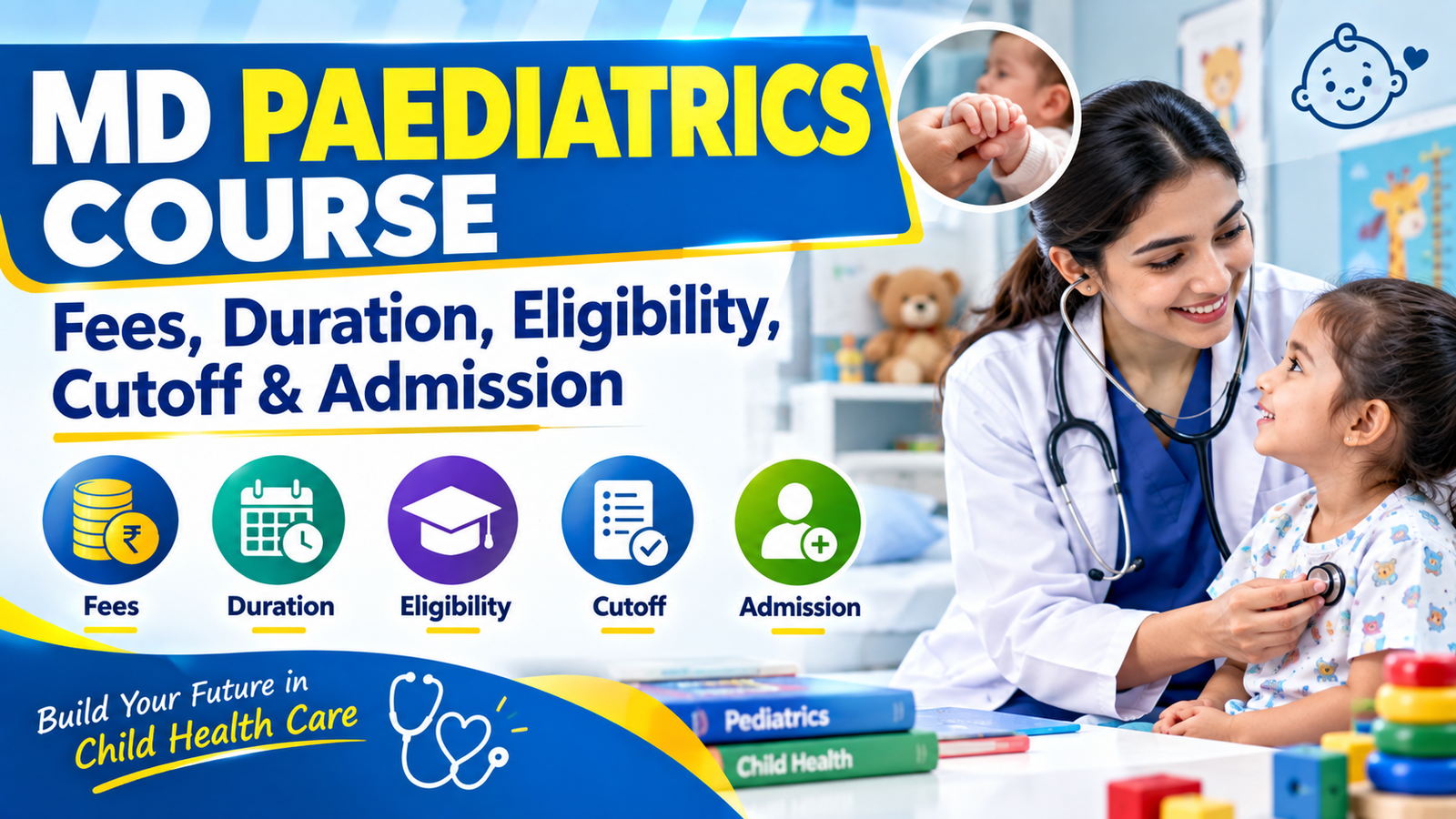
An infant who refuses to feed cannot explain what is wrong. A school-age child might describe a stomachache but struggle to say when it began. An adolescent may have questions they are reluctant to ask in front of a parent. MD Paediatrics trains doctors to care for all three, with decisions shaped by the child’s age, development, and circumstances.
This postgraduate course covers newborn care, growth and nutrition, immunisation, common illnesses, emergencies, and conditions that need long-term follow-up. It suits MBBS graduates who enjoy clinical problem-solving and want to work closely with children and families.
MBBS provides the medical foundation. During MD Paediatrics, residents spend much more time examining children, following their progress, responding when they become unwell, and discussing decisions with senior doctors. The learning comes from repeated clinical responsibility under supervision.
Admission usually runs through NEET-PG and postgraduate counselling. Seats at a particular college may be competitive, but there is no dependable “one rank fits all” answer. Category, quota, available seats, and the counselling round all affect the outcome.
What is MD Paediatrics?
MD Paediatrics is a postgraduate medical degree concerned with the health of newborns, children, and adolescents. A paediatrician diagnoses and treats illness, checks whether a child is growing and developing as expected, advises on prevention, and helps families manage ongoing health concerns.
The specialty requires more than applying adult medicine at a lower dose. Signs of illness can differ by age, and a child’s condition can change quickly. A paediatrician must also know how to obtain a useful history from caregivers without losing sight of the child’s own experience.
The National Medical Commission’s MD Paediatrics curriculum describes training across routine and emergency care, health promotion, and disease management from the newborn period through adolescence.
Graduates can work in general paediatrics or pursue further training in areas such as neonatology, paediatric intensive care, paediatric cardiology, neurology, or nephrology. Entry to a fellowship, DM, or DrNB course depends on that programme’s current eligibility rules.
MD Paediatrics Course Highlights
|
Particular |
Details |
|
Course Name |
MD Paediatrics |
|
Degree |
Doctor of Medicine |
|
Level |
Postgraduate medical course |
|
Duration |
Generally three years |
|
Basic Qualification |
MBBS qualification accepted under current PG admission rules |
|
Entrance Exam |
NEET-PG for applicable MD seats |
|
Admission Process |
Entrance result followed by the relevant counselling and seat allotment |
|
Training Type |
Supervised outpatient, ward, emergency, newborn, academic, and research work |
|
Major Focus |
Prevention, diagnosis, and treatment of health problems in children |
|
Further Study |
Eligible fellowships and super-specialty programmes |
|
Career Areas |
Clinics, hospitals, teaching, research, and child-health services |
Duration note: Verify the current duration and course requirements in NMC and institutional documents. The training pattern at an individual college can vary.
MD Paediatrics Duration
The MD generally takes three years. Residents do not move through identical timetables at every college, but responsibility usually increases as their skills develop.
Year 1: Learn to recognise what matters
A new resident spends considerable time taking histories, examining children at different ages, measuring growth, and managing common problems under close supervision. Fever, cough, diarrhoea, feeding difficulties, and routine newborn concerns form part of everyday learning.
The first year also teaches a harder skill: spotting the child who needs help urgently. Residents learn when an apparently minor symptom is accompanied by a warning sign and when to seek senior support.
Year 2: Manage more varied cases
Residents usually take on broader inpatient and emergency duties. Their exposure may include newborn units, paediatric intensive care, and specialty clinics, depending on the hospital’s services.
Cases become less straightforward. A child may return repeatedly with the same complaint, fail to gain weight, or need input from several departments. Residents learn to reassess the diagnosis and coordinate a sensible plan.
Year 3: Take the lead under supervision
Senior residents may guide ward work, support junior colleagues, handle more complex cases, and explain difficult decisions to families. They also complete their academic and research requirements and prepare for final assessments.
Duration disclaimer: The year-wise progression is illustrative. Confirm the college’s current postings, supervision, dissertation requirements, and examination rules through official sources.
MD Paediatrics Eligibility Criteria
The current NBEMS NEET-PG information bulletin and the relevant counselling prospectus should be read together. A candidate can meet the examination requirements yet still need to satisfy separate conditions for a particular seat.
- Base degree: Applicants generally need an MBBS degree or provisional pass certificate accepted under the applicable rules. Candidates who qualified outside India should check the additional requirements that apply to them.
- Internship: The compulsory rotatory internship must be completed by the cut-off date specified for the admission session.
- Registration: Candidates need the medical registration documentation required in the current examination and counselling instructions.
- Entrance examination: Applicants ordinarily take NEET-PG for MD admission. NBEMS sets out the MBBS, internship, and registration conditions on its NEET-PG information page.
- Qualifying requirements: Candidates must meet the applicable qualifying standard and any category, quota, domicile, or institutional conditions for the seats they seek.
Eligibility disclaimer: Internship deadlines, qualifying criteria, and document requirements can change. Check the current NBEMS bulletin and official counselling prospectus before applying.
MD Paediatrics Admission Process
- Complete MBBS and internship. Keep your degree or provisional certificate, internship proof, registration document, and other required records ready.
- Apply for NEET-PG. Read the current NBEMS bulletin, submit the application correctly, and appear for the examination.
- Review the result. Check your score, rank, and qualifying status. Identify the counselling routes for which you meet the conditions.
- Register for counselling. The Medical Counselling Committee (MCC) handles specified postgraduate seat categories, including All India Quota seats. State authorities conduct counselling for their respective seat pools.
- Fill choices. Depending on eligibility and the current seat matrix, choices may include government medical colleges, state government institutions, private colleges, and deemed universities. Confirm that the exact MD Paediatrics seat and quota are listed before selecting an option.
- Check the allotment. Read the published rules for accepting a seat, upgrading, or entering a later round. These decisions can affect deposits and further participation.
- Report for admission. Complete document verification and payment by the stated deadline. Obtain the fee schedule, stipend terms, and any service-bond conditions in writing.
Admission disclaimer: Counselling schedules, rounds, seats, and reporting rules change by session. Use the current MCC or state authority notices.
MD Paediatrics Fees
There is no single fixed fee for MD Paediatrics. A government seat and a private or deemed university seat may have very different costs. Even within one type of institution, state policy and seat category matter.
|
Institution or seat type |
General fee pattern |
What to check before accepting |
|
Government College |
Tuition is often comparatively lower |
Hostel charges, stipend, deposit, bond, and service conditions |
|
State Government College |
Fees vary under state rules |
Current state prospectus and applicable seat category |
|
Private College |
Tuition is generally higher and varies by institution |
Approved annual charges, stipend, and refund policy |
|
Deemed University |
Institution-specific fee schedule applies |
Total payable cost, payment dates, hostel, and deposits |
|
Management Quota |
A separate approved fee may apply where such seats exist |
Official seat listing, approved fee, and counselling route |
Ask for the full breakdown. It may include tuition, university fees, examination and registration charges, hostel and mess expenses, library charges, and a security deposit. Find out which charges recur, which are refundable, and when they must be paid.
Stipend and bond terms deserve the same attention. Two seats with similar tuition may have quite different practical costs if one has higher living expenses or a service obligation.
Fee disclaimer: The table gives general fee patterns, not quoted amounts. Verify current approved fees, deposits, stipend, bond, and refund terms with the college and official counselling documents before making a payment.
MD Paediatrics Cutoff
The word cutoff is often used without enough context. It can mean any of the following:
- Qualifying cutoff: The standard needed to qualify under the applicable NEET-PG rules.
- College-wise closing rank: The last allotted rank for MD Paediatrics at a named college.
- Category-wise cutoff: An allotment result for a specific reservation category.
- Quota-wise cutoff: A result for a particular seat pool.
- Round-wise cutoff: The closing result in one counselling round.
These figures answer different questions. Qualifying for counselling does not mean a candidate will obtain MD Paediatrics, and last year’s closing rank is not a promise for this year.
What Determines the Cutoff?
- Seat count: Availability in the exact course and seat pool.
- College reputation: Faculty, patient exposure, facilities, and location can influence demand.
- Government or private status: Fees and service conditions affect candidate preferences.
- Category: Applicable reservation rules shape the relevant allotment list.
- Quota: Different counselling pools can produce different closing results.
- Round: Upgrades and vacancies can shift the closing rank.
- Year-to-year competition: Applicants and their choices change each session.
Cutoff disclaimer: Verify qualifying criteria and round-wise allotment results on official NBEMS, MCC, or state counselling portals. Unlabelled or older cutoff figures should not be treated as admission predictions.
Rank or Score Required for MD Paediatrics
There is no universal NEET-PG score or rank for MD Paediatrics. To judge your options, start with what you can actually apply for: your eligible quota, category, and the seats listed in the current matrix.
Previous official allotments can provide a reference. Compare the same course, college, category, quota, and round wherever possible. Then look beyond rank. Would you be able to meet the full cost? Does the hospital offer the newborn and emergency exposure you want? Are you comfortable with its bond terms?
Make a broad preference list in your genuine order of choice. Include colleges you would be pleased to join and alternatives you have researched. Listing a seat you would never accept can create avoidable difficulty if it is allotted.
Rank and score disclaimer: Check current official seat matrices and allotment results. Earlier closing ranks cannot guarantee or rule out an individual allotment.
MD Paediatrics Syllabus
The course follows child health from the newborn period to adolescence. The NMC curriculum provides the competency framework; institutions may organise teaching and clinical postings differently.
Newborn care and neonatology
Residents study examination after birth, feeding problems, jaundice, prematurity, infection, and breathing difficulties. They learn when a baby needs routine follow-up and when closer monitoring is necessary.
Growth, development, and nutrition
This includes growth measurement, developmental milestones, feeding, nutritional deficiencies, and concerns about delayed growth or development. Residents learn to look at trends and family circumstances alongside a single measurement.
Common illnesses and infections
Fever, respiratory infections, diarrhoeal illness, and other frequent presentations are central to training. The aim is to assess severity, treat appropriately, and give families clear instructions about warning signs.
Respiratory and cardiovascular health
Residents learn to assess wheeze, pneumonia, persistent cough, and possible heart disease. They practise recognising when a child needs urgent stabilisation or a specialist opinion.
Neurological and developmental concerns
Topics may include seizures, headaches, developmental delay, and behavioural or learning concerns. Assessment changes with the child’s age and ability to communicate.
Digestive, kidney, blood, and endocrine conditions
Training includes problems such as persistent vomiting, urinary symptoms, anaemia, and growth-related endocrine concerns. Residents learn to investigate carefully and coordinate complex care with other teams.
Emergencies, prevention, and adolescent health
Residents study resuscitation and the assessment of seriously ill children. Immunisation, preventive counselling, and respectful care of adolescents are also part of the course.
Academic and research work
Case discussions, seminars, journal reading, and dissertation or research work help residents test their reasoning against evidence and feedback.
Practical Training in MD Paediatrics
Most learning happens with patients, under supervision. Residents examine children in outpatient clinics, follow admitted patients, respond to emergencies, and spend time in newborn services. The breadth of exposure depends on the hospital.
Take a child admitted with breathing difficulty. The resident assesses the child, starts the agreed treatment, checks whether it is working, and explains the plan to the family. If the child deteriorates, timely reassessment and escalation matter as much as the first diagnosis.
Practical work may include growth and developmental assessment, newborn examination, emergency stabilisation, and supervised procedures. Residents also learn follow-up: some children need a plan that continues long after discharge.
A college visit or conversation with current residents can answer useful questions. How much newborn and emergency work do trainees see? Who supervises night duties? Do residents get feedback on cases, or only a heavy workload? Those details can change the quality of training.
Career Scope After MD Paediatrics
- General paediatric practice: Provide preventive care, assess illnesses, treat children, and refer complex cases appropriately.
- Hospital-based paediatrics: Care for admitted children and work with newborn, emergency, and specialty teams.
- Teaching: Train medical students or residents, subject to current faculty eligibility rules.
- Research: Study childhood diseases, development, treatments, or healthcare delivery.
- Child-health programmes: Contribute clinical knowledge to prevention, screening, or service work.
- Further specialisation: Seek eligible fellowship or super-specialty training after checking current entry requirements.
The day-to-day work differs across these paths. Some doctors prefer seeing families over many years in a clinic. Others are drawn to acute hospital care or a focused field.
Salary After MD Paediatrics
Pay varies widely by employer, city, sector, experience, workload, and type of practice. A hospital salary, a teaching appointment, and income from an independent clinic follow different models.
Read job terms closely. Emergency duties, working hours, benefits, support from senior colleagues, and opportunities to develop skills all affect whether a position is a good fit.
Salary disclaimer: Verify current compensation through official recruitment notices or written offers. General salary claims cannot predict what an individual doctor will earn.
MD Paediatrics can be a good fit for a doctor who wants to combine clinical reasoning with long-term care for children and families. When choosing a seat, give as much attention to supervision, case exposure, fees, and bond terms as you give to the college name.