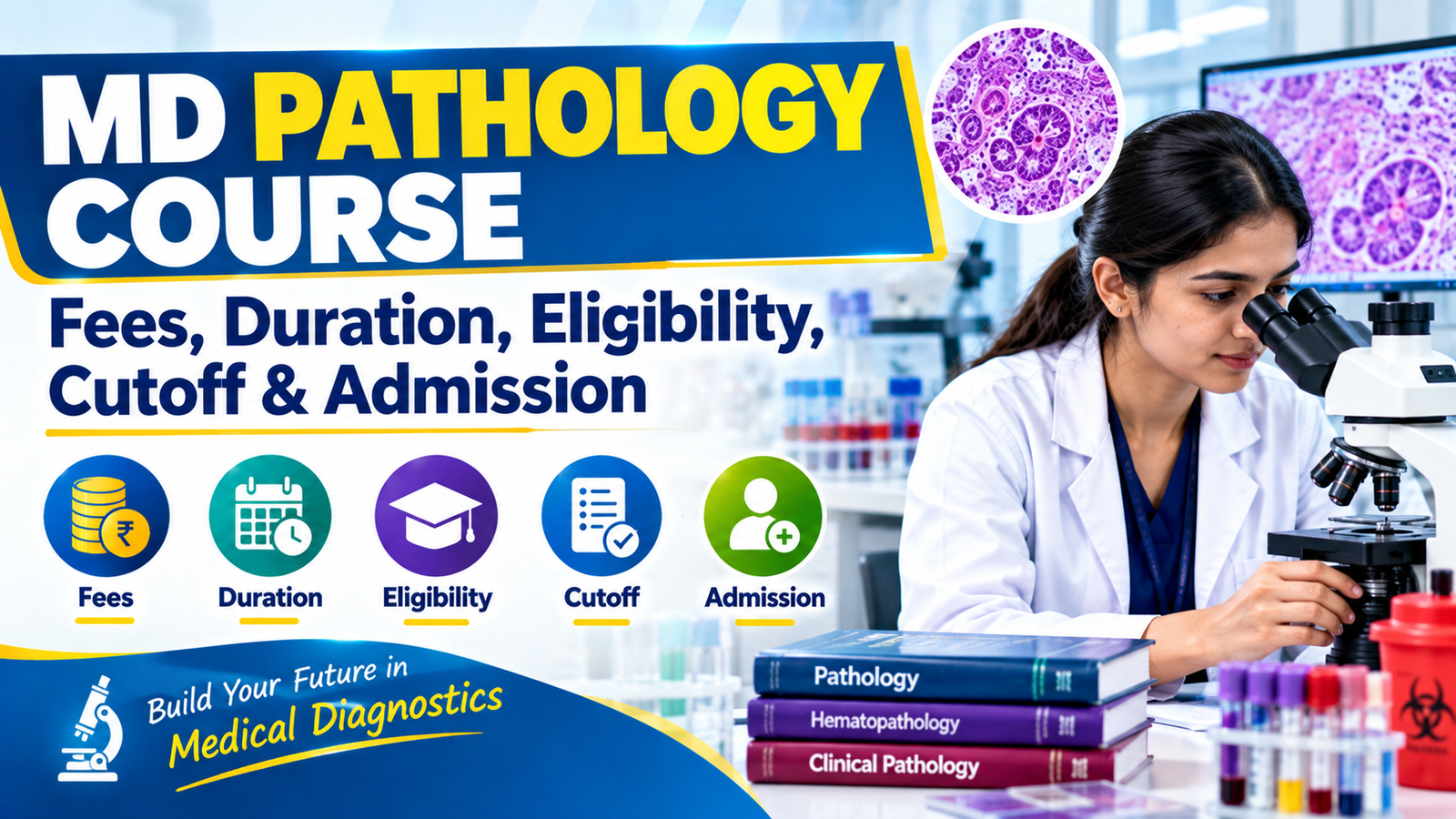
A biopsy can change a patient’s treatment plan. So can an unexpected blood count or a finding in a fluid sample. The pathologist examines the evidence behind those results and explains what it means to the treating team. MD Pathology trains doctors for that diagnostic work.
The course may suit MBBS graduates who enjoy close observation, clinical reasoning, microscopy, and laboratory-based investigation. It covers tissue diagnosis, cytology, haematology, clinical pathology, laboratory quality, and research.
MBBS introduces students to how diseases affect cells and organs. During MD Pathology, residents apply that knowledge to real specimens. They learn to recognise patterns, consider possible diagnoses, select appropriate additional tests, and write reports that clinicians can use.
Admission generally involves NEET-PG followed by the relevant postgraduate counselling process. A seat at a preferred college may be competitive, but closing ranks change with the category, quota, round, and seats available. There is no reliable rank that applies to every applicant.
What is MD Pathology?
MD Pathology is a postgraduate medical degree focused on the diagnosis and study of disease through tissues, cells, blood, and other specimens. Much of a pathologist’s work happens away from the bedside, yet it can directly shape decisions made there.
Consider a patient who has a lump removed. A pathologist studies the tissue, determines what changes are present, and may recommend or interpret additional tests. The report helps the treating team decide what care is needed next. A careful report must also make clear when a sample is limited or a finding remains uncertain.
The National Medical Commission (NMC) has published revised competency-based guidelines for MD Pathology. Training reaches across diagnostic practice, laboratory processes, teaching, and research.
Graduates may work in hospital or diagnostic laboratories, teach in medical colleges, conduct research, or build expertise in areas such as histopathology, cytopathology, haematopathology, molecular pathology, or oncopathology. Further fellowships and advanced courses have their own eligibility rules; the MD does not automatically establish eligibility for every programme.
MD Pathology Course Highlights
|
Particular |
Details |
|
Course Name |
MD Pathology |
|
Degree |
Doctor of Medicine |
|
Level |
Postgraduate medical course |
|
Duration |
Generally three years, subject to applicable regulations |
|
Basic Qualification |
MBBS qualification accepted under current PG admission rules |
|
Entrance Exam |
Usually NEET-PG for applicable MD seats |
|
Admission Process |
Entrance result, counselling, choice filling, seat allotment, and reporting |
|
Training Type |
Supervised specimen examination, laboratory work, case discussions, teaching, and research |
|
Major Focus |
Diagnosis of disease through tissues, cells, blood, and other specimens |
|
Further Study |
Relevant fellowships, research, or advanced training, subject to eligibility |
|
Career Areas |
Hospitals, diagnostic laboratories, medical colleges, research, and quality systems |
Duration note: Check the current NMC rules and the institution’s prospectus for the applicable duration and training requirements. Postgraduate regulations provide the framework for MD courses in India.
MD Pathology Duration
MD Pathology is generally a three-year degree. Residents gradually move from learning how specimens are processed and examined to interpreting complex cases and taking greater responsibility under faculty supervision.
Year 1: Learn the specimen and the method
Residents usually begin with specimen identification, handling, fixation, processing, basic microscopy, blood counts, and routine clinical pathology work. They learn why a diagnosis can be affected before a slide reaches the microscope: an incorrectly labelled or poorly preserved sample creates a serious problem.
They also start describing findings accurately. Clear observation comes before a confident diagnosis.
Year 2: Connect findings to clinical questions
Training commonly expands across histopathology, cytology, haematology, and other sections available at the institution. Residents examine more varied cases, discuss findings with clinicians, and learn when additional stains or tests may help.
Academic work becomes more substantial. Seminars, case presentations, audits, and dissertation or research activity encourage residents to explain how they reached a conclusion.
Year 3: Handle difficult cases with supervision
Senior residents may review complex specimens, help guide junior trainees, participate in multidisciplinary discussions, and take a larger role in quality checks. They complete their academic requirements and prepare for final assessments.
Duration disclaimer: This year-wise account is illustrative. Verify the current rotation schedule, dissertation rules, assessment pattern, and completion requirements with the college and official regulators.
MD Pathology Eligibility Criteria
Candidates should read both the current NBEMS NEET-PG information bulletin and the prospectus for their counselling route. Examination eligibility and eligibility for a specific seat must each be satisfied.
- Base degree: Applicants generally need an MBBS degree or provisional pass certificate accepted under applicable postgraduate medical admission rules. Candidates who studied outside India should check any additional qualification and registration conditions.
- Internship: The compulsory rotatory internship must usually be completed by the cut-off date announced for that admission session.
- Medical registration: Candidates must meet the stated registration requirement and submit the documents requested during verification.
- Entrance examination: NEET-PG is the usual examination for applicable MD seats. NBEMS provides the NEET-PG information bulletin and related admission notices.
- Qualifying and seat-specific conditions: Applicants must satisfy the applicable qualifying criterion and any category, quota, domicile, or institutional conditions. Qualifying does not guarantee an MD Pathology allotment.
Eligibility disclaimer: Internship dates, qualifying criteria, registration conditions, and required documents can change. Verify them in the latest official bulletin and counselling prospectus.
MD Pathology Admission Process
- Complete MBBS and the required internship. Prepare your degree or provisional certificate, internship proof, medical registration document, and other required records.
- Apply for and appear in NEET-PG. Follow the current NBEMS application instructions and notices.
- Check your result. Review your score, rank, and qualifying status. Identify the seat categories for which you are eligible.
- Register for counselling. Depending on the seat, this may be through the Medical Counselling Committee (MCC) or a state PG counselling authority. MCC handles specified postgraduate categories, including All India Quota and deemed university seats.
- Fill and lock your choices. Your eligible options may include MD Pathology seats in government medical colleges, state institutions, private colleges, or deemed universities. Check the current seat matrix, fee schedule, and service conditions for each choice.
- Review the allotment. Read the rules for accepting a seat, requesting an upgrade, or participating in another round before acting.
- Report for admission. Complete document verification and payment within the published deadline. Obtain written confirmation of fees, stipend, bond terms, and refund conditions.
Admission disclaimer: Counselling rounds, seat availability, deadlines, and reporting rules vary by session. Use current MCC or state authority notices.
MD Pathology Fees
There is no single fixed fee for MD Pathology. Costs differ by institution, state policy, and seat category. The amount advertised as tuition may not include the full cost of joining and completing the course.
|
Institution or seat type |
General fee pattern |
What to verify |
|
Government College |
Tuition is often comparatively lower |
Hostel charges, stipend, deposits, bond, and service conditions |
|
State Government College |
Fees vary by state and institution |
State prospectus, quota, and mandatory charges |
|
Private College |
Tuition is generally higher and varies by college |
Approved fee schedule, annual charges, stipend, and refund rules |
|
Deemed University |
Institution-specific fees apply |
Total programme cost, payment schedule, hostel, and deposits |
|
Management Quota |
A separate approved fee may apply where this seat category exists |
Official seat listing, approved fee, and counselling route |
Ask for a breakdown of:
- Tuition
- University or affiliation fees
- Registration and examination charges
- Laboratory and library charges
- Hostel and mess expenses
- Security or caution deposit
- Other charges listed in the official prospectus
Also examine the stipend and any mandatory service bond. A college with a lower tuition figure may still be a more expensive choice once living costs or other obligations are considered.
Fee disclaimer: The table describes common patterns, not payable amounts. Verify the current approved fees, stipend, deposits, refund rules, and bond terms with official college and counselling documents before paying.
MD Pathology Cutoff
There is no single MD Pathology cutoff. The word may refer to several different things:
- Qualifying cutoff: The applicable NEET-PG standard for eligibility.
- College-wise closing rank: The last rank allotted MD Pathology at a particular institution.
- Category-wise cutoff: A result for a stated reservation category.
- Quota-wise cutoff: A result for a particular counselling seat pool.
- Round-wise cutoff: The closing result in a specified round.
These figures should not be mixed. A candidate can qualify for counselling without obtaining a preferred seat. Likewise, a closing rank from an earlier year may shift when seats or candidate preferences change.
What Determines the Cutoff?
- Seat count: How many MD Pathology seats are offered in the relevant category.
- College reputation: Faculty, specimen variety, diagnostic facilities, and location may affect demand.
- Government or private status: Fees, stipend, and bond conditions influence choices.
- Category: Applicable reservation rules determine the relevant applicant group.
- Quota: Different counselling pools can close at different ranks.
- Counselling round: Vacancies, upgrades, and withdrawals can change the result.
- Year-to-year competition: The number and preferences of candidates vary.
Cutoff disclaimer: Verify current qualifying notices and official round-wise allotment data from NBEMS, MCC, or the relevant state authority. Past results are planning references, not guarantees.
Rank or Score Required for MD Pathology
There is no universal NEET-PG rank or score for MD Pathology. To assess your chances, start with your eligible category and counselling routes, then examine the seats offered in the current matrix.
When looking at a previous closing rank, check whether it refers to the same course, college, category, quota, and round. A number without those details has little practical value. Then ask whether the college’s training and full cost suit your plans.
Make a broad preference list in your genuine order of choice. Include colleges you would be pleased to join and research alternatives you could accept. Understand the rules for upgrades, deposits, and withdrawal before locking the list.
Rank and score disclaimer: Use current official seat matrices and allotment results. Previous closing ranks cannot predict an individual admission outcome.
MD Pathology Syllabus
The syllabus follows disease from visible changes in an organ to changes seen in cells and laboratory results. The exact competencies and assessment methods are set out in the applicable NMC MD Pathology guidance.
General and systemic pathology
Residents study how injury, inflammation, infection, immune responses, and tumours affect the body. System-based learning connects these processes to diseases of particular organs.
Histopathology
This involves examining tissue from biopsies and surgical procedures. Residents learn gross examination, tissue processing, microscopy, and the preparation of a clear diagnostic report.
Cytopathology
Residents assess cells collected through methods such as fine-needle aspiration or fluid sampling. They learn to recognise useful findings while being honest about the limits of a small or inadequate sample.
Haematology
Training covers blood counts, peripheral smears, anaemia, abnormal blood cells, and conditions affecting blood or bone marrow. Laboratory findings must be interpreted with the patient’s clinical history.
Clinical pathology
Residents examine urine, body fluids, and other routine specimens. They learn which findings require urgent communication and when a test result needs confirmation.
Immunopathology and molecular methods
Depending on the institution’s facilities, training may include immunohistochemistry and molecular tests that help classify disease or guide treatment. Residents must understand why a test is ordered and what its result can—and cannot—establish.
Laboratory quality, safety, and research
Residents study specimen identification, quality control, reporting errors, biosafety, and laboratory management. Research methods, case presentations, and a dissertation or equivalent academic work support diagnostic reasoning.
Practical Training in MD Pathology
The course is hands-on, though the work does not always resemble bedside clinical training. Residents handle and examine specimens, prepare case summaries, review slides with faculty, and compare their impressions with the clinical information.
A typical case may begin with a biopsy request that gives little history. The resident examines the tissue, reviews possible diagnoses, checks whether additional tests would help, and discusses the findings before a final report is issued. Learning to state uncertainty clearly is part of becoming a safe pathologist.
Training can also include cytology clinics, haematology work, body-fluid analysis, autopsy exposure where available, multidisciplinary meetings, and laboratory quality checks. The amount of exposure varies with the hospital’s services and specimen workload.
When comparing colleges, ask about the range of biopsies, cytology and haematology exposure, access to additional tests, faculty feedback, and opportunities to discuss cases with treating teams. A large laboratory workload is useful when residents also receive close teaching.
Career Scope After MD Pathology
- Hospital pathology: Report and interpret diagnostic specimens while working with clinical teams.
- Diagnostic laboratories: Practise in laboratory services, potentially taking responsibility for reporting, quality, and supervision.
- Teaching: Train medical students and residents, subject to current faculty eligibility rules.
- Research: Study disease processes, diagnostic methods, biomarkers, or treatment-related questions.
- Further specialisation: Seek eligible fellowships or advanced training in a focused pathology area after checking current entry conditions.
- Laboratory quality roles: Help improve specimen handling, test reliability, reporting, and patient safety.
Pathology offers varied working styles. Some doctors prefer a broad diagnostic practice; others spend much of their career in a focused area or combine reporting with teaching and research.
Salary After MD Pathology
Pay varies by employer, city, public or private sector, experience, diagnostic workload, and responsibilities. A salaried medical college post, a hospital role, and work in an independent diagnostic service may have different compensation structures.
When comparing positions, consider more than the stated amount. Look at reporting volume, access to senior consultation, available tests, working hours, benefits, and responsibility for laboratory quality.
Salary disclaimer: Verify current pay and contract conditions through official recruitment notices or written offers. A general salary estimate cannot predict an individual doctor’s earnings.
MD Pathology suits doctors who like making careful decisions from clinical evidence. Before accepting a seat, examine the actual specimen mix, faculty supervision, laboratory facilities, full fees, stipend, and bond terms. These will shape both the training and the work you can confidently take on afterward.