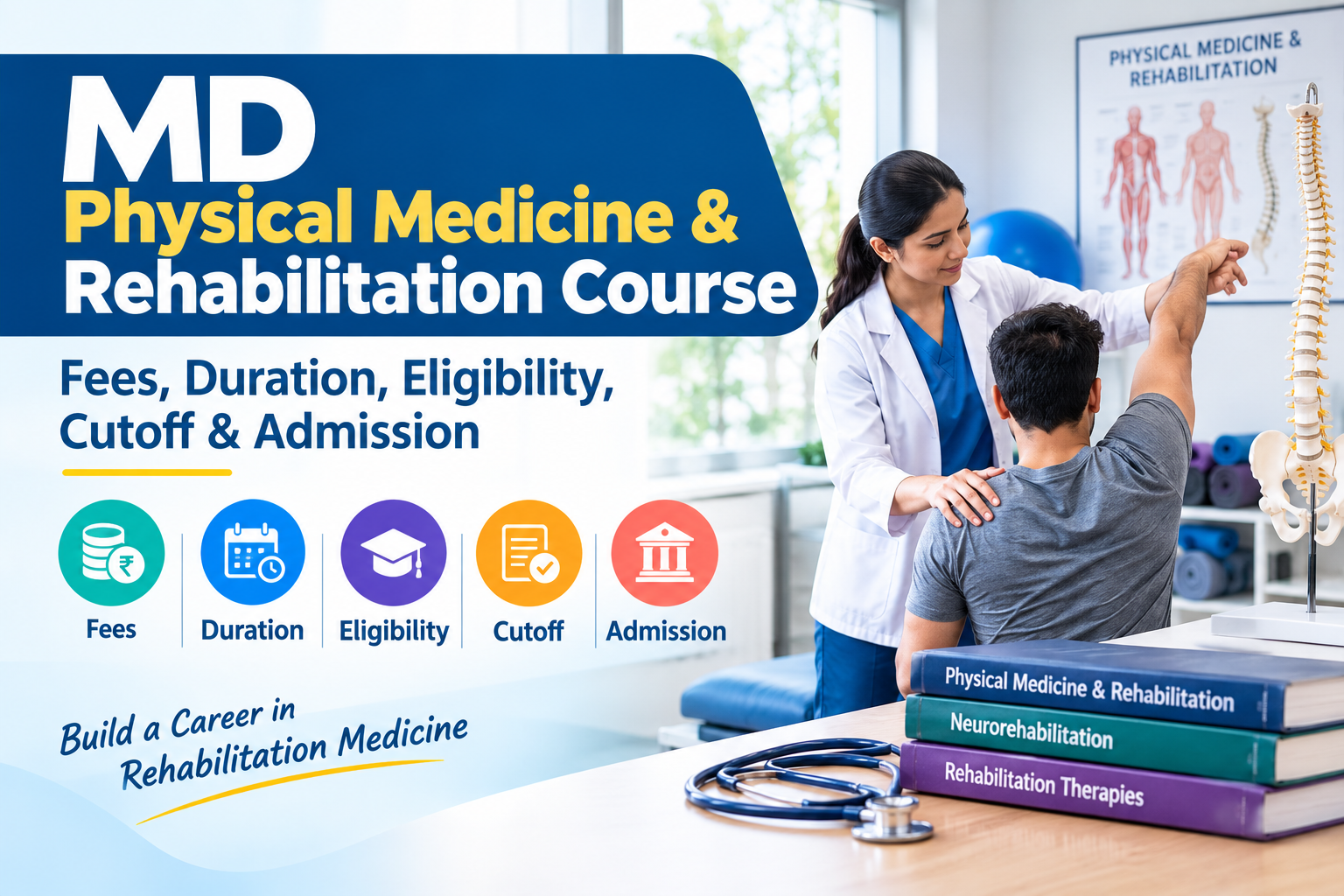
A stroke patient may be medically stable and still unable to climb the stairs at home. Someone recovering from a spinal cord injury may need help with movement, pain, bladder care, equipment, and returning to work. MD Physical Medicine & Rehabilitation (PM&R) trains doctors to assess such problems and guide a practical recovery plan.
The course suits MBBS graduates who enjoy clinical work, follow-up care, and working with a team. Residents study neurological and musculoskeletal conditions, disability assessment, rehabilitation therapies, assistive devices, and the medical issues that can slow recovery.
MBBS teaches doctors to diagnose and treat illness across specialties. PM&R looks closely at what happens next: how an illness or injury affects daily life, which abilities a person can regain, and what support they may need. Progress is often gradual, so reassessment matters.
Admission to applicable MD seats generally takes place through NEET-PG and postgraduate counselling. PM&R seats may be available at a limited selection of institutions in a given session. Competition and closing ranks depend on the college, category, quota, and counselling round.
What is MD Physical Medicine & Rehabilitation?
MD Physical Medicine & Rehabilitation is a postgraduate medical degree focused on improving function after disease, injury, or disability. A doctor trained in the specialty is often called a physiatrist.
Suppose a patient can stand after a stroke but cannot safely walk to the bathroom. The physiatrist assesses strength, balance, pain, and other medical problems, then works with the patient and rehabilitation team on achievable goals. Treatment may involve medication, therapy, equipment, caregiver training, and regular review.
The doctor works alongside physiotherapists, occupational therapists, speech and language professionals, prosthetists, nurses, and other specialists. Each has a distinct role. The physiatrist brings medical assessment and oversight to a coordinated rehabilitation plan.
The National Medical Commission (NMC) publishes competency-based guidance for MD PM&R. Graduates may work in hospitals, rehabilitation centres, outpatient clinics, teaching, or research. Focused interests can include neurorehabilitation, spinal cord injury, paediatric rehabilitation, musculoskeletal care, and pain management; further courses have separate eligibility rules.
MD Physical Medicine & Rehabilitation Course Highlights
|
Particular |
Details |
|
Course Name |
MD Physical Medicine & Rehabilitation |
|
Degree |
Doctor of Medicine (MD) |
|
Level |
Postgraduate medical course |
|
Duration |
Generally three years, subject to applicable regulations |
|
Basic Qualification |
MBBS qualification accepted under current PG admission rules |
|
Entrance Exam |
Usually NEET-PG for applicable MD seats |
|
Admission Process |
Entrance result, counselling, choice filling, allotment, and reporting |
|
Training Type |
Supervised patient care, rehabilitation planning, team discussions, academic work, and research |
|
Major Focus |
Function, independence, mobility, and management of disability |
|
Further Study |
Relevant fellowships or advanced training, subject to eligibility |
|
Career Areas |
Rehabilitation hospitals, general hospitals, clinics, medical colleges, and research |
Duration note: Confirm the current duration, course approval, and training requirements with the NMC and the institution’s prospectus. Postings vary between colleges.
MD Physical Medicine & Rehabilitation Duration
MD PM&R is generally a three-year programme. The years do not have identical duties at every institution, but responsibility normally builds as the resident gains clinical experience.
Year 1: Learn to assess the whole problem
Residents develop skills in neurological and musculoskeletal examination, gait assessment, functional evaluation, and goal setting. They learn to ask about daily activities: Can the patient transfer from bed to chair? Manage personal care? Move around their home?
They also become familiar with the work of the rehabilitation team. A treatment plan is stronger when the doctor understands what each professional can assess and provide.
Year 2: Apply rehabilitation plans across conditions
Residents generally see a wider range of patients, including those recovering from stroke, brain or spinal cord injury, fractures, and chronic musculoskeletal problems. They learn to assess pain, weakness, stiffness, balance, and complications caused by limited mobility.
Academic work becomes more demanding. Residents may present cases, review evidence, participate in audits, and progress with a dissertation or research project.
Year 3: Coordinate complex care
Senior residents take greater responsibility for supervised consultations, follow-up, team discussions, and discharge planning. They learn to revise goals when a patient’s condition, support at home, or priorities change.
Duration disclaimer: This year-wise outline is illustrative. Verify the official posting schedule, assessment pattern, research requirements, and permitted procedures at the college you are considering.
MD Physical Medicine & Rehabilitation Eligibility Criteria
Read both the current NBEMS NEET-PG information bulletin and the relevant counselling prospectus. Examination eligibility alone does not establish eligibility for every seat.
- Base degree: Candidates generally require an MBBS degree or provisional pass certificate accepted under applicable postgraduate medical admission rules. Those who studied outside India should check any additional conditions.
- Internship: The compulsory rotatory internship must be completed by the cut-off date announced for the admission session.
- Medical registration: Applicants must meet the stated registration requirement and present the required proof during verification.
- Entrance examination: NEET-PG is the usual examination for applicable MD admission. NBEMS sets out MBBS, registration, and internship conditions for NEET-PG applicants.
- Qualifying and seat-specific conditions: Candidates must satisfy the applicable qualifying standard and any category, quota, domicile, or institutional rules.
Eligibility disclaimer: Internship deadlines, qualifying criteria, and certificate requirements can change. Verify them in the latest NBEMS bulletin and official counselling documents.
MD Physical Medicine & Rehabilitation Admission Process
- Complete MBBS and internship. Gather your qualification, internship, registration, identity, and other required documents.
- Apply for and appear in NEET-PG. Use the current NBEMS instructions and check official notices for updates.
- Review the result. Check your score, rank, and qualifying status. Identify the seat categories open to you.
- Register for counselling. The Medical Counselling Committee (MCC) conducts counselling for specified postgraduate seats, including All India Quota seats. State authorities handle their respective PG counselling categories.
- Fill and lock choices. Depending on the current matrix, you may find eligible MD PM&R seats at government colleges, state institutions, private colleges, or deemed universities. Check that the exact course and seat category are listed.
- Check the allotment. Read the rules for joining, upgrading, later rounds, and deposits before making a decision.
- Report for admission. Complete document verification and payment by the deadline. Ask for written details of fees, stipend, hostel charges, and any bond.
Admission disclaimer: Seats, schedules, rounds, and reporting conditions can change by session. Follow current MCC or state authority notices.
MD Physical Medicine & Rehabilitation Fees
There is no single fixed fee for MD PM&R. The college, state policy, and seat category determine the charges. Budgeting should include living expenses and any terms attached to the seat.
|
Institution or seat type |
General fee pattern |
Details to check |
|
Government College |
Tuition is often comparatively lower |
Stipend, hostel charges, deposit, and service bond |
|
State Government College |
Fees vary by state and institution |
State prospectus, quota, and compulsory charges |
|
Private College |
Tuition is generally higher and varies considerably |
Approved annual fees, stipend, and refund terms |
|
Deemed University |
Institution-specific fee schedule applies |
Full programme cost, hostel, deposits, and payment dates |
|
Management Quota |
A separate approved fee may apply where such seats exist |
Official seat listing, fee approval, and counselling route |
A college’s fee schedule may include tuition, university or affiliation fees, registration and examination charges, library fees, hostel and mess expenses, and a security deposit. Ask which amounts recur and which, if any, are refundable.
Compare the stipend and service-bond terms as carefully as tuition. They can change the practical cost of a seat and your plans after graduation.
Fee disclaimer: The table describes general patterns, not quoted fees. Verify current approved charges, stipend, deposits, bond, and refund rules in official college and counselling documents before paying.
MD Physical Medicine & Rehabilitation Cutoff
A cutoff is not one permanent number. The term may refer to:
- Qualifying cutoff: The applicable NEET-PG standard for eligibility.
- College-wise closing rank: The last allotted rank for MD PM&R at a named institution.
- Category-wise cutoff: An allotment result for a specified reservation category.
- Quota-wise cutoff: A closing result for a particular counselling seat pool.
- Round-wise cutoff: The closing result in a stated allotment round.
A candidate can meet the qualifying standard without receiving a PM&R seat. An earlier closing rank is useful only when its course, category, quota, and round are clearly identified.
What Determines the Cutoff?
- Seat count: PM&R availability in the relevant seat pool.
- College reputation: Faculty, patient mix, rehabilitation facilities, and location.
- Government or private status: Differences in fees, stipend, and service terms.
- Category: Applicable reservation rules.
- Quota: The counselling pool through which a seat is offered.
- Round: Vacancies, upgrades, and candidate decisions.
- Year-to-year competition: Changes in applicants and preferences.
Cutoff disclaimer: Verify qualifying criteria and round-wise allotment results on official NBEMS, MCC, or state portals. Previous closing ranks cannot guarantee admission.
Rank or Score Required for MD Physical Medicine & Rehabilitation
There is no universal NEET-PG rank or score that secures this degree. Your options depend on the seats actually offered, your eligible counselling routes, and how others order their choices.
Start with the current seat matrix. Compare previous official allotments for the same course, category, quota, and round where possible. Then look at the training: Does the department see a range of neurological and musculoskeletal cases? Are residents involved in team planning and follow-up? What facilities are available?
Build a broad preference list in the order you would genuinely accept seats. Include preferred institutions and researched alternatives, then check the current rules for upgrades and withdrawals before locking your choices.
Rank and score disclaimer: Use current official seat matrices and allotment data. An old closing rank is a reference, not a prediction.
MD Physical Medicine & Rehabilitation Syllabus
PM&R combines clinical assessment with the science and practice of rehabilitation. The NMC’s revised MD PM&R guidance provides the formal curriculum; the exact clinical exposure depends on the institution.
Rehabilitation principles and functional assessment
Residents learn to assess activity limitations, set goals with patients, and measure progress. A goal such as walking to a nearby shop calls for a more useful plan than a vague instruction to “improve mobility.”
Neurological rehabilitation
Topics may include stroke, spinal cord injury, brain injury, and other conditions affecting movement or function. Assessment covers strength, sensation, balance, muscle tone, and associated medical problems.
Musculoskeletal and pain conditions
Training includes joint and muscle problems, back pain, injury recovery, and persistent pain. Residents learn to choose interventions based on the diagnosis and the patient’s functional needs.
Rehabilitation therapies and exercise
Residents study the principles behind therapeutic exercise and the roles of physiotherapy, occupational therapy, and speech and language services. They learn to coordinate care while respecting each professional’s scope.
Prosthetics, orthotics, and assistive devices
This area includes artificial limbs, braces, walking aids, wheelchairs, and other equipment. Residents learn that a device is helpful only if it fits the patient and can be used in their daily environment.
Special populations and long-term care
Paediatric rehabilitation, older adults, and people with long-standing disability may need different goals. Family support, home access, and prevention of complications are part of planning.
Research and professional communication
Case presentations, critical reading, research methods, and dissertation work help residents test whether an intervention has made a meaningful difference.
Practical Training in MD Physical Medicine & Rehabilitation
Residents generally work in outpatient clinics, inpatient rehabilitation, and consultations requested by other departments. They follow patients over time, assess changing needs, and participate in team discussions.
For a person recovering from a spinal cord injury, the plan may involve mobility, skin protection, bladder management, pain, and the home environment. The resident learns to address medical issues while coordinating therapy and equipment needs with the wider team.
Depending on the college, training may include gait assessment, prosthetic and orthotic clinics, electrodiagnostic services, and supervised treatment of pain or spasticity. Not every department has the same facilities or offers identical procedural exposure.
Ask current residents what they do on a normal week. Do they see new patients and follow them after discharge? Are therapists part of regular case meetings? Is there supervision for difficult decisions? These questions reveal more than a list of equipment.
Career Scope After MD Physical Medicine & Rehabilitation
- Hospital physiatrist: Assess functional problems and coordinate rehabilitation with clinical and therapy teams.
- Rehabilitation centre doctor: Care for people recovering from injuries, neurological conditions, or other causes of disability.
- Outpatient PM&R practice: Manage mobility, musculoskeletal, pain, and long-term functional concerns within the specialist’s scope.
- Teaching: Train medical students or residents, subject to current faculty eligibility rules.
- Research: Study rehabilitation methods, outcomes, assistive devices, or delivery of care.
- Further specialisation: Pursue an eligible fellowship or advanced programme after checking its current entry requirements.
The specialty offers continuity. Residents often see how a patient’s goals change from leaving the hospital safely to returning to family life, education, or work.
Salary After MD Physical Medicine & Rehabilitation
Pay varies by employer, city, sector, experience, duties, and practice setting. A salaried hospital role, academic post, and independent consultation practice may have different compensation structures.
Look at the whole position, including team support, patient workload, available facilities, working hours, benefits, and opportunities to develop skills. The stated pay is only one part of the decision.
Salary disclaimer: Verify current compensation and contract conditions in official recruitment notices or written offers. General salary claims cannot predict individual earnings.
MD PM&R is a good fit for doctors who want to help patients recover abilities that matter in everyday life. Before choosing a seat, examine the actual case mix, team structure, supervision, total fees, stipend, and service conditions.