What does a psychiatrist actually do? The familiar answer is “treat mental illness,” but the daily work is more varied than that. A psychiatrist may see someone with a first episode of psychosis, help a person recover from alcohol dependence, or assess whether a medical condition is contributing to a patient’s change in behaviour.
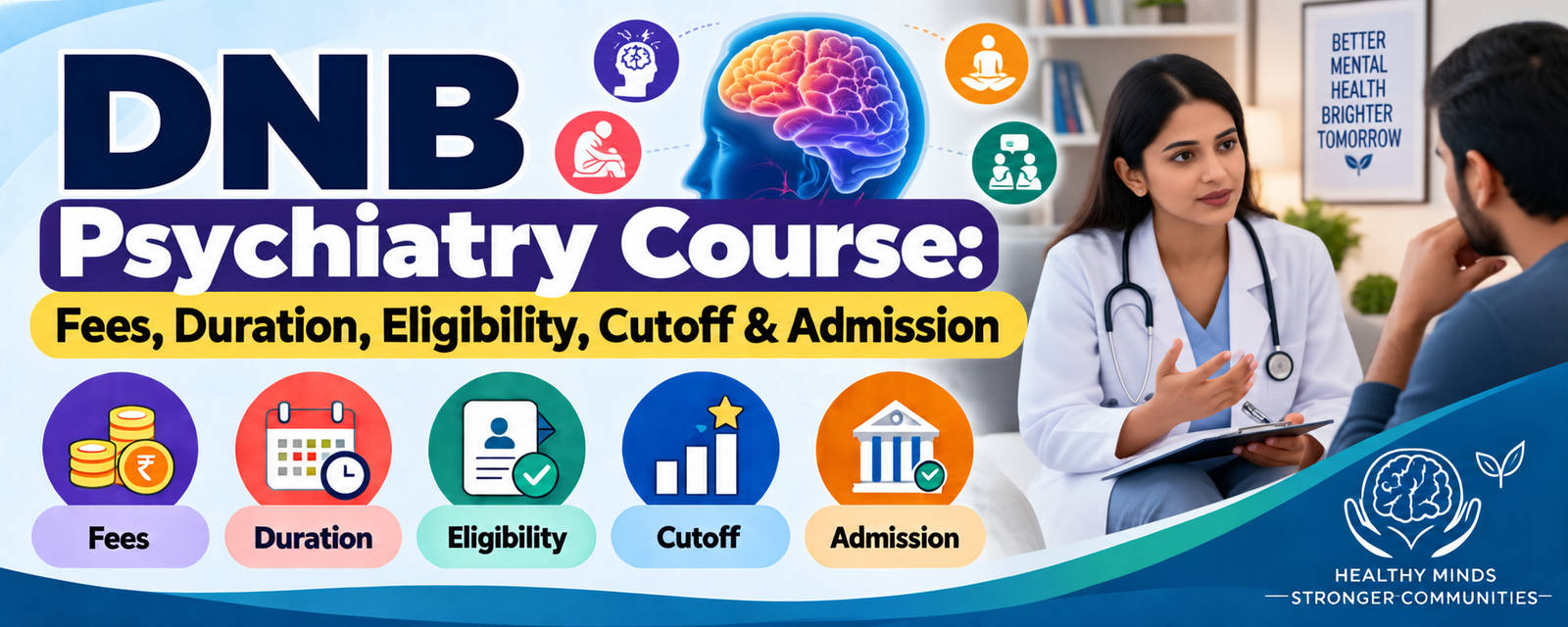
MD Psychiatry is the postgraduate medical course that prepares MBBS graduates for this work. It brings together careful interviewing, diagnosis, medicines, psychological approaches, emergency care, and long-term follow-up. Residents also learn to work with families and with psychologists, nurses, social workers, and doctors in other specialties.
During MBBS, students encounter psychiatry as one part of general medical training. During the MD, they spend sustained time in psychiatric services, take responsibility for patients under supervision, and learn to manage situations that rarely have a quick answer.
Most applicants enter through NEET-PG, followed by counselling. Institutes of National Importance that offer the course may instead use INI-CET, the separate entrance and seat allocation process for participating institutes. Seats at a preferred department can be competitive; the options available to a student depend on the examination route, category, quota, and that year’s seat matrix.
What is MD Psychiatry?
MD Psychiatry trains a doctor to assess, diagnose, and treat mental, emotional, and behavioural conditions. That starts with listening, but it also requires medical judgment. Symptoms such as poor sleep, confusion, low mood, or unusual behaviour can have several possible causes, including physical illness, substance use, medicines, or a psychiatric disorder.
A psychiatrist builds a picture from the patient’s history, a mental status examination, relevant physical and medical findings, and, when appropriate, information from family or caregivers. Treatment might involve medication, psychological therapy, support with daily functioning, treatment of a substance use disorder, or referral to another service.
Continuity matters in this specialty. Someone may improve and then relapse; another person may need months of follow-up before the right treatment plan becomes clear. Residents learn to review progress, discuss adverse effects, assess safety, and change a plan when it is not helping.
The National Medical Commission (NMC), which sets standards for medical education in India, publishes competency-based guidance for MD Psychiatry. It describes a clinician trained to provide psychiatric care, contribute to prevention and community care, and work as a consultant and teacher.
After the MD, a doctor may practise in a hospital or clinic, teach, conduct research, or work in community mental health. Further training may focus on child and adolescent psychiatry, addiction psychiatry, older adults, consultation-liaison psychiatry, or another area. Entry to a particular fellowship or advanced programme depends on its own eligibility rules.
Course Highlights
|
Particular |
Details |
|
Course Name |
MD Psychiatry |
|
Degree |
Doctor of Medicine in Psychiatry |
|
Level |
Postgraduate medical degree |
|
Duration |
Generally three years |
|
Basic Qualification |
Recognised MBBS qualification, subject to current eligibility rules |
|
Entrance Exam |
Usually NEET-PG; INI-CET for applicable participating institutes |
|
Admission Process |
Entrance result, counselling or institute seat allocation, choice filling, allotment, verification, and joining |
|
Training Type |
Supervised outpatient, inpatient, emergency, academic, and research work |
|
Major Focus |
Psychiatric assessment, treatment, safety, rehabilitation, and continuing care |
|
Further Study |
Eligible fellowships, focused clinical training, or research degrees |
|
Career Areas |
Hospitals, clinics, medical colleges, community services, and research |
Course details note: Check the current examination prospectus and institution notice for the duration, approved seats, and admission route that apply to your choice.
MD Psychiatry Duration: Year by Year
The standard MD Psychiatry course generally lasts three years after MBBS. It is a working residency, so learning happens alongside patient care, case discussions, reading, and research.
No two departments have identical posting calendars. Still, the responsibilities usually grow in a recognisable way.
Duration note: Confirm the course structure and current training requirements with the admitting institution and applicable NMC guidance.
Year 1: Learn how to understand the person
The first challenge is learning to take a psychiatric history well. Residents practise asking about symptoms, sleep, relationships, substance use, physical health, and risk while making space for a patient to tell their story.
They learn the mental status examination and begin seeing patients under close supervision. Seminars, case presentations, and ward work help them connect diagnostic concepts with people whose symptoms do not always fit neatly into a textbook example.
Research planning commonly begins here too. A resident identifies a question, reads existing work, and develops a dissertation or thesis proposal according to university and institutional requirements.
Year 2: Manage treatment and follow-up
Residents usually take on more outpatient and inpatient work. They learn to choose and monitor treatments, discuss psychological approaches, manage adverse effects, and assess patients whose mental and physical conditions affect each other.
Exposure may include addiction services, child and adolescent cases, older adults, emergencies, and consultation requests from other hospital departments. A department’s facilities determine how much time residents spend in each setting.
Follow-up teaches a different skill from making an initial diagnosis. Has treatment helped the patient return to work or study? Can the family support the plan? Does a side effect make the prescribed medicine difficult to continue? These questions shape care.
Year 3: Take the lead under supervision
Senior residents generally handle more complex cases and coordinate care with greater independence, while faculty supervision remains available. They may teach junior trainees and medical students, present difficult cases, and contribute to service decisions.
They also complete their research and prepare for final assessments. By graduation, they should be able to explain a diagnosis and treatment plan clearly, respond to a crisis, and recognise when a patient needs care beyond what one clinician or service can provide.
MD Psychiatry Eligibility Criteria
- Base degree: A candidate generally needs a recognised MBBS qualification or an accepted provisional MBBS certificate. Those with a medical degree obtained outside India must check the additional rules that apply to their qualification.
- Internship: The compulsory rotating internship must be completed by the deadline specified for the relevant admission session.
- Registration: Applicants generally need the provisional or permanent medical registration required by the entrance examination and counselling authority.
- Entrance examination: NEET-PG is the usual route for MD Psychiatry seats in its admission system. Participating Institutes of National Importance use INI-CET for their applicable postgraduate seats.
- Qualifying requirements: The candidate must meet the examination’s qualifying conditions and any category, quota, document, or institution-specific requirements. Being eligible to participate does not guarantee an MD Psychiatry seat.
Read the current NBEMS bulletin for NEET-PG or the current INI-CET prospectus, along with the relevant counselling notice. Internship dates, documents, and admission conditions must be checked for the session in which you apply.
MD Psychiatry Admission Process
Step 1: Finish MBBS and internship
Complete the required qualification and internship within the published dates. Keep your certificates, registration proof, identity documents, and any category documents ready.
Step 2: Take the correct entrance examination
Apply for NEET-PG if your target colleges use that route. If you are considering a participating Institute of National Importance, check its current INI-CET prospectus and course availability instead of assuming the NEET-PG process applies.
Step 3: Review your result
Check the official score or rank and qualifying status. Then look at the current seat information. A result alone does not show which departments have seats available in your eligible categories.
Step 4: Register for counselling
The Medical Counselling Committee (MCC) handles specified NEET-PG seat categories, including All India Quota and deemed university seats. State counselling authorities handle eligible seats under their respective systems. INI-CET candidates follow the participating institutes’ seat allocation process.
Step 5: Fill your choices
You may find options in government, state government, private, and deemed medical colleges, depending on your route and eligibility. Put them in the order you would genuinely prefer to join.
For psychiatry, the department deserves a close look. Find out whether residents see a broad mix of patients, who supervises them, what inpatient and emergency services are available, and how psychotherapy and community care are taught.
Step 6: Check seat allotment
Follow the instructions for the round in which you receive an allotment. Acceptance, upgrades, deposits, and withdrawal rules may differ between authorities and rounds.
Step 7: Report to the institution
Present original documents, complete verification, and join within the official reporting period. Use the institution’s current joining notice for its exact requirements.
Admission note: Confirm the live seat matrix, counselling charges, round rules, and deadlines on the official examination, MCC, state authority, or institute portal.
MD Psychiatry Fees
There is no single MD Psychiatry fee that applies to every college. Costs vary with the institution, state policy, and seat category. Hostel expenses and compulsory charges can make two colleges with similar tuition costs quite different in practice.
|
College or seat type |
General fee pattern |
|
Government College |
Tuition is often comparatively lower, but university, accommodation, and other charges may apply. |
|
State Government College |
Fees vary between states and institutions; check any associated service conditions. |
|
Private College |
Tuition and additional charges can differ substantially across colleges and approved seat categories. |
|
Deemed University |
The institution publishes its applicable schedule; hostel and other expenses may be separate. |
|
Management Quota |
Where an approved category exists, its published fee can differ from other seats at the same college. Entrance and counselling requirements still apply. |
Ask for a written breakdown before comparing offers. It should show:
- Tuition and any stated revision policy
- University registration and examination fees
- Hostel and mess costs
- Security or caution deposits
- Other compulsory institutional charges
- Stipend terms, any service bond, and refund or exit conditions
Residents may receive a stipend under applicable institution rules. Compare its written terms with the total cost rather than assuming it cancels out tuition or living expenses.
Fee disclaimer: Verify the latest approved fee schedule, stipend, deposits, bond conditions, and refund rules directly with the college and relevant authority before paying.
MD Psychiatry Cutoff
Parents often ask, “What is the psychiatry cutoff?” The first useful response is: which cutoff?
The qualifying cutoff is the examination requirement for a candidate to be considered under the applicable rules. A college-wise cutoff usually means the last allotted candidate’s score or rank. That closing position can be different for each category, quota, and counselling round.
So a closing rank shown for one government college’s All India Quota seat cannot be applied to a state quota seat or a deemed university seat. Nor does it necessarily stay the same in a later round.
What Determines the Cutoff?
- Seat count: Fewer available seats can intensify competition for a particular department.
- College reputation: Applicants consider clinical exposure, supervision, teaching, and location.
- Government or private status: Fees and working conditions affect preferences.
- Category: Reservation and eligibility rules determine who competes for a seat.
- Quota: All India, state, institutional, and other approved categories have different conditions.
- Counselling round: Vacancies, upgrades, and withdrawals can move the closing position.
- Year-to-year competition: Candidate performance, seat availability, and preferences change.
Cutoff disclaimer: Use current official qualifying notices and round-wise allotment results. Past closing ranks help with planning but cannot promise an admission outcome.
What Rank or Score Is Needed for MD Psychiatry?
There is no universal NEET-PG or INI-CET rank for MD Psychiatry. Even within one college, the last allotted position can vary by seat category and round.
Start with the current seat matrix for your examination route. Then, if earlier official allotment data is available, compare the same course, college, category, quota, and round. This is more useful than searching for a single “MD Psychiatry cutoff” online.
Make a broad choice list, but keep it realistic in a practical sense: include only places you would consider joining. An ambitious preference can sit above a more attainable one if that is your true order. Before locking the list, check the department, total costs, location, and any bond.
Rank and score disclaimer: Verify current eligibility and seat data through the official examination and counselling portals; earlier results are guides, not guarantees.
MD Psychiatry Syllabus
Psychiatry is learned through patients as much as books. The NMC competency guidance provides the broad framework, while universities and departments arrange their teaching and postings.
Clinical assessment and foundations
- Psychiatric history and mental status examination
- Diagnostic formulation and assessment of daily functioning
- Biological, psychological, and social influences on mental health
- Research methods, ethics, and evaluation of clinical evidence
Mood, anxiety, and related conditions
- Depression and bipolar disorder
- Anxiety and panic symptoms
- Obsessive-compulsive and trauma-related conditions
- Assessment of safety, treatment response, and relapse
Psychotic disorders
- Schizophrenia and related presentations
- Acute care and continuing treatment
- Medicine monitoring, family work, and rehabilitation
Substance use and addiction
- Alcohol, opioid, tobacco, and other substance use disorders
- Withdrawal and continuing care
- Relapse prevention and associated physical or mental health problems
Psychiatry across different ages
- Child and adolescent mental health
- Developmental, learning, and behavioural concerns
- Mental health in older adults, including cognitive symptoms
Treatment and service settings
- Psychiatric medicines and their adverse effects
- Principles of psychological therapies
- Emergency and consultation-liaison psychiatry
- Community care, communication, and relevant ethical and legal issues
Practical Training in MD Psychiatry
A resident spends substantial time interviewing patients. That includes an initial assessment, but follow-up visits often teach just as much: what has changed since the last appointment, whether treatment is tolerable, and what barriers the patient faces at home.
Inpatient and emergency work brings more urgent decisions. Residents learn to assess risk, discuss a plan with seniors, document their reasoning, and communicate with patients and families during stressful situations.
Postings may introduce addiction care, child and adolescent services, older adult psychiatry, consultation requests from other wards, and community work. The exact exposure varies by institution. Anyone choosing between colleges should ask current residents what their typical week looks like.
There is academic work alongside clinical care. Case conferences, journal clubs, teaching sessions, and a research project help residents test their decisions against evidence and explain those decisions to others.
Career Scope After MD Psychiatry
- Hospital practice: Work in outpatient, inpatient, and emergency psychiatry services.
- Clinic practice: Provide assessment and continuing treatment, subject to applicable professional rules and local service needs.
- Community mental health: Work with programmes concerned with access to care, follow-up, and support outside hospitals.
- Teaching: Train medical students and residents in a medical college, subject to current recruitment criteria.
- Research: Study treatments, patient outcomes, or ways to improve mental health services.
- Further training: Apply for eligible focused programmes in child and adolescent, addiction, geriatric, or other areas of psychiatry.
The settings differ, but the central skill stays much the same: understanding what is happening to a person, agreeing on a workable plan, and reviewing it honestly over time.
Salary After MD Psychiatry
Earnings vary widely after MD Psychiatry. A salaried post in a government hospital is structured differently from a private hospital job or a clinic practice.
Employer type, city, sector, experience, working hours, and the nature of the role all affect pay. For someone considering independent practice, expenses and the time needed to establish a patient base matter too.
During residency, check the institution’s written stipend terms when assessing an offer.
Salary disclaimer: Verify current stipend and employment terms with the institution or employer. A salary figure quoted for another city, role, or year may not reflect what you would receive.