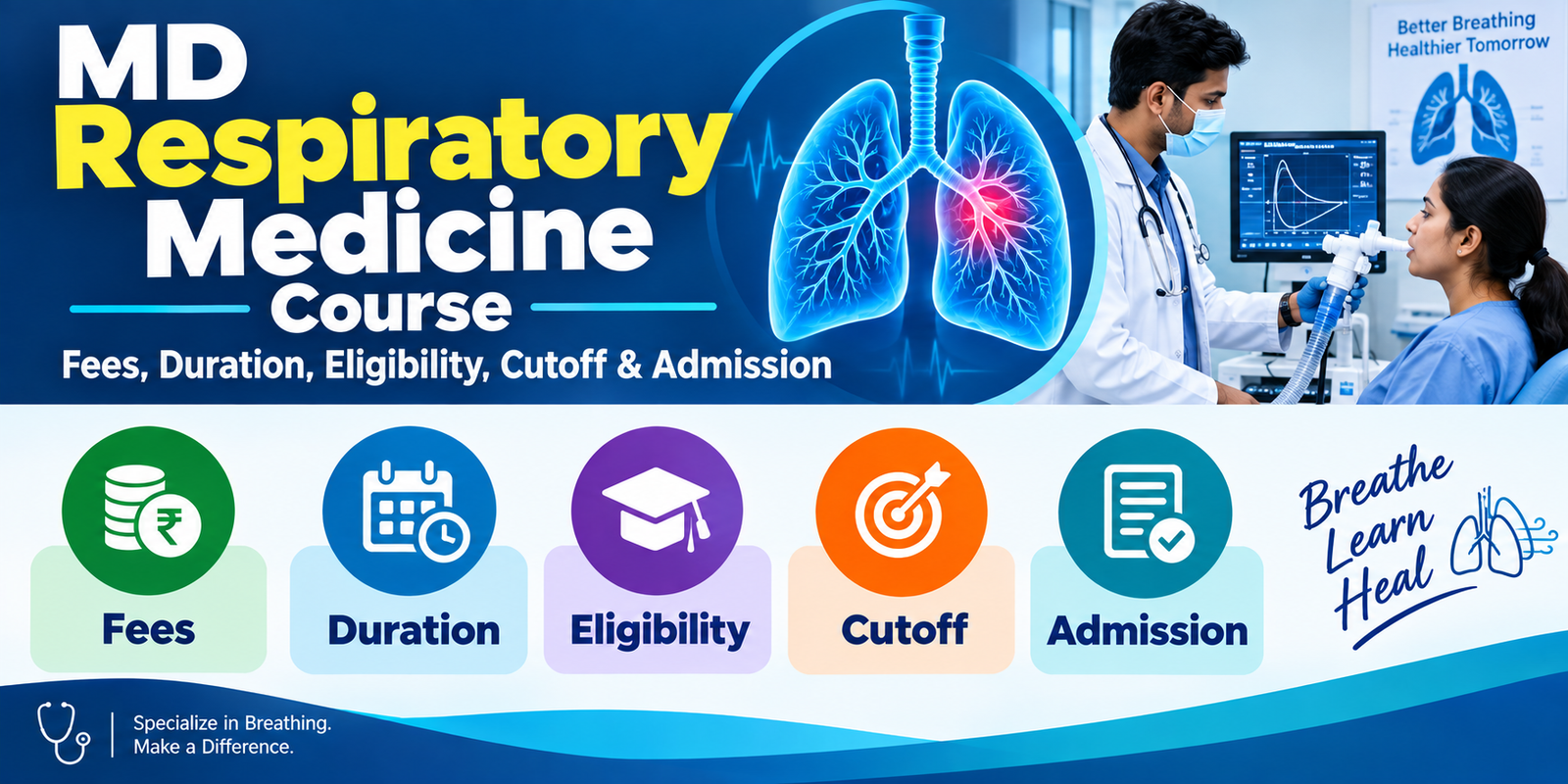
A person comes to the hospital short of breath. The cause could be asthma, an infection, heart disease, a blood clot, or something else entirely. MD Respiratory Medicine trains doctors to work through problems like this, treat diseases of the lungs and airways, and care for patients who may need support with breathing.
The course is meant for MBBS graduates who are drawn to clinical medicine, procedures, and long-term patient care. Residents see common problems such as asthma and tuberculosis, but also learn to manage serious infections, chronic lung disease, and respiratory failure.
MBBS gives doctors a broad foundation. In this MD, they spend sustained time in chest clinics, wards, diagnostic services, and, depending on the hospital, critical care settings. They learn to interpret lung tests and scans, make treatment decisions, and follow patients whose illness may last for years.
Admission to most seats is through NEET-PG and then counselling by the Medical Counselling Committee (MCC) or a state authority. Participating Institutes of National Importance use INI-CET, a separate postgraduate entrance and seat allocation route. Competition differs between colleges and seat categories, so it is better to research actual departments than to rely on one “required rank.”
What is MD Respiratory Medicine?
Respiratory medicine deals with diseases that affect breathing: conditions of the lungs, airways, pleura, and related systems. A specialist may assess a persistent cough in the morning, review a patient’s oxygen needs on a ward, and discuss a possible lung cancer diagnosis with another clinical team later that day.
The work combines clinical reasoning with tests. A respiratory physician takes a history and examines the patient, then uses investigations such as chest imaging, pulmonary function tests, sputum or other laboratory tests, and selected procedures when appropriate. The test result matters, but it has to make sense alongside the patient’s symptoms and overall health.
The National Medical Commission (NMC), which sets standards for medical education in India, has published a competency-based curriculum under MD Pulmonary Medicine. Colleges and admission lists may use names such as Respiratory Medicine, Pulmonary Medicine, or Tuberculosis and Respiratory Diseases. Check the exact title and approved seats in the current seat matrix before filling choices.
After the degree, doctors may work in chest clinics, hospitals, medical colleges, or research. Some pursue focused training in interventional pulmonology, sleep medicine, pulmonary critical care, lung infections, or other areas. A particular fellowship or higher course has its own entry requirements.
Course Highlights
|
Particular |
Details |
|
Course Name |
MD Respiratory Medicine; related course titles may include MD Pulmonary Medicine |
|
Degree |
Doctor of Medicine |
|
Level |
Postgraduate medical degree |
|
Duration |
Generally three years |
|
Basic Qualification |
Recognised MBBS qualification, subject to current admission rules |
|
Entrance Exam |
Usually NEET-PG; INI-CET for applicable participating institutes |
|
Admission Process |
Entrance result, counselling or institute seat allocation, choice filling, allotment, verification, and joining |
|
Training Type |
Supervised clinics, ward care, investigations, procedures, academic work, and research |
|
Major Focus |
Diagnosis and management of lung, airway, pleural, and breathing-related conditions |
|
Further Study |
Eligible fellowships or focused training in respiratory subspecialties |
|
Career Areas |
Hospitals, chest clinics, medical colleges, critical care-related services, and research |
Course details note: Verify the exact specialty name, duration, approved seats, and admission route in the current official prospectus and seat matrix.
MD Respiratory Medicine Duration: Year by Year
The standard MD degree generally takes three years after MBBS. A resident’s responsibilities grow steadily, although the order and length of postings depend on the institution.
Duration note: Check the current NMC guidance and your prospective college’s training plan for its course requirements.
Year 1: Learn to assess breathing problems
Early training starts with the basics done well: taking a focused history, examining the chest, reading a chest X-ray in context, and understanding when a patient needs urgent support. Residents see patients in clinics and wards under close supervision.
They also revisit respiratory physiology. What does a lung function test actually show? Why might oxygen levels fall? How can a patient appear comfortable while a serious illness develops? These questions become more useful once residents have met patients with different forms of breathlessness.
Academic work usually includes case presentations, seminars, and planning a dissertation or thesis project.
Year 2: Join the pieces together
Residents generally manage a wider range of cases, including chronic airway disease, tuberculosis, pneumonia, pleural conditions, and suspected lung cancer. They learn to interpret pulmonary function tests and imaging alongside laboratory findings rather than treating any one result as the whole diagnosis.
Depending on the department, training may include supervised bronchoscopy, pleural procedures, sleep-related assessment, and work in a respiratory high-dependency or intensive care setting. Residents also collect research data and discuss challenging cases with senior doctors.
This is often the year when follow-up becomes especially instructive. A treatment plan may look reasonable at discharge, but what happens when the patient struggles with an inhaler, cannot tolerate a medicine, or returns with the same symptoms?
Year 3: Take greater clinical responsibility
Senior residents usually lead more case discussions and make initial plans for complicated patients, subject to supervision. They may help coordinate care with infectious disease specialists, radiologists, oncologists, surgeons, and critical care teams.
They also complete their research and prepare for final assessments. By graduation, they should be able to judge who can be treated in a clinic, who needs admission, and who needs immediate help with breathing.
MD Respiratory Medicine Eligibility Criteria
- Base degree: Candidates generally need a recognised MBBS qualification or an accepted provisional MBBS certificate. Those who studied outside India must check the additional conditions that apply to them.
- Internship: The compulsory rotating internship must be completed by the deadline stated for the relevant admission session.
- Medical registration: Applicants generally need the provisional or permanent registration specified in the entrance bulletin and counselling rules.
- Entrance examination: NEET-PG is the usual route for seats within its admission system. Participating Institutes of National Importance use INI-CET for their applicable postgraduate courses.
- Qualifying requirements: Candidates must meet the examination’s qualifying conditions and any category, quota, domicile, document, or institution-specific rules. Qualifying for consideration does not guarantee a seat.
Read the current NBEMS bulletin or INI-CET prospectus, as appropriate, and the relevant counselling notice. The published internship deadline and document rules for your session are the ones that matter.
MD Respiratory Medicine Admission Process
Step 1: Complete MBBS and internship
Finish the degree and internship within the required dates. Keep qualification, internship, registration, identity, and applicable category documents ready for verification.
Step 2: Take the relevant entrance examination
Apply for NEET-PG for colleges using that route. For participating Institutes of National Importance, check INI-CET and whether the specialty appears in that session’s seat information.
Step 3: Review your result
Check your official result and qualifying status. Then examine the current seat matrix, including variations in the course title. A college may list Pulmonary Medicine where you expected Respiratory Medicine.
Step 4: Register for counselling
MCC handles specified NEET-PG categories, including All India Quota and deemed university seats. State authorities manage eligible seats under their own counselling systems. INI-CET applicants follow that process’s institute seat allocation instructions.
Step 5: Fill choices
Depending on your eligibility and the live seat matrix, options can include government, state government, private, and deemed colleges. Put them in your genuine order of preference.
Look into the department before choosing it. Ask about outpatient volume, tuberculosis and general respiratory exposure, bronchoscopy, pulmonary function testing, pleural procedures, supervised critical care work, and research support.
Step 6: Check the allotment
If offered a seat, read that round’s rules for acceptance, upgrades, payments, and deadlines. They can differ between counselling authorities.
Step 7: Report and join
Present original documents at the allotted institution and complete joining formalities within the official reporting period.
Admission note: Verify current seat availability, counselling charges, round rules, and reporting dates through the official examination, MCC, state authority, or institute portal.
MD Respiratory Medicine Fees
There is no single fixed fee for MD Respiratory Medicine across India. Tuition varies with the college, state policy, and approved seat category. Accommodation and other compulsory charges affect the full cost.
|
College or seat type |
General fee pattern |
|
Government College |
Tuition is often comparatively lower, though university and living costs still apply. |
|
State Government College |
Fees differ by state and institution; check any service conditions as well. |
|
Private College |
Published fees can vary considerably between colleges and approved seat categories. |
|
Deemed University |
The institution’s current schedule sets out applicable charges; hostel costs may be separate. |
|
Management Quota |
Where an approved category exists, its published fee may differ from other seats. Applicable entrance and counselling rules still govern admission. |
Ask for an itemised statement covering:
- Tuition and any stated revision policy
- University registration and examination fees
- Hostel and mess costs
- Security or caution deposits
- Other mandatory institutional charges
- Stipend, refund, service bond, and exit terms
A residency stipend may be available under the institution’s applicable rules. Compare its written terms with the whole cost, rather than assuming it will cover every expense.
Fee disclaimer: Verify the latest approved fee schedule and written stipend, deposit, bond, and refund terms with the college and relevant authority before paying.
MD Respiratory Medicine Cutoff
A parent looking for “the cutoff” may find several figures that appear to disagree. They may all refer to different things.
The qualifying cutoff is the entrance examination requirement for consideration under applicable rules. A college-wise closing score or rank is the position of the last candidate allotted a particular seat. That closing position changes by category, quota, and counselling round.
What Determines the Cutoff?
- Seat count: The seats offered by a department limit how many candidates it can take.
- College reputation: Applicants value supervision, clinical exposure, facilities, and location.
- Government or private status: Fees and working conditions influence choices.
- Category: Applicable reservation and eligibility rules change the candidate pool.
- Quota: All India, state, institutional, and other approved seats have different conditions.
- Round: Vacancies, upgrades, and withdrawals can move the closing position.
- Year-to-year competition: Candidate results, seat availability, and preferences change.
Cutoff disclaimer: Consult current official qualifying notices and round-wise allotment results. An earlier closing rank is useful for planning, not an assurance of admission.
What Rank or Score Is Needed for MD Respiratory Medicine?
There is no universal NEET-PG or INI-CET rank for this course. Even the same college can have different closing positions for different categories and rounds.
Start with the current seat matrix and the correct specialty name. Then review earlier official allotments for the same college, course, category, quota, and round. Comparing unlike seats will give you a poor estimate.
Prepare a broad preference list, but include only colleges you could realistically join after considering fees, location, bond terms, and the department’s training. Place choices in your genuine order of preference and follow the counselling authority’s instructions when locking them.
Rank and score disclaimer: Verify live seats and qualifying conditions on official portals. Past allotments cannot predict an individual outcome with certainty.
MD Respiratory Medicine Syllabus
The subject stretches from basic lung function to emergencies in which treatment cannot wait. NMC’s MD Pulmonary Medicine guidance covers respiratory physiology, infections, non-infectious lung disease, investigations, and clinical management.
Respiratory physiology and investigations
- Breathing mechanics and gas exchange
- Pulmonary function tests and their interpretation
- Blood gas analysis and assessment of respiratory failure
- Chest imaging and the role of relevant laboratory tests
Airway disease
- Asthma and chronic obstructive pulmonary disease
- Bronchiectasis and other causes of chronic cough or sputum
- Inhaled medicines, device technique, and long-term follow-up
Lung infections
- Tuberculosis and its diagnosis, treatment, and complications
- Pneumonia and other lower respiratory infections
- Infections in patients with reduced immunity
- Appropriate use of antimicrobial medicines
Pleural and interstitial conditions
- Pleural effusion, pneumothorax, and empyema
- Interstitial lung diseases and pulmonary fibrosis
- Clinical assessment, investigations, and treatment decisions
Cancer, sleep, and vascular disease
- Suspected lung cancer and coordination with cancer teams
- Sleep-related breathing disorders
- Pulmonary vascular conditions and other causes of breathlessness
Acute and critical respiratory care
- Oxygen treatment and ventilatory support principles
- Severe asthma, acute respiratory failure, and other emergencies
- Infection control, patient safety, and supportive care
Research methods, ethics, scientific writing, and teaching also form part of postgraduate training.
Practical Training in MD Respiratory Medicine
The outpatient clinic teaches pattern recognition: a persistent cough is not always an infection, and breathlessness does not always come from the lungs. Residents learn to choose investigations thoughtfully and explain a treatment plan a patient can follow at home.
Ward work is different. Residents monitor people with more severe disease, review oxygen and other support needs, respond when a patient worsens, and coordinate with nursing and other medical teams.
Practical skills may include pulmonary function testing, blood gas interpretation, pleural procedures, and bronchoscopy under appropriate supervision. Exposure to non-invasive ventilation, intensive care, sleep studies, or specialised procedures depends on the hospital’s services.
Tuberculosis work also requires careful follow-up, attention to drug effects, and public health awareness. Whatever the setting, hands-on training should include clear documentation and a habit of asking whether the diagnosis still fits as new information arrives.
Career Scope After MD Respiratory Medicine
- Hospital physician: Manage respiratory patients in clinics, wards, and services that assess acute breathing problems.
- Chest clinic practice: Provide assessment and follow-up for asthma, chronic lung disease, infections, and other respiratory conditions.
- Teaching: Train medical students and residents in a medical college, subject to recruitment requirements.
- Research: Study respiratory disease, treatments, diagnostic methods, or patient outcomes.
- Further focused training: Apply for eligible programmes in areas such as interventional pulmonology, sleep medicine, or pulmonary critical care.
The available work depends partly on the hospital. A large centre may have separate procedural and critical care teams; another may need a respiratory specialist with a broader clinical role.
Salary After MD Respiratory Medicine
Salary varies widely. Government employment, a medical college appointment, a private hospital role, and clinic practice have different pay structures.
Employer type, city, sector, experience, duties, and access to procedural or critical care facilities can affect earnings. When comparing positions, look at supervision, working hours, benefits, and opportunities to develop skills as well as the stated pay.
During residency, stipend arrangements depend on the college and applicable rules.
Salary disclaimer: Verify current stipend and employment terms directly with the institution or employer. A figure reported for another role or year may not apply to your offer.